The Standard
Copyright © 2026 by J. Brent Tuttle. All rights reserved.
No part of this publication may be reproduced, distributed, or transmitted in any form or by any means, including photocopying, recording, or other electronic or mechanical methods, without the prior written permission of the author, except for brief quotations embodied in reviews and certain other noncommercial uses permitted by copyright law.
The findings in this book were derived from data gathered across roughly 30,000 AI-recommended businesses and are current as of 2026. Because the answer engines change continually, the ranking factors and their weights are re-evaluated on an ongoing basis. Nothing in this book guarantees any particular ranking or business result.
First Edition · 2026
aibusinessscore.com · viizable.com
Contents
- Chapter 1Why This Book
- Chapter 2The Demographics Are Changing
- Chapter 3When Tech Shifts, The Work Shifts
- Chapter 4What Ranking Means To Your Client
- Chapter 5The Need For An Index
- Chapter 6How You Can Use The “Standard” Ranking Factors
- Chapter 7Where To Start Working
- Chapter 8How to Work the Factors
- Chapter 9Free Resources To Help Rank Your Client
- About the AuthorAbout the Author
- Appendix AWhat the Categories Mean
- Appendix BThe Full Factor List
Why This Book
Why I wrote this book
I'm going to start out this book in an unconventional way because I want you to understand why I even wrote it. I didn't need to write it because I needed to be more famous, or wealthier and it sure wasn't because I was bored. I wrote it because someone had to. The 'ranking industry' needed a kick in the pants to stop arguing about what ranked businesses and to start really working on it.
Let me give you an idea of why I didn't even want another big project. I semi-retired about 10 years ago and I've been living in the coffee triangle of Colombia and I can literally walk five minutes and pick coffee cherries off the plants. I spent a lot of time in New York, Seattle, San Francisco and DC in their best coffee shops with friends and associates and I remember the conversation going like this. "I wonder what coffee tastes like right off the farm, freshly dried and then roasted". Well, now I know. And I was set down here because besides this home in the highlands I have another one on the coast. I can throw a rock from my balcony and watch it sink in the Caribbean Sea. It's in a remote area and most of the fish have never seen a fish hook and the lobsters there are as big as your forearm. So, I had no desire to head back to the US and join the rat race again.
But AI happened—and I saw it was going to destroy a lot of the businesses that millions of good people worked for years and years to build.
As I got more and more involved in figuring out what needed to be done to help these businesses, I realized there was another group that was going to get hit equally hard—an industry I had been passionate about for over 40 years. Online marketing, especially SEO, was going to be under a lot of pressure. Neither group did anything to cause this—it was just another seismic shift in technology that had caused similar disruptions before. I knew I could never reach the millions of individual businesses but I could help the marketing industry that was sure to pivot to helping them get ranked in AI.
The Paradigm Shift I’m Hoping For
Let me start off with a story that I would never have told anyone years ago in my 30s and 40s, when I was in business. In fact I did everything I could to hide the little bit of a Texas accent that I have when I speak. I have been in boardrooms from coast to coast, and I don't think anybody really recognized what my background was.
When I was a teenager, I wanted to be popular like any other kid, and one of the most popular kids in our school was of all things—a bull rider. One day I asked him if he would teach me how to ride as well, and he just stood there and chuckled lightly, then said, "Ok, meet me at the rodeo this weekend behind the gates." I don't think he really expected me to show up, but I did, and when I dropped down on top of that 2,000 pound sweaty piece of quivering meat, I should have been afraid, but instead I was eager to give it a try.
My friend saw that I was serious about this, and we started going to rodeos almost every weekend together. I didn't realize it at the time, but I was extremely lucky to have him as my mentor. He was very serious about it, he was very good at it, and he went on to become one of the top rodeo professionals in the nation.
I was ok as a rider, but not great. It was not until my parents made me go to a bull riding school that things changed for me. The school was a full week long and they gave us a lot of new information, but of all the things I learned one thing changed who I was.
Three words: "Watch his neck".
It allowed me to go from being like teflon, sliding off most of the bulls I tried to ride, to super-glue-and-velcro. Out of hundreds of bulls over the next two years, I might have been thrown off a dozen. I had the most consistent bull riding record in Texas my senior year of high school and won the TYRA bull riding championship, gaining my friend and I the title of best two bull riders in Texas. The problem I had and why most people don't ride is they watch the bull's head to see where he's going next. They fall off when they shift their weight based on where the head's going.
This was the first time that I had been exposed to a "catalyst" like this. It was almost like that tiny new "insight" was magic. It changed me: I got a confidence and swagger I'd never experienced before.
The same thing happened to me a few years later. My dad owned an insurance and real estate company in our small town of El Campo, Texas, and he got lung cancer and asked me to drop out of college and come home to run the businesses while he either passed or got better. Luckily he got better, but we never really agreed on how to market the company. At just 19 or 20, I was afraid to go out and shake hands with 60 or 70 year old farmers and business owners that needed to buy insurance from me…so I came up with other ways to bring in customers using sales letters, postcards, doorhangers, etc. It was working, but it wasn't his way.
So, I moved an hour away to Houston and set up my own insurance agency.
I quickly discovered getting started was expensive. By the time I paid for office space and employees and everything else, the bank account was almost empty. I knew a few months down the road I'd be completely broke.
One day, pondering my misfortune, I happened to pick up a copy of Inc. magazine and it had an article about a man named W. Edwards Deming. Mr. Deming is now known as the father of quality in Japan and was largely responsible for turning around their manufacturing sector after World War II. His quality engineering process is much more complex than this, but what I got out of the article was try, measure, repeat, the “Quality Loop.”
Deming's process applied to car design, but I didn't know any better and thought it would also work for my agency. So I started improving everything (and measuring). The new "Quality Loop" was applied to my newspaper ads, my postcards, my brochures, my handouts, what we said on the phone, how we closed calls and every customer interaction was measured for response and tracked on the whiteboard in my office. And, it actually worked and we started growing fast, insanely fast. In fact, about 18 months after opening, I was featured by the Houston Independent Insurance Association as the 'Fastest Growing Insurance Company in Houston, Texas' out of over 7,000 other insurance agents.
I was about 23 at the time and was loving life. I had just found another 'catalyst' that helped me find my 'swagger' again.
You guys are marketers, and that formula doesn't seem much like magic today — it's more standard procedure, right? But to me back then, it was another catalyst that changed my fortunes again.
One more quick story and we'll get into the meat of the book. There was a man named Rich Harshaw that owned Monopolize Your Marketplace, one of the fastest growing marketing agencies back in the 80's. As a lead generation tool, he had created two audio files telling business owners how to adjust their marketing. He cited over a dozen client stories that demonstrated how powerful his method was, but the one that got my attention was a client family that had immigrated to the United States with nothing, that spent a year working for other moving companies, and then bought their own trucks. Then they did what most of the other moving companies did which was to pay $3,000 or more a month for their yellow pages ad and sit by the phone. They made their ad like the other moving companies, and got a whopping 70 calls a month which kept them just above bankruptcy and starving. The second year, after getting a copy of the audio program and hiring one of Rich's guys to rewrite their ad, they got different results. The first month the new yellow pages book came out, they got 955 calls.
Yes, I had to double check that number too.
I was hooked and amazed. His method taught business owners back then to present their content as if you were drinking a beer or on a camping trip with a good friend. I heard 'find the heart' in his method, and that has allowed me to essentially turn an average campaign into one that could 10X sales. That was like being given the secret to the universe.
And again, I had proof that a tiny phrase, a small change in a process or how you placed words on a page could be the 'catalyst' that can separate you from struggle and give you a new level of confidence and a swagger that literally "goes before you" in life.
Nearly every creative I touched after that shot up conversion rates — I was having so much fun that I sold my agency and have been either in marketing or technology ever since. That catalyst enabled me to generate hundreds of millions in revenues, and explosive growth for most of the companies that I've started, worked for, consulted with or owned a part of.
Building the systems and analyzing the data behind this book was not a first time project for me. I had spent almost 15 years working with data warehouses, data marts, etc., in lead positions responsible for reverse-engineering and other systems projects in some of the largest government and private companies. Setting up the environment so that it was 'free of opinion' from my team, myself and our new AI friends was the first thing I did.
I’m hoping that what I present in this book will be a paradigm shift for the professionals that are trying to move into the new “ranking industry”.
I think everyone that reads the book will be surprised at our findings and how valuable a new ‘Google-like’ index and checklist would be.
What I hope this book does for you
So, while this book might be dry, analytical, controversial and even adversarial at times—I'm hoping you'll find it as a catalyst. Something that will encourage you to get out of the argument about what AI needs and leapfrog over the experts, consultants and agencies that are stuck.
In fact, I’m hoping the three words “Adopt the Standard” will stick with you long after you set this book down.
Who the book is for, and not for
I published our internal foundational factor list to help as many businesses and marketers as possible 'get started'.
Two kinds of people will get the most out of it. The first is the agency owner, or the person who does the SEO. Their clients have started asking a question the old search methods can't answer: why does the AI never name us? The second is the marketer or web lead at a local business. They can already see that being recommended by a machine is about to matter more than ranking on a page, and they want the actual checklist instead of one more essay about it.
This book is not for national or international brands, large franchises, or multi-location businesses. They already have thousands of reviews and do not need the foundational factors to get recommended. In a franchise, the main brand domain carries about 60% of the weight. A single location can do little to change its own score, even with its own subsite. This book is for the agencies, consultants or operators with clients that operate from a physical location or one local service area. We may write a guide for the big brands later.
The Demographics Are Changing
Search changed shape, from a long list you choose from, to a short list of 2 or 3.
Technology has shifted consumer preferences again
For twenty years the job was to rank on a page. There were ten blue links and a map pack, and you scrolled and you clicked. A business competed for a spot, and landing on page one meant you were at least in the running. That world is quietly ending, without a headline to mark it. A person asks an AI assistant — ChatGPT, Gemini, Google's AI Overviews, Perplexity — "who's the best plumber near me." They don't get ten options to sort through. They get two or three names, already picked for them.
The market moved from search to recommendation. The choice used to belong to the customer. Now it happens inside the AI assistant, before the customer sees anything. A business on page one used to get a fair chance at being picked by a person who was looking. That chance is gone. If the AI assistant does not name the business, the customer never learns it exists.
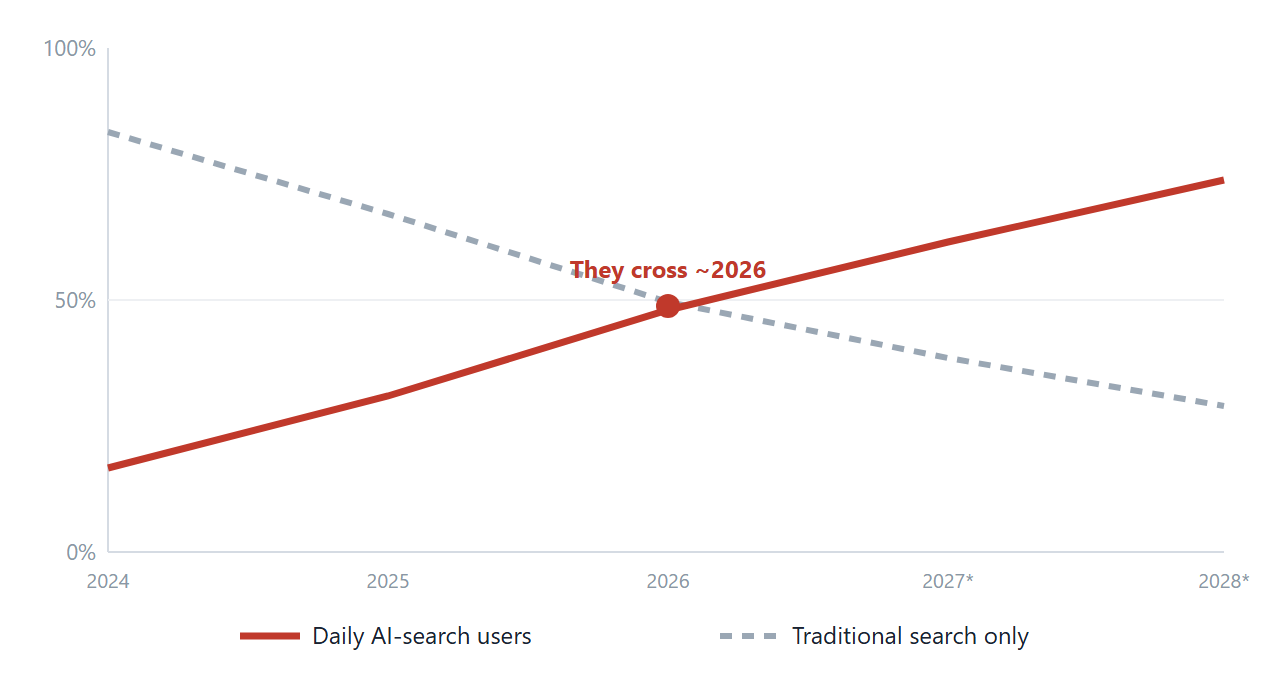
Sources: Gartner, “Search Engine Volume Will Drop 25% by 2026 Due to AI Chatbots” (Feb 2024); McKinsey & Company, “New Front Door to the Internet: Winning in the Age of AI Search” (Oct 2025); Search Engine Land, “37% of Consumers Start Searches with AI Instead of Google” (2025); Dataslayer, “Google AI Overviews: The End of Traditional CTR” (2025); Exposure Ninja, “AI Search Statistics for 2026” (2026); BrightLocal, “Local Consumer Review Survey 2026” (2026); Click Intelligence, “Sundar Pichai Says Google Search Will Change Profoundly in 2025” (2025).
The Death Cross
Traditional search is falling while AI discovery is climbing, and the two lines meet around 2026, the point where about half of the searching has crossed over to AI and does not cross back. That is the death cross. The numbers behind it are not subtle. In 2024, Gartner forecast that traditional search volume would fall 25% by 2026. The measured numbers since have gone further. By October 2025, McKinsey found half of all consumers already using AI search, and put the traffic decline facing brands that don't adapt at 20 to 50 percent. Thirty-seven percent of consumers now start a search with AI instead of Google. When Google runs an AI Overview, organic click-through falls 61 percent and paid falls 68 percent, and six in ten searches now end with no click to any website, eight in ten when an Overview is on the page. For local businesses the shift is faster still: in a single year, the share of consumers using AI to find one rose from 6 percent to 45 percent, while Google's share of that job fell from 83 percent to 71 percent.
Examples from the past
This is not the first time technology changed what people use. It happens again and again. Each time, the businesses tied to the old way lose.
The PC replaced the typewriter. The fax replaced the mailed letter, and then email replaced the fax. Recorded music went from the LP to the 8-track to the cassette to the CD, and then to the download and the stream. Movies went from the theater to the VHS tape to the DVD, and then to streaming.
Blockbuster had more than 9,000 stores and did not move to streaming. Netflix did. Blockbuster is gone.
Chegg didn't see it coming. Students paid Chegg for homework help and textbook answers. ChatGPT launched in November 2022 and gave the same answers for free. On May 2, 2023, Chegg’s stock fell 48% in a single day, after its CEO said ChatGPT was cutting into new customers. Its subscribers dropped from 7.8 million to 3.2 million, and its market value fell from $14.7 billion to about $115 million, a 99% loss in three years.
There are roughly 36 million businesses in the United States. Several sources confirm that more than 18 million of them operate from a physical location and/or serve a local area. Since we’re seeing AI recommend only 5% to 15% of businesses when it refers a new prospect, that splits the local universe into the 1 to 2 million it names and the 16 million it doesn’t. If AI does a full sweep the way other technologies have — DVD to streaming, newspapers to video feeds — as many as 16 million businesses could literally go the way of Blockbuster’s almost 10,000 stores. This is a HUGE OPPORTUNITY for anyone who chooses to become an expert in this field, because practically every business is asking the same question: “How do I get ranked in AI?”
Whether the rest of the world sees it yet or not, we're at the front-end of the biggest technological shift in the last half century. This is when fortunes are made and lost.
When Tech Shifts, The Work Shifts
The current debate
Normally I would write a book or report on a topic and stay out of the debate, out of anything controversial, because I didn't want it getting in the way of the point I was trying to make. But this time it IS the point. So you're going to find a steady comparison of SEO and other forms of marketing to what AI is forcing us all to do. Regardless of which side you're on right now, I hope this book gives you something to help you transition — from whatever title you use to describe your expertise, to whatever title this disruption is going to cause you to be on the other side.
I gave a friend an advance copy of this book a few weeks before I published it and asked for his comments. He said it's great — but if you put those Death Cross stats in the book, every SEO is going to realize, "oh, shit — my old job is going away."
Every agency that used to sell "SEO" now has a new service to sell, but from what we gather from the forums, Reddit, and other groups where the industry is discussing what to do, we're seeing a lot of confusion, misinformation, and conjecture expressed as facts. Nearly every large marketer is scrambling to fit in — but to date none have proven they have the magic formula to consistently rank their clients. Pity the poor client who trusts someone to advise them whose only tools are a visibility tool using AI, AI itself, and the standard SEO tool suite.
The current chaos is no different from back when Google was number three, behind Yahoo and AltaVista. I was working for a company then, a dot-com startup that had just raised $100 million from investors like Dave Thomas of Wendy's, Jim Patterson of Long John Silver's, and Governor Wallace of Kentucky. As their Director of Internet Marketing, there was a lot of pressure on me to get our company and our products listed at the top of these three search engines. There was no book, no guidelines, no classes, and no help from the companies themselves. It was just a small team and I, and the 15 years of business process reengineering that I had before taking this position.
We're not the only ones who noticed. The whole search industry is in motion right now, and it's worth pulling that conversation out into the open where you can see it.
And there are no classes now, no training, no help from the inside of the AI companies. Same as before, the right way to identify how to rank your client's business is to deconstruct the top ranking businesses. If anyone else has done it, they're not sharing the information.
Two years ago the debate was whether AI search even mattered. That argument is over. Gartner's 25%-by-2026 call was controversial once. Now it reads like a complete miss next to the real data. The big agencies and marketing platforms have stopped asking whether to adapt and started publishing their own AEO and GEO playbooks.
Everyone is scrambling to figure out what 'actually works' to help their clients.
Is SEO the same as AI Ranking?
I've tried to make this book as neutral as possible. There is a lot of debate across the entire marketing industry about what AI actually requires to rank. On one hand, there are the SEO purists who say ranking in AI is exactly like SEO. Others believe it's an entirely new discipline. I'm not taking sides, but having witnessed both startups, Google and now AI, I think you should keep this image in mind. Imagine a class being taught by a teacher who for 20 years has rewarded their students for keeping their head down and following a long list of rules. Then without asking for permission, six unruly and hyper-intelligent kids take over the class and could care less about the previous rules, and in fact will lie if you ask them what the new rules are.


What are the similarities
Much of the on-site work is the same. Titles, headings, schema, page speed, a secure HTTPS connection, a clean mobile layout: those are SEO factors, and they are on the factor list here too. Content analysis is the same. Proving real expertise, answering the questions a customer asks, and writing clear service pages all carry over. And where SEO targeted keywords, AI ranking targets prompts. 'Plumber near me,' 'emergency Sunday plumber,' 'best running shoes for flat feet': the local, service, and product prompts a person types into an AI assistant are the same intent an SEO used to chase with keywords.
For the nimble marketing agency or SEO expert, they are not losing a job, they are just losing a job title.
What are the differences
The fact is, while many factors are the same, the weighting on those factors shown to matter to AIs varies widely. Search engine optimization weighed heavily on keywords and backlinks. What we are seeing weighted now is identification, reputation, and corroboration.
No SEO guy ever asked a client to link their medical certification back to the school's website so the consumer could check it. No SEO expert ever suggested that a restaurant link to the local newspaper's coverage of the graduation ceremony of its three new chefs, and then ask the author to make sure the restaurant's website was linkable from the article. But the skills are similar, even though the strategies are changing drastically.
There is no mutually agreed upon index of web pages; in fact, AI doesn't need to go to Google at all. It's already absorbed Google and close to all the pages on the planet, and practically the contents of every book or publication as well, plus it's pulled in Dun & Bradstreet, the BBB, Hoovers, and every business directory that matters. It could basically tell you about a business without ever hitting Google.
One of the reasons the debate continues is that the information the industry is getting from the AI apps themselves is total bunk. The AI apps are not going to tell you how to rank them, at a granular level, because the actual chat or API that you're asking the question to isn't privy to the exact program that's being used.
You can ask one of Tesla's new robots, 'What program do you use to lift your arm?', but you won't get the 'right' answer, because only the programmers have that information. Too many people expect the AI to give them its source code. Only the individual AI companies have it, and so far none of them are as forthcoming as Google was with its community.
I expect the argument will rage on for a few more years.
The 3 list vs the 3 billion list
Google returned a list. It might hold billions of pages, but every ranked page held a position in the index somewhere. A business could see exactly where it stood, page one or page ten, position four, and measure progress week to week.
An AI assistant returns three names. Sometimes two. There is no list to find yourself on. A business is either one of the three or it is nowhere, and nowhere gives no signal. There is no way to tell if a business is the fourth choice or the forty-thousandth.
Giving the industry a way to rank and score a business on an 'index of sorts' that is beyond the nebulous mentions that most people are using now, is what I aim to do in this book.
What Ranking Means To Your Client
Here's a fair question every client asks: if you get me into one of the top spots in AI, what is that worth?
I'll be honest with you. I have not found a way to calculate it exactly, and most of us sitting across from clients are in the same spot. What I can give you is the rough way we lay out the possible upside, so an owner can at least see the shape of it. Every number here is a projection, and the right move is to adjust it to whatever real data you can find.
It starts with where the money comes from: new prospects each month, the brand-new customers, not the repeat ones.
How We Show It
We start with the crossover graph from the front of this book. We show the client that at the end of 2025, a business like theirs was pulling in about $5,000 a month from brand-new customers. For many businesses that is a low number, because customers are always leaving — moving away, passing on, changing what they want — and new ones have to replace them just to stay even.
Then if we look around the neighborhood, the competitors on Google, local directories, etc., we could easily find 50 competitors for most businesses in any metropolitan area. Obviously every geographic area and every business type could be above or below that threshold, but for ease of calculation we use 50. At $5,000 each, they are splitting about $250,000 a month. For most businesses at the end of 2025, most of that came from natural search, local search, and word of mouth, usually a referral from someone the customer already knew.
Since 2025 it has shifted fast. Today, roughly half of all new prospects come through AI, whether that is an AI answer directly or a referral that began with someone asking an app. That moves half of the $250,000, about $125,000 a month, toward the businesses AI actually recommends.
And AI does not recommend many. The stats put it under 10% of local businesses; to stay conservative, let's say 20% win its attention. Twenty percent of 50 is 10. So ten businesses now split that $125,000, which is $12,500 each in new AI money. The non-AI half that is left is spread thin across the whole field, so every business's baseline is cut in half, to about $2,500 a month. The forty AI never names are stuck with just that base, down from $5,000. The ten it does name keep the $2,500 and add the $12,500, coming out to about $15,000 a month each.
It does not stop there. By the end of 2027, and the sources we have found agree on the direction, we expect about 75% of new-prospect referrals to come through AI. The same math makes the gap brutal. The businesses AI ignores drop to around $1,250 a month, a quarter of the $5,000 they started with, while the ten AI keeps recommending are splitting most of the pie, on the order of $20,000 a month each.
Is this exact? No. It is a projection. Use whatever real numbers you can gather for a given town and trade. The result is the same either way. A few businesses take almost everything, and the rest get very little.
The hard part isn't the math. It is that most owners still don't believe this is happening, or that it could happen to them. I believe those that deny this is happening and don't start to act will be the hardest hit.
If you're reading this and you've found a better way to show a client what's at stake, I'd genuinely like to hear it. Reach out.
The Need For An Index
What the index does
Having an index like the one search engines have gave marketers a milestone, a starting point, a goal. Mentions are not at all the same. They are more fluid, and while they can be counted, they are everchanging, almost on a daily basis. Then there are the hallucinations, and the lack of timely training-data updates. And there are five or six hyper-competitive companies all jockeying for top position. AI has no publishing cycle like Google's algorithms, and it doesn't appear to care at all about giving the new 'ranking experts' a real answer as to why one business ranked over another.
In the first month, I used every AI and every visibility tool I could find, until the inconsistencies in where clients ranked, the outright hallucinations, and the red herrings I got from AI made it impossible to continue successfully.
That's when we decided to build a system to extract the index. Even if I couldn't have a search-engine-style view of every ranked prompt across the world, I could at least build a 'shadow index' of the factors that were prominent in the majority of AI-recommended businesses.
The problem I kept having is that AI can code, and it can reorganize data, but it could not give me a top-to-bottom list of all the factors that I needed to rank client businesses. It kept leaving out the foundational issues, and depending on the engine, the day, or the month, it would only keep half a dozen 'tips to ranking in AI' consistent enough to consider them 'real'.
Someone gave me this example the other day. He said, in many ways AI are like humans, and if you ask a father what things are important that he does for his daughter, he'll give you a list of 10 things, like tell her I love her, teach her about boys, go to her sporting events, etc. But that's really a partial list because the foundational things get overlooked whether you ask a human or AI. What he should have said is, I protect her, above all else. I make sure she has water, food, medical care, good grooming, and education.
We knew we could not ask AI, because we kept getting incomplete answers. But we could ask the 'evidence'.
I knew that there was not going to be a huge single index, probably ever again, but I also knew from my experience that I could build a shadow list of all the factors that the top-ranked AI-recommended businesses exhibited. If I could find out the factors that are present, then I could build the checklist that had served the Google ranking experts for so long.
Just like if you ask AI for a good bakery near you, you get an answer, and even the criteria. It does not tell you it only recommends a business with a front door and glass in the windows. That sounds ridiculous, but it is true. A business without the foundational things, the front door, the glass, the electricity, does not get recommended. There is no point debating whether citations, mentions, listicles, or reviews matter more, until the foundational factors are in place.
Regardless of how you ask, the AIs will skip ranking factors.
| What Is Required To Rank This Bakery | ||
|---|---|---|
| Ranking Factors | What AI Says | What AI Forgets |
| Good Reviews | ✓ | |
| Clear Description of Services | ✓ | |
| Google Profile | ✓ | |
| Off-Site References | ✓ | |
| Roof on Building | ✓ | |
| Electricity | ✓ | |
| Front Door | ✓ | |
| Glass in Windows | ✓ | |
| Proper Schema | ✓ | |
| Specific Title Layout | ✓ | |
Fictitious example only. Every check in the red column is a factor AI never mentioned but should have.
Were there factors that AI was not giving us that mattered to the ranking process? We knew there were, and there was a way to deduce what they were.
No matter how good the strategies or tactics that a person is using to rank a business, its services, or its products in AI, there are foundational factors that need to be resolved before the full 'lift' is possible.
What it would look like
Before we built the systems to find those foundational factors, we had to picture what the output would look like and how it would be used. We imagined there would be about 250 things we could possibly test any business for. We identified seven categories of inputs: the rendered website, the network layer beneath it, the domain registration record, the performance measurements, the outside profiles like Google and the review sites, the independent sources that could corroborate a claim, and a structured read of the page by an AI. We were not sure we could get to all of that data, or that once we had it, we could test it reliably.
And so that is what you're going to be looking at today, a result set of roughly 250 tests that over time distilled down to the 141 criteria that are most often present in top AI-recommended businesses. Not every business will have all of them present, in place, or aligned. In fact, we found that the average top-ranked business consistently has about 100 of them. The average unranked business has about 75 or 80 of them aligned.
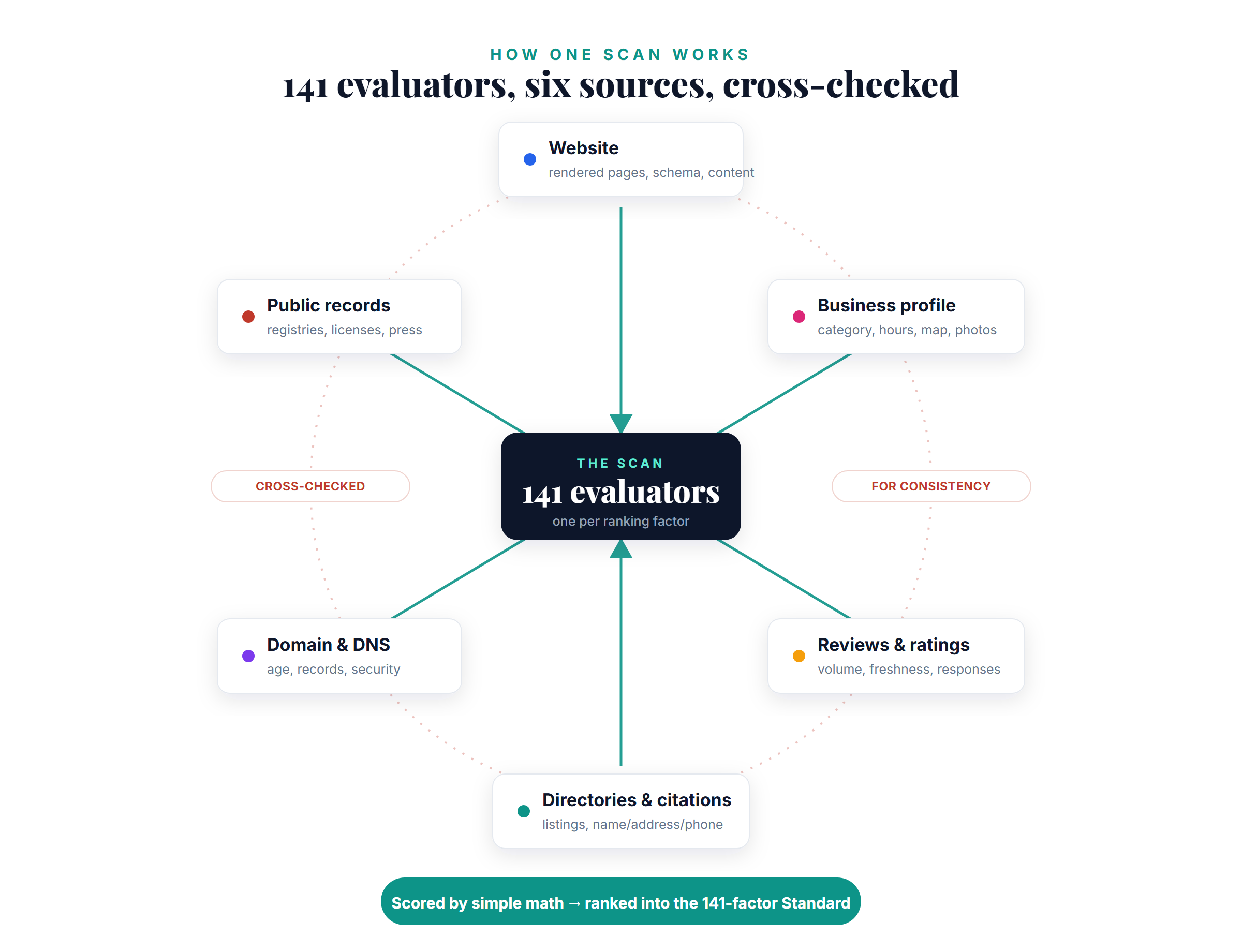
From there, the score is simple arithmetic. Whether we start a scan ourselves or a business runs a free one at AIBusinessScore.com, the data flows into the same system, and the score is just the share of those 141 baseline factors the business has in place. The work never really stops: the analysis and the prominence ranking re-run on their own every day, and any new domain that enters the system gets scanned the same way.
Keep The Data Free From Opinion
The last thing I want to say before we get started is that the data that I'm going to present to you is not my opinion. It's not filled with my personal interpretation or my team's influence.
The standard that I'm going to give you today was not us asking AI how to rank businesses, or how to rank products or services. The standard is the work of our system literally evaluating hundreds and hundreds of factors, most of which can be extracted from either websites or external data, until the data revealed a set of criteria that exists on the majority of top-ranked local businesses.
We insulated our testing so that AI was not involved in the analysis at all.
Let me define what we did to get to our conclusions because "reverse-engineering" can have different meanings depending on where it's applied. We started with the universe of things you can test a business, domain, and website for.
We asked the data, math and science to get the answers being careful to not let AI or human opinion influence the outcome. This empirical data set is what I believe should be the key factors that professionals in the new AEO/GEO industry should focus on first, or at least in parallel with the other known factors such as content relevance, to establish a foundation.
Building the evaluators
We started out to answer this one question: what do the businesses AI already recommends have in common? To answer it, we drilled into their websites with every method we could, and pulled their off-site signals too. Once the collectors were feeding us clean data, we built an evaluator for each thing worth testing.
At the peak we were running almost 250 separate tests on every AI-ranked business. After roughly 10,000 analyses, the list settled at around 150 factors that showed up in most AI-recommended businesses, and we have since tightened it to 141. It has held steady at 141 since March of this year.
The engine we built to distill down these factors started as the backend to AIBusinessScore.com, our consumer-side website that allows businesses to see what they need to do to 'fix' their businesses to prepare for ranking in AI. When we first started, I had an uncomfortable feeling about providing advice that I could not definitively prove. I'm sure some of you are advising clients or stakeholders and feel the same uneasiness.
In order to get the best answers possible, we ramped up our technical resources. There were many false starts, and many factors we felt just had to be influential to AI's decision that the data proved were not. Always the data, always the facts. It took us about 10 months, but now we've proven with mathematical certainty that the foundational factors in this list exist in most highly ranked AI-recommended businesses. It did not take us 10 months to scan the 30,000 businesses. It took us ten months to develop the collectors, evaluators, results interpreters, and the reporting necessary to be sure the result sets were valid.
Where the data comes from
Every score comes from the public information about a business, the same information a machine would use: its website, its Google profile, its reviews, its listings, its domain record, and the public data tied to its name. We don't ask the business anything. For each business we run seven passes, and each one pulls a different kind of information.
The rendered site. The first and largest pass is the business's own website. We don't just grab the raw HTML; we load and render each page the way a real browser would, then read what is actually on the screen. From that we pull the name, phone, address, and hours; whether there are real about and contact pages; the title and meta tags; the headings and structure; the schema markup; the images and their alt text; the links, buttons, and social profiles; the policies; the trust language and licensing claims; and the quality and specificity of the content. This one pass feeds more than half of all the factors. It also tells us something most tools miss: whether the content even survives with JavaScript turned off, which is close to what a machine sees.
The headers and the network. The second pass works below the page, at the network level. It reads the site's response headers and its root files. From here we check the robots.txt file — including a separate check for each individual AI crawler it might allow or block — plus the sitemap and the llms.txt file; the security headers and the SSL certificate; the response speed, redirects, and page size; the DNS records; and how the site handles a page that isn't there.
The domain record. A quick lookup of the domain's registration tells us how old it is and how long it is committed to stay. Two factors, but they carry weight, because an established domain reads differently than one registered last month.
The performance measurement. A separate pass measures how the site actually performs, on both mobile and desktop: its speed scores, its core loading metrics, whether its images are optimized and its code compressed, and whether anything is blocking the page from painting quickly.
The outside profile. Another pass pulls what the wider world already publishes about the business: its main profile listing, its reviews, and its directory citations. From that we look at whether the profile exists and is verified, how complete it is, its category and photos and hours; the volume, freshness, spread, and responsiveness of the reviews; the directory citations; and, importantly, whether the name, phone, and address on that profile match the ones on the site.
The outside corroboration. This pass checks the business against independent sources, to see whether its story holds up away from its own pages. It looks at whether the business is recognized at all, what it is known for, its reputation, the year it was established, its presence on outside review and rating sources, and whether claims like a professional license actually check out.
The AI read. The last pass is a QA read of what the evaluators returned. This AI step cannot change the data or massage it or touch it. Its only role in the process is to double check that data exists where data should exist. It's worth repeating that AI is not involved at all in the prominence scoring, and our numbers and conclusions are simple math, a series of pass-fail criteria.
A few factors deliberately draw on more than one of these passes. The clearest are the consistency checks — they exist precisely to compare what a business says on its own site against what its outside profile says, and to flag it when the two do not match.
The Foundational Shadow Appears
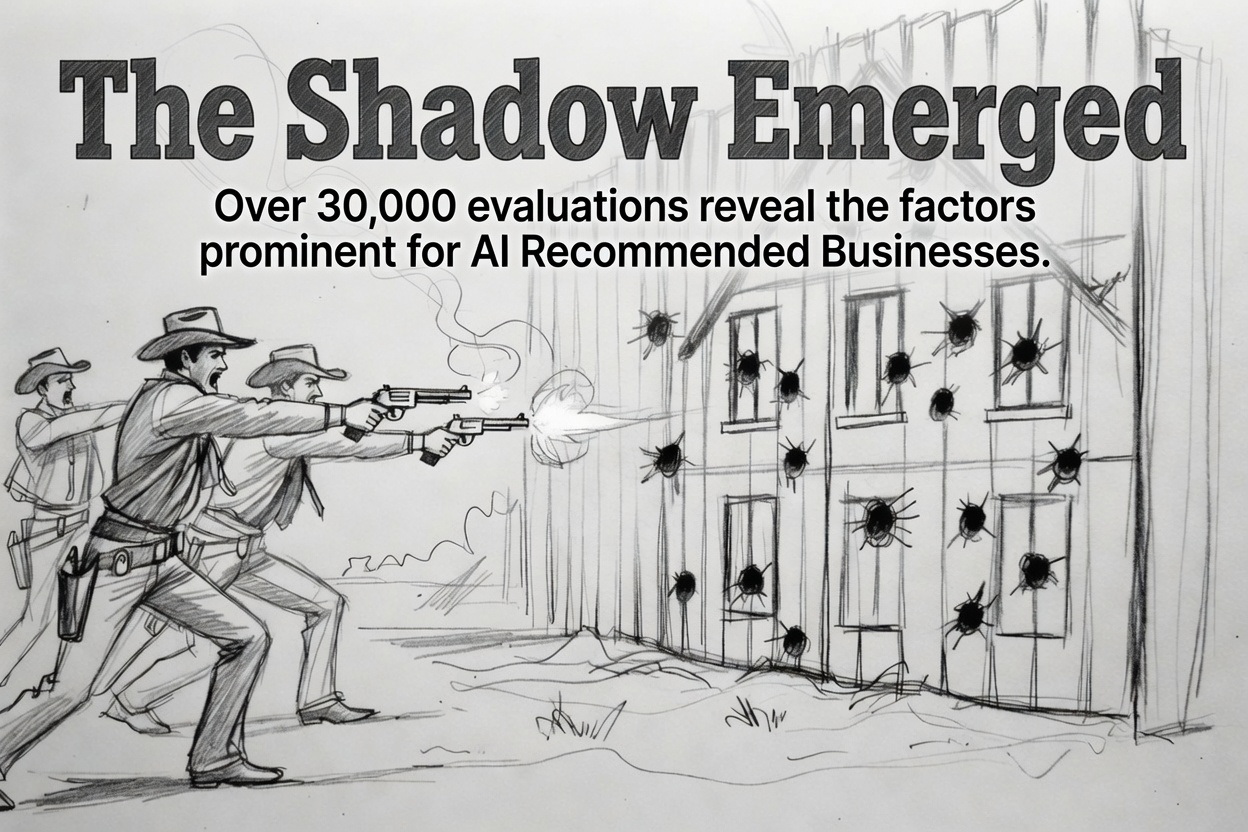
Our tests were like an ultrasound that sends a spray of rays at a mother's stomach. The ones that pass through open space tell you nothing — it's the rays that bounce back off the baby that let you see the shape that's really there. We were doing the same thing, except picture us firing 250 lasers from the same spot at every top-ranked business, one after another. Pretty soon the shape appears.
That shape shows the 141 factors that appear consistently on the winners and less consistently on the losers, derived not from asking AI, not from our opinions, but from evaluating 30,000 AI recommended businesses in 120 different industry categories that we analyzed.
Each of the Factors Fell Into One of 12 Categories
Here's the typical local business pass rate across the twelve categories of factors, which are weighted and shown in detail further along in the book.
| Category | Avg. pass rate | Read | |
|---|---|---|---|
| UX & Conversion | 81% | Most pass | |
| AI Visibility | 77% | Mostly fine, but the failures are fatal | |
| AI Corroboration | 48% | Few have it everywhere it counts | |
| SEO (technical) | 43% | Basics pass, quality fails | |
| Content & Expertise | 41% | Wide open | |
| Trust & Safety | 37% | SSL yes, depth no | |
| Business Identity | 35% | The basics aren't on the page | |
| Contact Prominence | 35% | Reachability gaps | |
| Local SEO & GBP | 34% | Half never claimed or matched the profile | |
| Social Presence | 34% | Lightest-weighted | |
| Service Trust (LSA) | 30% | Service trades under-signal | |
| Reputation | 28% | Lowest scored — heavily weighted |
As you can see, most of what every SEO and new AEO/GEO expert says lines up: these categories of factors are important to ranking in AI. This just further validated that our deductions were sound. In a future chapter we'll discuss the categories that carry the most weight, and what to work on as you align the foundational factors.
The Early Assumptions
What was surprising was that much of what the SEO experts said mattered did matter. But there was an underlying foundational issue no one was addressing.
It was the same issue the AIs were not addressing. There are key things that need to be in place before an AI will choose a business. If they are not aligned properly, the AI may be confused about a business's identity. If the site uses excessive JavaScript, the AI, which focuses on extracting the HTML, will miss key information. If the phone number is not clickable on mobile, that could have an impact. If the office hours on the GBP say one thing and the site says another, it could cause the AI to bypass a business. If the reviews show a negative trend or the responses are stale, that could cause AI to bounce off a site. And when there is no About Us page, no email, and no contact form, what happens?
We've gone factor by factor to understand the impact each one could have, and all 141 are important to a degree. There is a direct correlation between the number of factors and the position in the rankings. In almost every case, the more factors aligned or present for a business, the higher the ranking it achieves.
There is one exception. National brands, franchises, and multi-location businesses rank on the brand alone. They already carry thousands of reviews, so the factor count on a single location does not move them the way it moves a local business. In a franchise, the main brand domain carries about 60% of the weight, and one location can do little to change its own score. Everything here is for the local business.
How You Can Use The “Standard” Ranking Factors
The “Foundational” Alignment Factors
The ranking factors below are not sorted in any particular order, but each one is grouped into one of 12 categories. To display them here we’ve shortened each to its name; the full detail on every factor is in Appendix B.
Having this factor list allows us to score any domain and its competitors. This provides a reference point, or ‘standard,’ to measure against, and it also provides a deep list of factors to align to help your client rank. Again, this list was not derived by a human or AI’s opinion, and as of June 2026 shows the factors present on 30,000 AI-recommended businesses.
Along with the factor name and category, the table has a column for a client domain and three competitor domains.
The recommended use for the factor list is to check a client’s site first for the factors that are in place, then check the top competitors to that client. Once each factor either passes or fails, the percentage of passes out of the 141 determines the percentage score.
As you can see in this example, the client scores 58% and the closest competitor is at 64%. From here the agency knows exactly which factors to work on to catch up. The first goal is to start being recommended alongside the nearest competitor.
I believe this should be this industry's new checklist.
| Ranking Factor | Client | Top Ranked A | Top Ranked B | Top Ranked C |
|---|---|---|---|---|
| Business Identity | ||||
| Business Name In Title | ✗ | ✗ | ✗ | ✗ |
| Business Category Clarity | ✗ | ✗ | ✗ | ✗ |
| Years In Business Signal | ✗ | ✗ | ✗ | ✓ |
| Location Validation Strength | ✗ | ✗ | ✓ | ✓ |
| Team & Role Transparency | ✗ | ✓ | ✓ | ✓ |
| Domain Age Verification | ✗ | ✓ | ✓ | ✓ |
| Business Email Configured | ✓ | ✓ | ✓ | ✓ |
| About Page Present | ✓ | ✓ | ✓ | ✓ |
| Legal Entity Type Disclosed | ✓ | ✓ | ✓ | ✓ |
| Local SEO & GBP | ||||
| GBP Listing Present | ✗ | ✗ | ✗ | ✗ |
| GBP Category Aligns With Site Content | ✗ | ✗ | ✗ | ✗ |
| GBP Core Profile Fields Complete | ✗ | ✗ | ✗ | ✓ |
| Photo Coverage Strength | ✗ | ✗ | ✗ | ✓ |
| Weekly Operating Hours Coverage | ✗ | ✓ | ✓ | ✓ |
| GBP Core Listing Fields Present | ✗ | ✓ | ✓ | ✓ |
| NAP Elements Present On Site | ✓ | ✓ | ✓ | ✓ |
| Contact Channel Readiness | ✓ | ✓ | ✓ | ✓ |
| Service Area Specificity | ✓ | ✓ | ✓ | ✓ |
| Map Embed Present | ✓ | ✓ | ✓ | ✓ |
| Keeps Prospects Informed (Google Posts) | ✓ | ✓ | ✓ | ✓ |
| Reputation | ||||
| Review Volume Strength | ✗ | ✗ | ✗ | ✗ |
| Review Freshness Indicators | ✗ | ✗ | ✗ | ✗ |
| Review Sentiment Balance | ✗ | ✗ | ✗ | ✗ |
| Responsiveness to Reviews | ✗ | ✗ | ✗ | ✗ |
| Negative Review Pattern Recognition | ✗ | ✗ | ✓ | ✓ |
| GBP Photos And Reviews Present | ✗ | ✓ | ✓ | ✓ |
| Rating Distribution Health | ✗ | ✓ | ✓ | ✓ |
| Complaint History Signal | ✗ | ✓ | ✓ | ✓ |
| Known-For Clarity | ✓ | ✓ | ✓ | ✓ |
| Review Cadence | ✓ | ✓ | ✓ | ✓ |
| Award or Recognition Present | ✓ | ✓ | ✓ | ✓ |
| Service Trust (LSA) | ||||
| Services Clearly Described | ✗ | ✗ | ✗ | ✗ |
| Contact Options Available | ✗ | ✗ | ✓ | ✓ |
| Licensing Signal On Site | ✗ | ✓ | ✓ | ✓ |
| Insurance Signal On Site | ✗ | ✓ | ✓ | ✓ |
| Business Owner Identity Signals | ✓ | ✓ | ✓ | ✓ |
| Local Profile Completeness | ✓ | ✓ | ✓ | ✓ |
| Contact Prominence | ||||
| Email Address Present On Site | ✗ | ✗ | ✗ | ✗ |
| Contact Form Accessibility | ✗ | ✗ | ✓ | ✓ |
| Call-to-Action Buttons Present | ✗ | ✓ | ✓ | ✓ |
| Clickable Phone Tags | ✓ | ✓ | ✓ | ✓ |
| Contact Page Present | ✓ | ✓ | ✓ | ✓ |
| Physical Address Visibility | ✓ | ✓ | ✓ | ✓ |
| Operating Hours On Site | ✓ | ✓ | ✓ | ✓ |
| UX & Conversion | ||||
| Above-the-Fold Clarity | ✗ | ✗ | ✓ | ✓ |
| Booking or Availability Signal | ✓ | ✓ | ✓ | ✓ |
| No Intrusive Popups | ✓ | ✓ | ✓ | ✓ |
| Call-to-Action Variety | ✓ | ✓ | ✓ | ✓ |
| SEO (technical) | ||||
| Page Load Speed | ✗ | ✗ | ✗ | ✗ |
| Title Tag Quality | ✗ | ✗ | ✗ | ✗ |
| Image Optimization Indicators | ✗ | ✗ | ✗ | ✗ |
| Meta Description Quality | ✗ | ✗ | ✗ | ✗ |
| H1 Tag Presence | ✗ | ✗ | ✗ | ✓ |
| Script Efficiency Signals | ✗ | ✗ | ✗ | ✓ |
| Front-End Best Practices | ✗ | ✗ | ✓ | ✓ |
| Image Alt Text Coverage | ✗ | ✓ | ✓ | ✓ |
| Server Response Time | ✗ | ✓ | ✓ | ✓ |
| Internal Link Structure | ✓ | ✓ | ✓ | ✓ |
| Main Content Load Speed | ✓ | ✓ | ✓ | ✓ |
| Canonical Tag Presence | ✓ | ✓ | ✓ | ✓ |
| Responsive Layout Stability | ✓ | ✓ | ✓ | ✓ |
| Page Payload Weight | ✓ | ✓ | ✓ | ✓ |
| Sitemap Availability | ✓ | ✓ | ✓ | ✓ |
| Desktop Load Performance | ✓ | ✓ | ✓ | ✓ |
| Robots.txt Published | ✓ | ✓ | ✓ | ✓ |
| Breadcrumb Schema Present | ✓ | ✓ | ✓ | ✓ |
| Healthy Page Size | ✓ | ✓ | ✓ | ✓ |
| Schema Depth and Richness | ✓ | ✓ | ✓ | ✓ |
| Review Markup with Data | ✓ | ✓ | ✓ | ✓ |
| Low Redirect Count | ✓ | ✓ | ✓ | ✓ |
| Total Page Response Time | ✓ | ✓ | ✓ | ✓ |
| Site Reachable Without Errors | ✓ | ✓ | ✓ | ✓ |
| Viewport Meta Tag Present | ✓ | ✓ | ✓ | ✓ |
| Technical SEO Score | ✓ | ✓ | ✓ | ✓ |
| AI Visibility | ||||
| Allows Anthropic ClaudeBot | ✗ | ✗ | ✗ | ✗ |
| Allows ChatGPT On-Demand (ChatGPT-User) | ✗ | ✗ | ✗ | ✗ |
| Allows Google-Extended | ✗ | ✗ | ✗ | ✗ |
| Allows OpenAI GPTBot | ✗ | ✗ | ✓ | ✓ |
| Allows OpenAI Search (OAI-SearchBot) | ✗ | ✓ | ✓ | ✓ |
| Allows Perplexity On-Demand (Perplexity-User) | ✓ | ✓ | ✓ | ✓ |
| Allows PerplexityBot | ✓ | ✓ | ✓ | ✓ |
| llms.txt File Present | ✓ | ✓ | ✓ | ✓ |
| Established Entity Recognition | ✓ | ✓ | ✓ | ✓ |
| Indexing Allowed | ✓ | ✓ | ✓ | ✓ |
| Crawler Access Allowed | ✓ | ✓ | ✓ | ✓ |
| LocalBusiness Schema Present | ✓ | ✓ | ✓ | ✓ |
| Reputation Standing | ✓ | ✓ | ✓ | ✓ |
| Open Graph Tags Present | ✓ | ✓ | ✓ | ✓ |
| Sitemap Linked In Robots.txt | ✓ | ✓ | ✓ | ✓ |
| Allows Claude On-Demand (Claude-User) | ✓ | ✓ | ✓ | ✓ |
| Allows Claude Search (Claude-SearchBot) | ✓ | ✓ | ✓ | ✓ |
| Structured Data Completeness | ✓ | ✓ | ✓ | ✓ |
| Service or Product Schema | ✓ | ✓ | ✓ | ✓ |
| FAQPage Schema Present | ✓ | ✓ | ✓ | ✓ |
| AI Live-Fetch Speed | ✓ | ✓ | ✓ | ✓ |
| Content Visible Without JavaScript | ✓ | ✓ | ✓ | ✓ |
| Content & Expertise | ||||
| Content Recency Signals | ✗ | ✗ | ✗ | ✗ |
| Homepage Content Length | ✗ | ✗ | ✗ | ✗ |
| Content Structure Readability | ✗ | ✗ | ✗ | ✗ |
| Target Customer Stated | ✗ | ✗ | ✗ | ✓ |
| Specialization Declared | ✗ | ✓ | ✓ | ✓ |
| Language or Population Served | ✗ | ✓ | ✓ | ✓ |
| Pricing Transparency | ✗ | ✓ | ✓ | ✓ |
| Case Study or Portfolio Presence | ✓ | ✓ | ✓ | ✓ |
| Title Tag Not Keyword-Stuffed | ✓ | ✓ | ✓ | ✓ |
| Testimonial or Review Content | ✓ | ✓ | ✓ | ✓ |
| FAQ Content Present | ✓ | ✓ | ✓ | ✓ |
| Author or Person Schema (Expertise) | ✓ | ✓ | ✓ | ✓ |
| Social Presence | ||||
| Facebook Profile Linked | ✗ | ✗ | ✗ | ✗ |
| Instagram Profile Linked | ✗ | ✗ | ✓ | ✓ |
| LinkedIn Profile Linked | ✗ | ✓ | ✓ | ✓ |
| YouTube Channel Linked | ✓ | ✓ | ✓ | ✓ |
| Yelp Profile Linked | ✓ | ✓ | ✓ | ✓ |
| Trust & Safety | ||||
| Privacy Policy Availability | ✗ | ✗ | ✗ | ✗ |
| Terms of Service Accessibility | ✗ | ✗ | ✗ | ✗ |
| Secure HTTPS Connection | ✗ | ✗ | ✗ | ✗ |
| User Data Handling Clarity | ✗ | ✗ | ✗ | ✓ |
| Third-Party Trust References | ✗ | ✗ | ✓ | ✓ |
| Payment Trust Seals | ✗ | ✓ | ✓ | ✓ |
| Trustpilot Badge or Reference | ✗ | ✓ | ✓ | ✓ |
| Google Trust Badge Shown | ✓ | ✓ | ✓ | ✓ |
| Content Security Policy | ✓ | ✓ | ✓ | ✓ |
| Secure Resource Loading | ✓ | ✓ | ✓ | ✓ |
| Valid SSL Certificate | ✓ | ✓ | ✓ | ✓ |
| Security Headers Present | ✓ | ✓ | ✓ | ✓ |
| SSL Certificate Not Expiring Soon | ✓ | ✓ | ✓ | ✓ |
| Refund and Cancellation Policy Published | ✓ | ✓ | ✓ | ✓ |
| Guarantee Statement Present | ✓ | ✓ | ✓ | ✓ |
| BBB Reference Present | ✓ | ✓ | ✓ | ✓ |
| AI Corroboration | ||||
| Google Business Profile Links This Domain | ✗ | ✗ | ✗ | ✗ |
| Independently Recognized on Yelp | ✗ | ✗ | ✗ | ✗ |
| Business Name Consistent Across Sources | ✗ | ✗ | ✗ | ✗ |
| LinkedIn Profile Matches the Business | ✗ | ✗ | ✗ | ✓ |
| Phone Consistent Across Sources | ✗ | ✗ | ✓ | ✓ |
| Address Consistent Across Sources | ✗ | ✓ | ✓ | ✓ |
| Independently Recognized by the BBB | ✗ | ✓ | ✓ | ✓ |
| License Verified Against State Source | ✓ | ✓ | ✓ | ✓ |
| Independently Recognized on Trustpilot | ✓ | ✓ | ✓ | ✓ |
| Corroborate the founding date with an offsite source | ✓ | ✓ | ✓ | ✓ |
| Displayed Rating Matches Google | ✓ | ✓ | ✓ | ✓ |
| Posted Hours Match Google | ✓ | ✓ | ✓ | ✓ |
| Score | 58% | 64% | 71% | 78% |
The Objection: "The Little Things Don't Matter"
The experienced answer-engine skeptic has a fair position. It's mostly reviews and mentions and outside authority, they might say, and all these small on-site factors are rounding error. Let me give you two situations that explain why that is likely wrong.
From the other side, both buildings look identical.
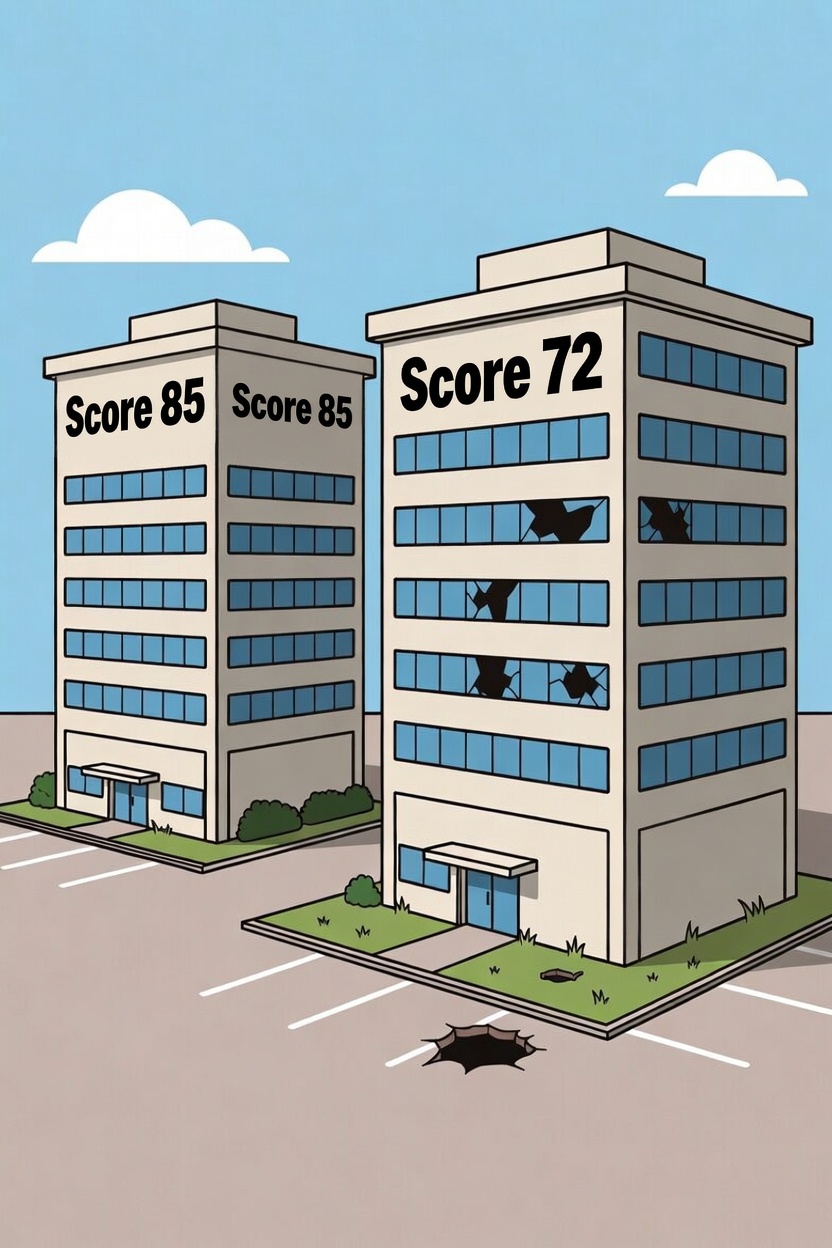
But a thorough review would prove they are not.
You just interviewed someone. You saw the suit, the tie, the nice watch, the fresh haircut, the pressed shirt. So you make your decision and reach across the table to shake their hand, sure you've got them read. Then, as they leave the conference room, you notice they're wearing shorts and no shoes. That's what the full factor list is for.
Or, you ask a strong candidate to come in. They have your address, they sound perfect on the phone, they answer every question right, and they tell you they'll be there in an hour. Three hours later, nobody has shown up. Eventually you work out that you told them Suite B in Building C, and they've been sitting in Building B, Suite C the whole time. You thought you had everything you needed to place them. One character kept them from reaching you.
It doesn't matter how good your ranking strategy is — if the basics are not in place, the engines can't be sure. They are all racing to be the “most trusted” AI so they can't afford to send someone to an abandoned building or to Joe's in the wrong part of town.
Where To Start Working
Which Categories Carry the Most Weight
After running tens of thousands of tests, we have validated what the search community has said were key factors in ranking in AI. We can definitively say that while you’re laying the foundation, GBP, reputation, and corroboration are the big rocks to work on to move the needle the fastest.
A category’s weight is derived from the individual factors associated with it. All factors are reweighted from new scans each month so we can track changes in AI preferences. We publish the new weights on the 5th day of the following month. The weights in the table are from June 2026.
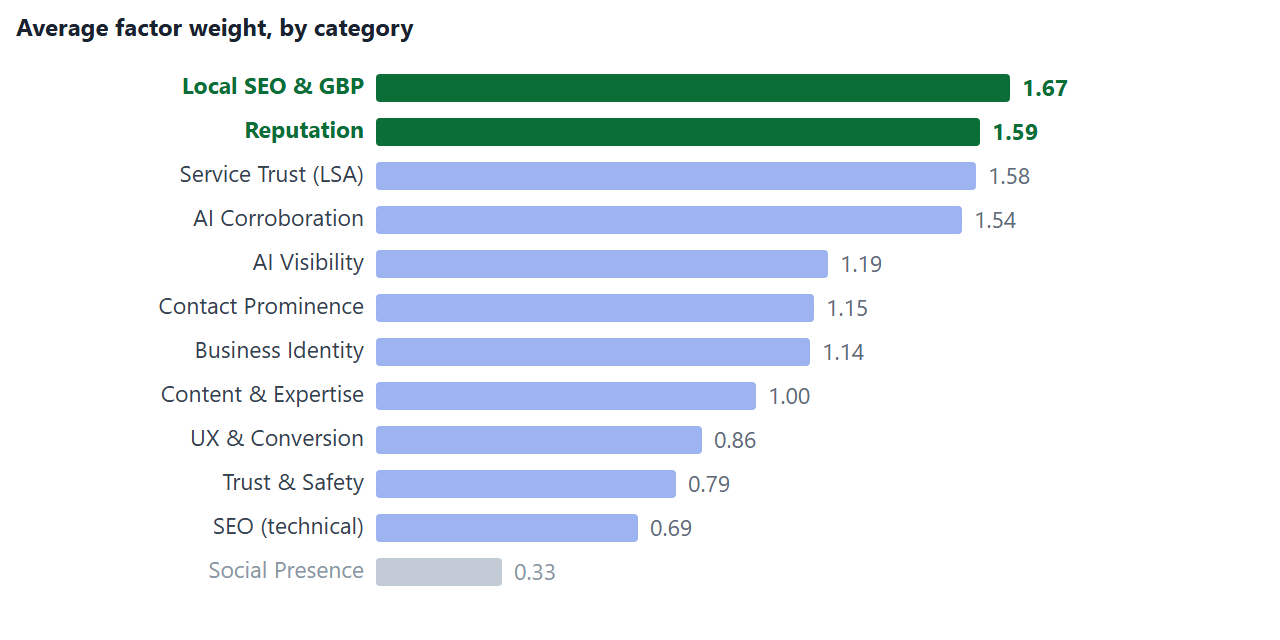
The Top Three Groups, in Order of Weight
Most of what the SEO and AEO field already teaches lines up with what our data shows.
1. GBP and consistent identifying factors
An answer engine's first challenge is identity resolution. It has to decide that the website, the Google profile, the Yelp page, and the directory listing all belong to the same company. It does that by matching the name, the address, and the phone across those sources. When they all match, the model can fuse everything it knows into one confident record. When they don't, the record fractures. A phone that's off by a digit, a suite number on the site but not on the profile, "& Sons" in one place and "and Sons" in another — any of those will do it. And a fractured record is a business the model can't recommend with any confidence.
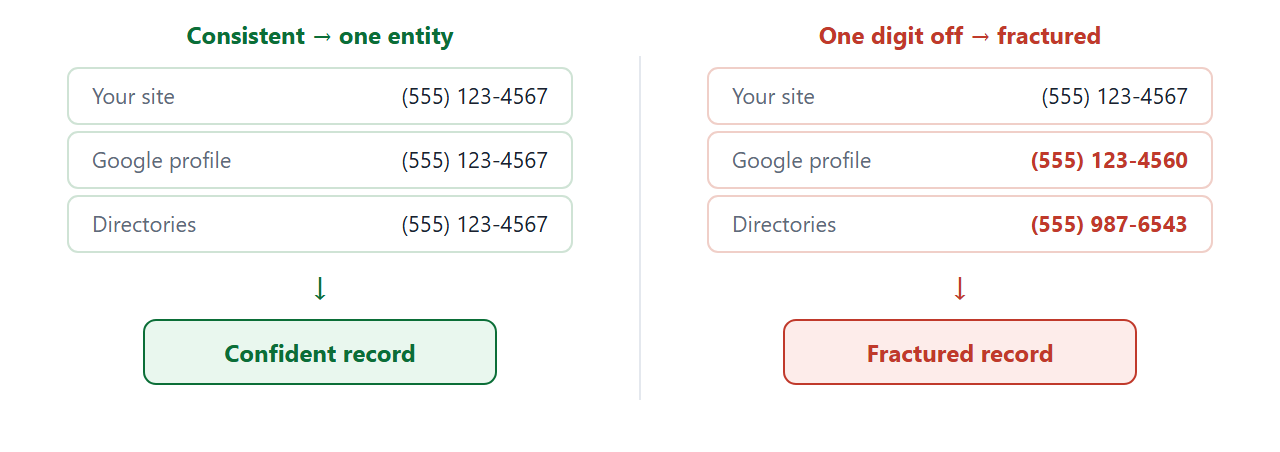
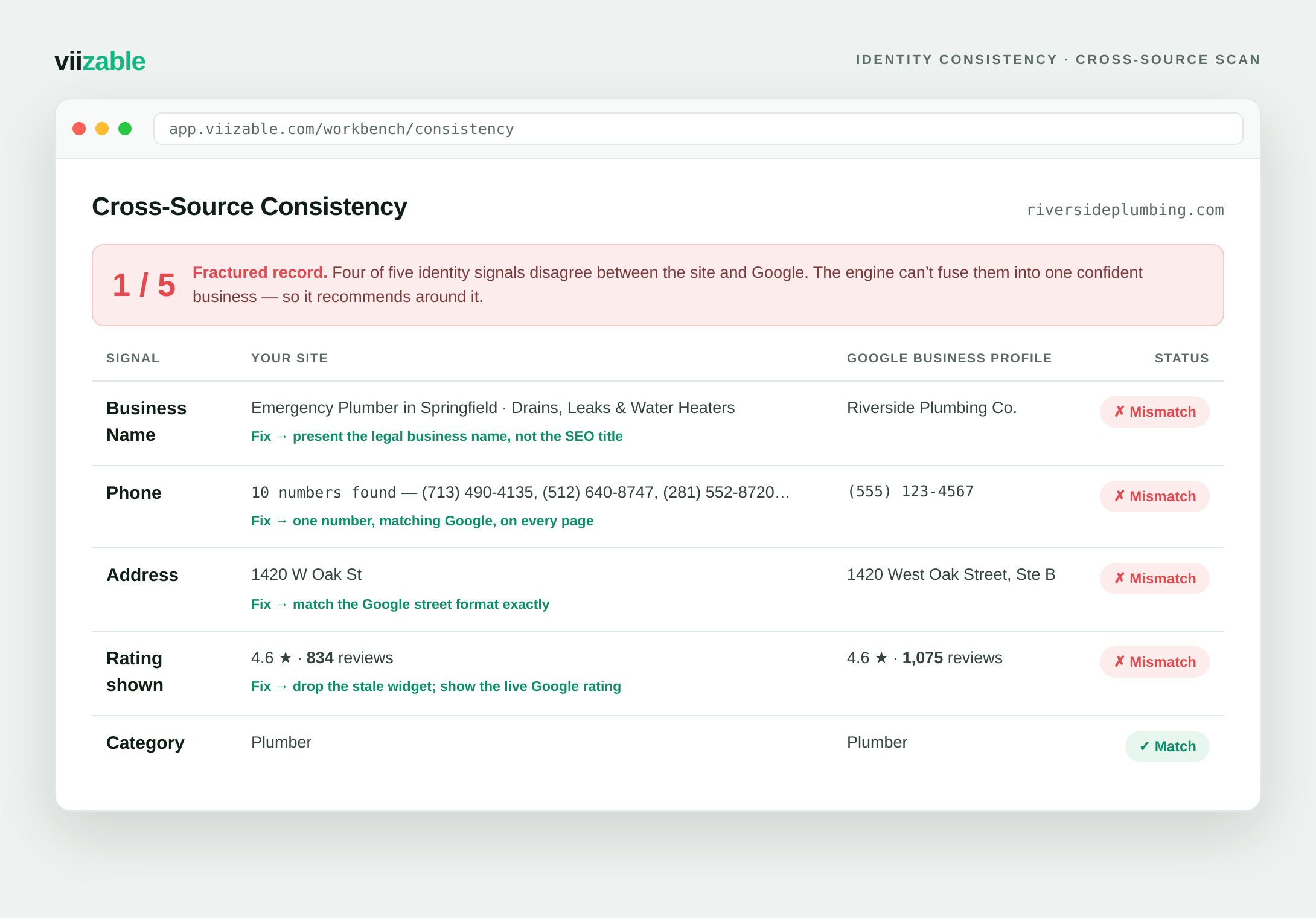
Cross-source consistency is where the standard shows its teeth most plainly — whether the same name, phone, address, and rating turn up identical everywhere an engine looks. Three real cases from live domains, names removed:
The wall of phone numbers. On one plumbing company, the scan pulled four different phone numbers scattered across the site, not one of them matching the single number on its Google profile. This is rarely the owner's doing — it is usually the website builder, a booking widget or a call-tracking script seeding phone-formatted strings into pages the owner never sees. But the machine sees all four and has to decide which one is the business. Hand it one number, everywhere, and there is nothing to untangle.
The name that wasn't the name. Picture Willie's Icehouse — a hand-painted sign, a gravel lot, a crowd that's called it Willie's for 20 years. Ask anyone in town and they'll point you straight to it. Now watch a machine try. The sign says Willie's Icehouse. The business license, filed with the state, reads Williams Restaurant & Bar. The Google profile — where the reviews actually live — shows Willie's Ice House & Grill. And the local news station that ran a segment on the place calls it Willie's Bar and Grill. Four names, one building. A person reconciles all four without a second thought: the same beloved dive whether the paperwork says Williams or the sign says Willie's, whether it's "Icehouse" or "Ice House" or the anchor's "Bar and Grill." A machine can't — it sees four separate businesses, confirms none of them, and recommends the competitor down the road whose name reads the same in every place it appears.
The name that was a page title. On one plumbing company, the name the site handed the engine wasn't a name at all — it was the SEO page title, "Emergency Plumber in Springfield · Drains, Leaks & Water Heaters," while the Google profile, the directories, and the lettering on the truck all read a plain company name. Chasing keywords, the site told the machine a different business than every other source listed.
The rating that didn't add up. On a third, the site displayed 834 reviews; Google showed 1,075. The scan says it plainly: "site shows 834 reviews vs Google 1,075 — show your real Google rating, not an inflated or stale one." A stale review widget was quietly undercutting the one number a prospect trusts most, shown in a single line.
2. Reputation: the reviews
Reputation is the second most heavily weighted category. Only the completeness of the Google profile counts for more. It is also the category businesses score worst on. Most businesses have not built it, and fixing it costs a few minutes a week.
When an answer engine recommends a business, it puts its own credibility at risk. It is telling a real person to go use that business.
Reputation is not one number. The engine weighs four separate parts of it. The first is volume: enough reviews to look like a real, active business, not three reviews from 2021. The second is recency: new reviews need to keep arriving, because a business that stopped collecting reviews looks like a business that stopped operating. The third is response: whether the owner replies to reviews, which makes the owner look engaged and accountable. The fourth is distribution: the engine looks past the average star rating and checks whether the low ratings all name the same complaint.
Response is the easiest of the four to fix, and it is heavily weighted. Yet across the businesses we scanned, only 0.8% reply to their reviews. That 0.8% is the share that reply at all, not the share with good reviews. Replying costs only a few minutes a week.
Reputation is also the one signal a consultant cannot fake or rush. It has to be built. The business asks its happy customers for reviews on a regular basis, and it handles the unhappy customers in public.
There are dozens of ways to increase reviews:
One barbecue restaurant in South Texas uses this strategy. Before a group leaves, the manager or owner arrives at the table with a plate of peach cobbler. It costs the restaurant about 70 cents to make, but they have some of the best reviews in the state. He sets the plate down, tells them it's free, and says while you're still in the restaurant, we'd be grateful for a review of how your experience was today. Then he pulls out a business card, bends over the table, and writes the server's name on the back along with 10% off. Show this when you come back in, he tells them. And if your server took good care of you, his name is on the card as well.
The name on that card is not the server's real name. It is a code word, and it lets him count how many reviews those cards brought in.
3. Corroboration: outside sources back up the claims
At the beginning of 2026, corroboration was a minor factor. Every month since, at every reweighting, we are seeing it rise in prominence. Anyone can type "licensed and insured" on a homepage. Far fewer businesses link that claim to the state licensing board's verification page. A founding year printed in the footer is only a claim. The same year listed on an independent business registry is a fact the engine can check. Corroboration is the difference between a business making a claim about itself and an outside source confirming that claim.
National Chains Get A Head Start
This one will save you from burning a client's budget in the wrong place. Your local businesses are not going to out-rank the national chains on the generic head terms, the "pizza near me" and the "dentist near me." The chain's brand is corroborated all across the web. The model has seen it again and again, and even a single mediocre franchise location inherits all that strength. We watched it happen right in the data. One national chain scored near the bottom of the factor list on its own site, and it still came back as the top AI recommendation, on the brand alone.
Local businesses win on the specific — the neighborhood, the niche service, the odd-hours or odd-need question the chain doesn't serve. A model routes a specific request to a specialist, because specificity is exactly the thing it can match and a chain's generic profile can't. "Emergency Sunday plumber in the Heights who works on tankless systems" is a query no franchise is set up to win. And every well-built local business can.
This is why the factor list matters more for a local business than for a chain, not less. The chain is coasting on corroboration it piled up over decades. The local business has to build its case on purpose, deliberately, and the factor list is that case, item by item.
How to Work the Factors
The Work List
By now it seems like everyone has an AI visibility tool; there's one in every browser.
But what good is knowing Joe's Auto is behind Main Street Repair if you don't know why?
That is where the factor list earns its keep. You don't just see the percentage Joe is behind; you see the exact factors Main Street has in place that Joe doesn't yet. That gap is filled with things that can be done immediately by the agency to show their client their activities while they are waiting on the longer-tail content strategies to kick in.
I can't promise that if Joe aligns his on-site and off-site factors to match his competitors he will pass them. Every case is different, and Joe may never catch Main Street. But our data is clear on one thing: the businesses that focus on aligning these foundational factors get AI's attention a lot faster than the ones that don't.
Here is what two months of that work looks like. As Joe's score climbs toward Main Street's, AI names his shop more often. As the aligned factors increase the mentions generally follow. Having the factor checklist to follow puts clients at ease because they see weekly improvement in alignment while they are waiting for mentions to increase.
The Gap Analysis
A green mark means the factor is in place. A red mark means it is missing. This is a typical situation in which a client is only a few factors away from their competitors. In this example the client comes in with three of the nine factors in place.
| Prominent Ranking Factor | Client | Top Ranked A | Top Ranked B | Top Ranked C |
|---|---|---|---|---|
| Business Name In Title | ✗ | ✗ | ✗ | ✗ |
| Business Category Clarity | ✗ | ✗ | ✗ | ✗ |
| Years In Business Signal | ✗ | ✗ | ✗ | ✓ |
| Location Validation Strength | ✗ | ✗ | ✓ | ✓ |
| Team & Role Transparency | ✗ | ✓ | ✓ | ✓ |
| Domain Age Verification | ✗ | ✓ | ✓ | ✓ |
| Business Email Configured | ✓ | ✓ | ✓ | ✓ |
| About Page Present | ✓ | ✓ | ✓ | ✓ |
| Legal Entity Type Disclosed | ✓ | ✓ | ✓ | ✓ |
| Score | 58% | 64% | 71% | 78% |
Often it is just a few factors that separate a business that doesn't rank from the next one that does.
The gaps are easy to see. Each of the three top-ranked businesses carries more of these factors than the client does. Every red mark in the client column with a green mark beside it is a specific thing to fix.
The Task List
Every factor has a known fix, and every fix gets logged as it is done, so the client can see the work happening. Click any factor to open its full detail in the Appendix.
| Prominent Ranking Factor | Client | Task List |
|---|---|---|
| Business Name In Title | Fixed | Added the business name to the homepage title tag.Mac · Mon |
| Business Category Clarity | Fixed | Stated the service category in the title and main heading.Mac · Mon |
| Years In Business Signal | Fixed | Added a tenure line to the footer.Sue · Tue |
| Location Validation Strength | Fixed | Added address, hours, map, and LocalBusiness schema to the Contact page.Mac · Wed |
| Team & Role Transparency | Fixed | Added a Team page naming the owner and roles.Sue · Thu |
| Domain Age Verification | ✗ | Can’t be changed. A young domain will always fail this one, and that is just life. |
| Business Email Configured | ✓ | Already in place. |
| About Page Present | ✓ | Already in place. |
| Legal Entity Type Disclosed | ✓ | Already in place. |
| Score | 89% |
The Manual Process
Scoring one business against all 141 factors by hand takes hours, and an agency doing this for many clients cannot keep doing it that way. AI can take on part of the work. You can have an AI model write code that reads a website and checks the factors found on the page itself, such as the title tags, the headings, the contact details, and the schema markup. That covers a meaningful share of the list, and you can build it with the AI tools you already have.
The rest of the work is harder, and doing it well is a real engineering project. Two things make it hard. First, a business's information does not stay the same over time, so its website has to be scanned again on a regular schedule to catch what has changed since the last scan. Second, an AI model working on its own is not reliable at this task. It will report that a factor is present when it is actually missing, and report a factor as missing when it is actually present. On a single business you could catch those mistakes by hand, but across hundreds of businesses you cannot.
Everything in this book you can verify for your client by hand. In fact we did check all 250 of the starting factors by hand several times to make sure the programs we wrote were accurate. Does the name match, letter for letter, on the site, on the Google profile, and across the directories? Is the phone a real tap-to-call link on a phone, or just a picture of a number? Is the schema there, and the right kind? Do popups shove themselves in front of the content before a reader gets to it? Are there negative reviews sitting months old with no reply? With a good programmer and AI you can check just about everything, and it only took us a few days each time.
You can lean on AI to move through it faster. But keep one thing in mind while you do. An AI will sometimes tell you what it thinks you want to hear instead of what’s actually on the page, and it says both with the same confidence. So anything you don’t check with your own eyes, treat as a maybe. Count on some of the data you don’t personally verify being dead wrong.
Then, once you’ve scored the client and a dozen competitors, the real job starts. You fix the site, build the offsite proof, get the reviews answered, and a week later you do it all again, the same way, so you can see what your work changed.
This is why a purpose-built system does the job better than a person, and better than a person using AI alone. If you're serious about building a system to check these factors yourself, it is best to build a separate evaluator for each factor and then store the result every time you run it.
The Easy Way To Track Everything
I’m hoping you can see how the ‘standard’ foundational factors would help you, as an agency or consultant, rank your clients. It was not my intention to turn this book into a sales brochure for my company. I could have done that with a brochure, a webpage, or an article. But almost a year ago I struggled to check these factors, manually and even programmatically, and it is a real challenge.
I realize that now that I’ve published the full list, anyone could upload it into a database and use it. I expect competitors to build their own scanning radar to analyze the prominent factors too. But I don’t think anyone will ever build a better mousetrap to rank local businesses than what we built, and I am proud of it.
Here’s what viizable does for you as an agency, solopreneur, or consultant.
First, like any AI visibility tool, you can research mentions and citations for any domain. Since there are hundreds of variations, we’ve set it up so with a click you can move just the ones you want to include in the weekly trend reports.
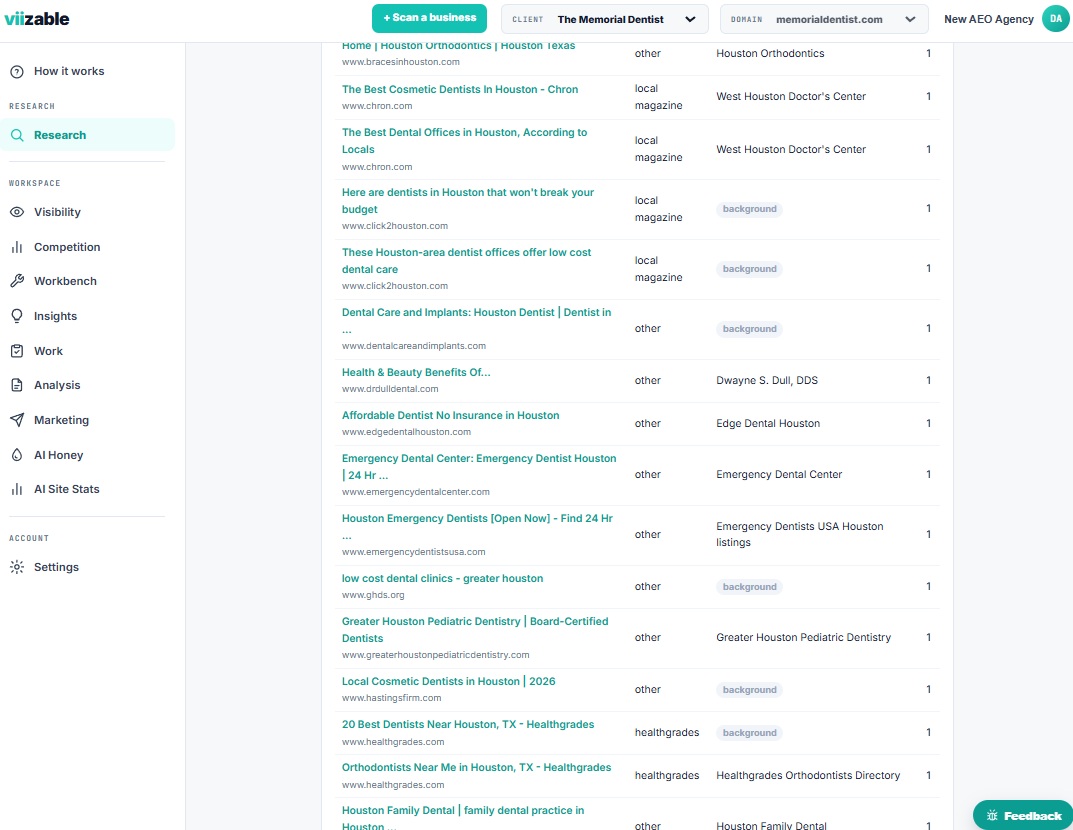
In the Visibility tab we track prompts, stats and trends to show progress for the client week to week. Once a prompt to track is added, it will be included in a weekly rescan for the agency and client progress reports and trend charts.
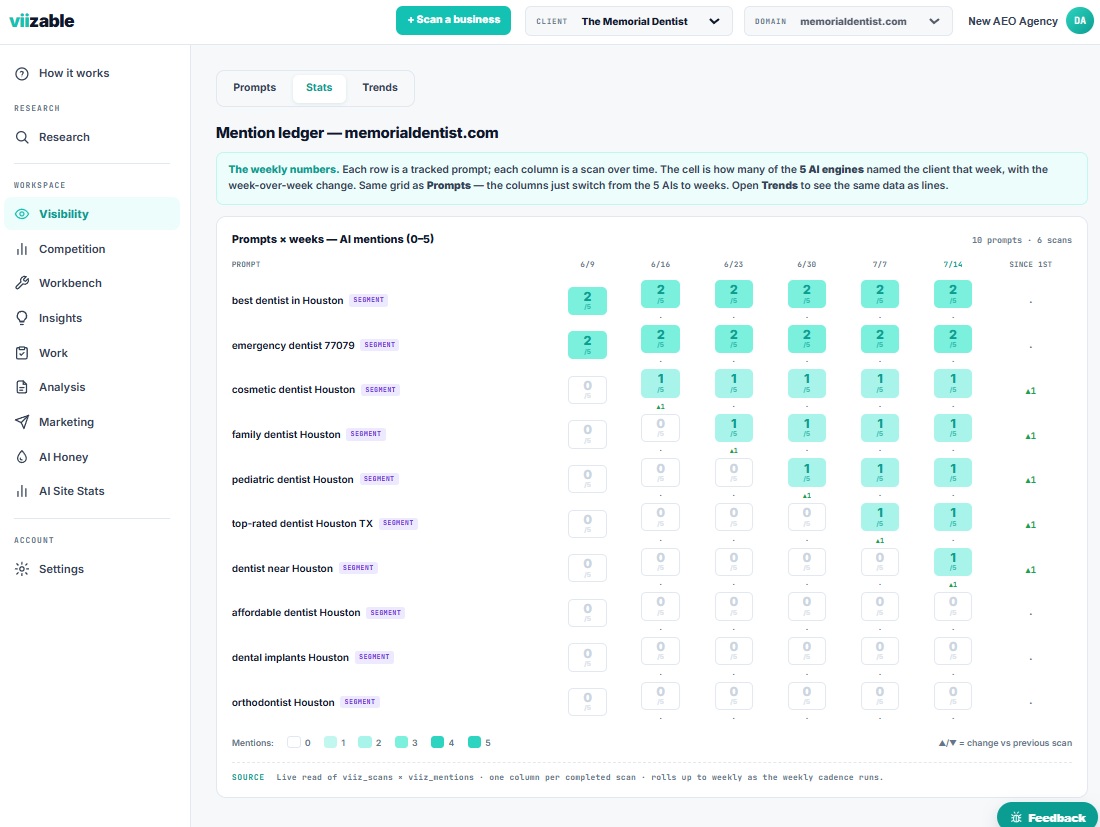
Does this look familiar? Just enter a domain and we automatically check the 141 factors for you and drop them in the workbench—and we select, out of the 50 nearest, the 5 AI-recommended businesses that rank higher than you. But all the hard work is done—you just need to work on aligning the factors so your client can catch their competitors. Just click down to see the detail.
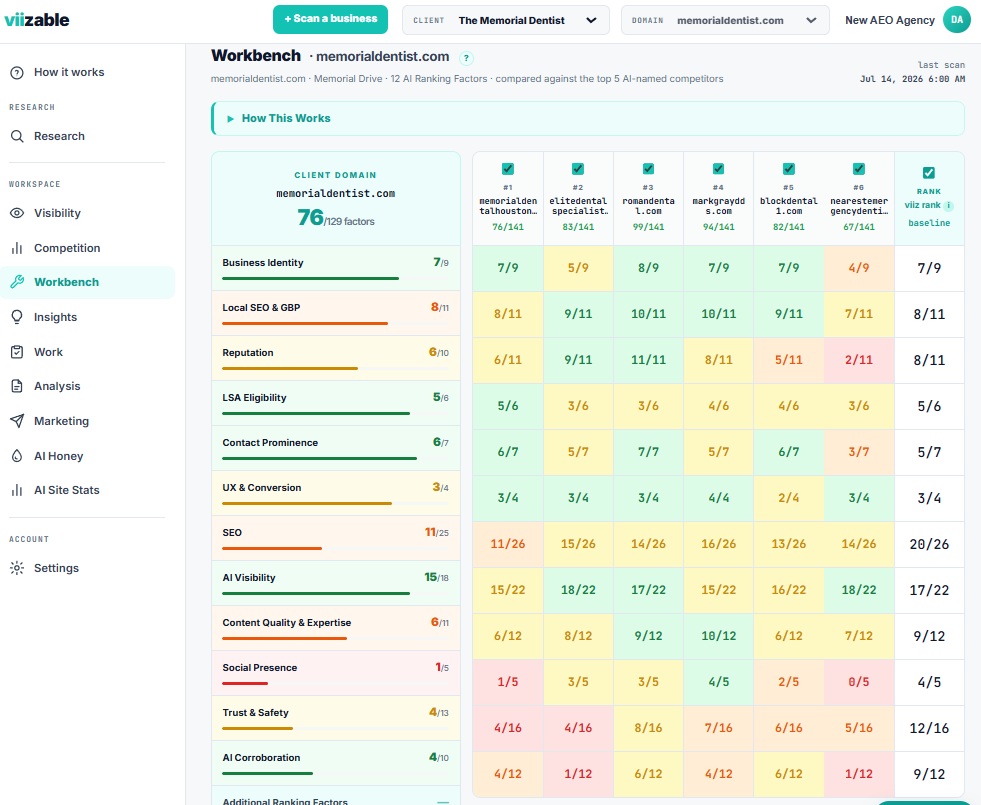
When you click down on a category, you get the factors in that category. When you click a factor, you get the details, and the details show you the data the evaluator found that failed the test. And we tell you exactly how to fix this factor. Plus you click the task button and assign the fix right to the client’s tech guy, or your tech contractor, or even back to the client for research. Working the factors is as easy as pushing buttons all day.
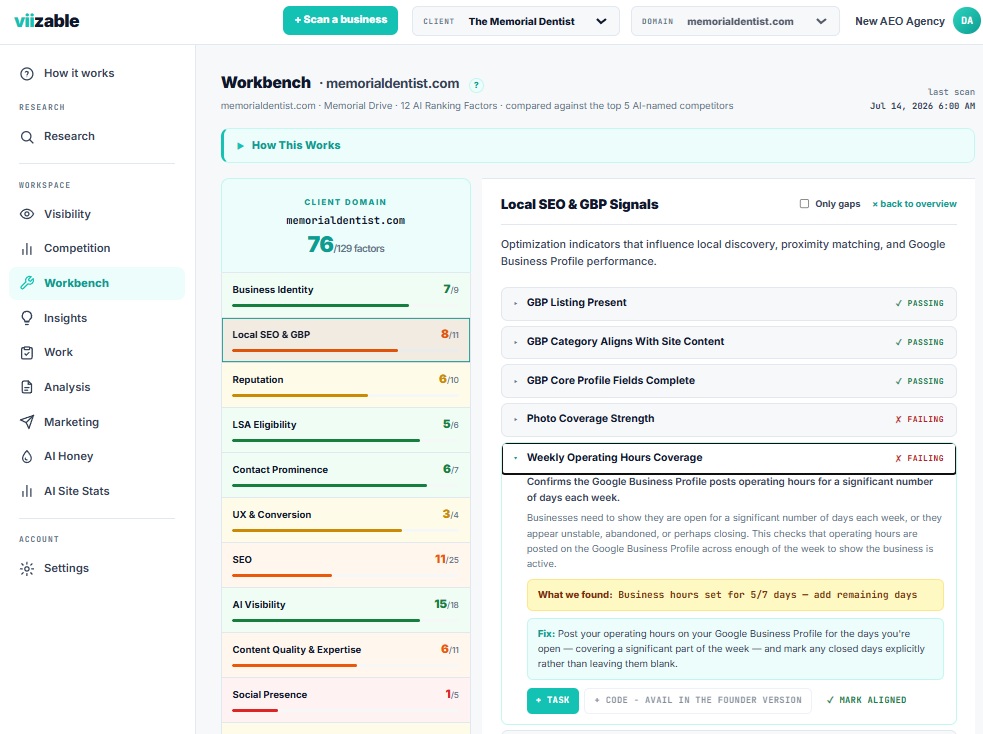
We drilled down on a category, then on the failed factor to get the detail, and from the detail we click the Task button and here we are—everything is completely filled, just assign it to someone and put in a due date.
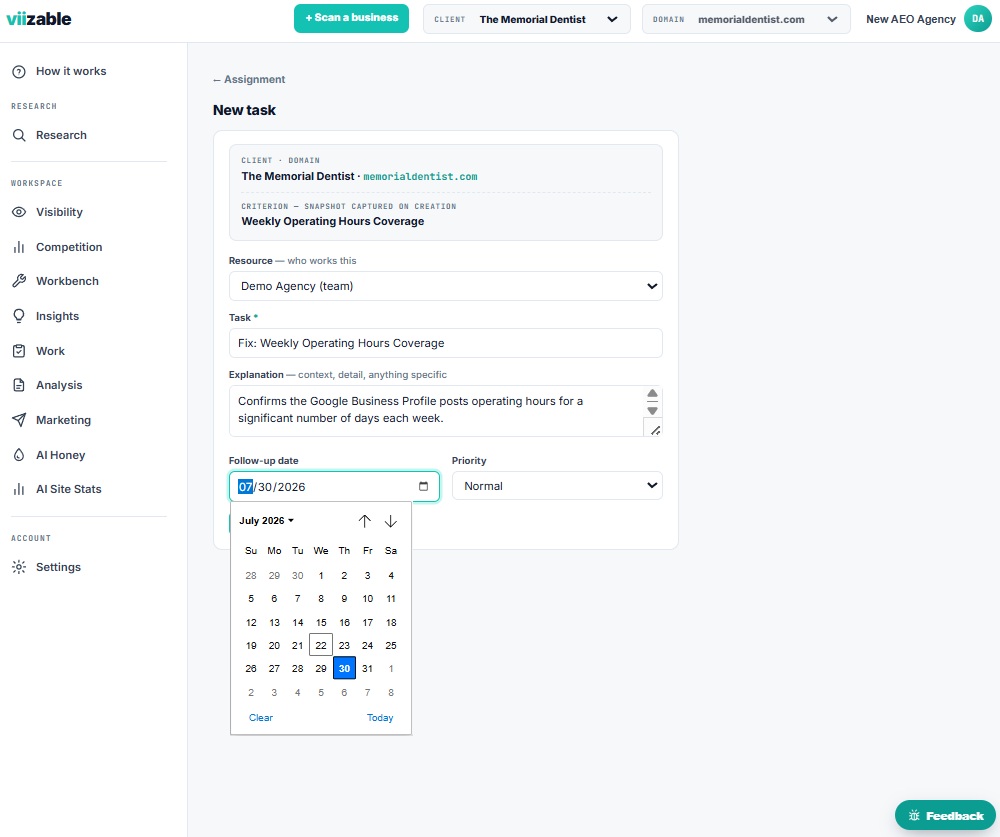
As you work or your team works, you can easily keep track of everyone’s assignments, delivery dates, and more. And all the factors you fix roll right up to the client and agency reports, showing each week’s progress.
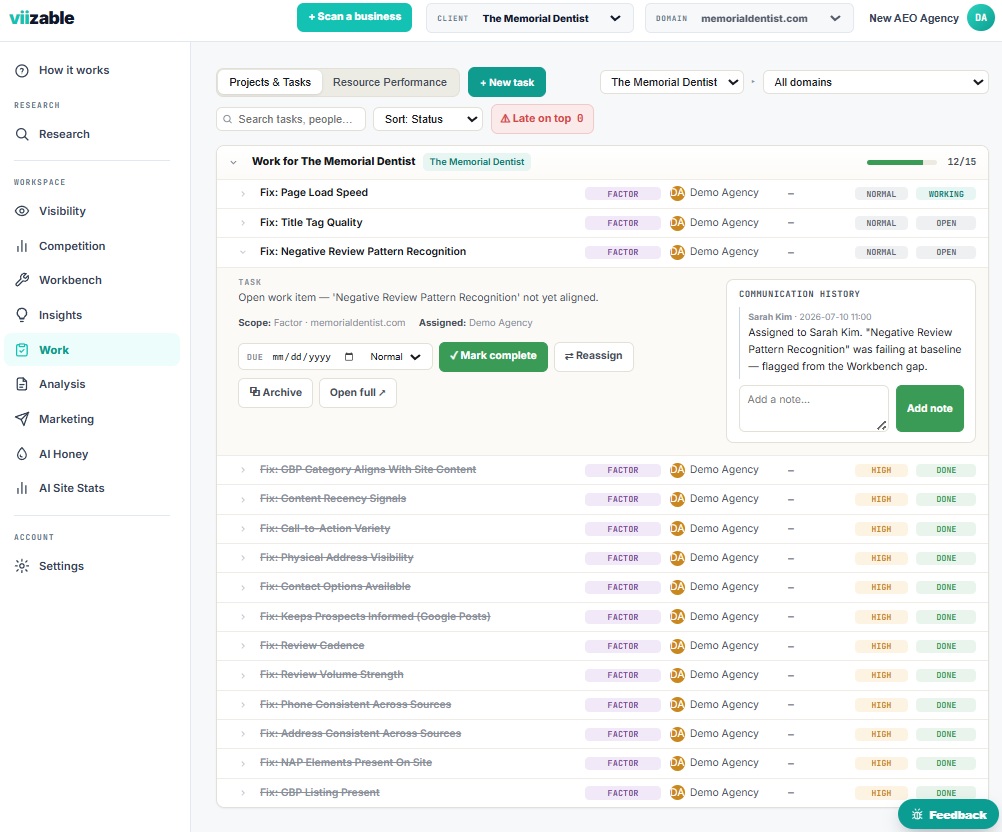
We don’t trust AI to weight or scan the factors, but we do use it to find helpful insights that will allow you to identify the quick wins and impress your client. They are different, and specifically drafted based on each domain’s unique situation and data.
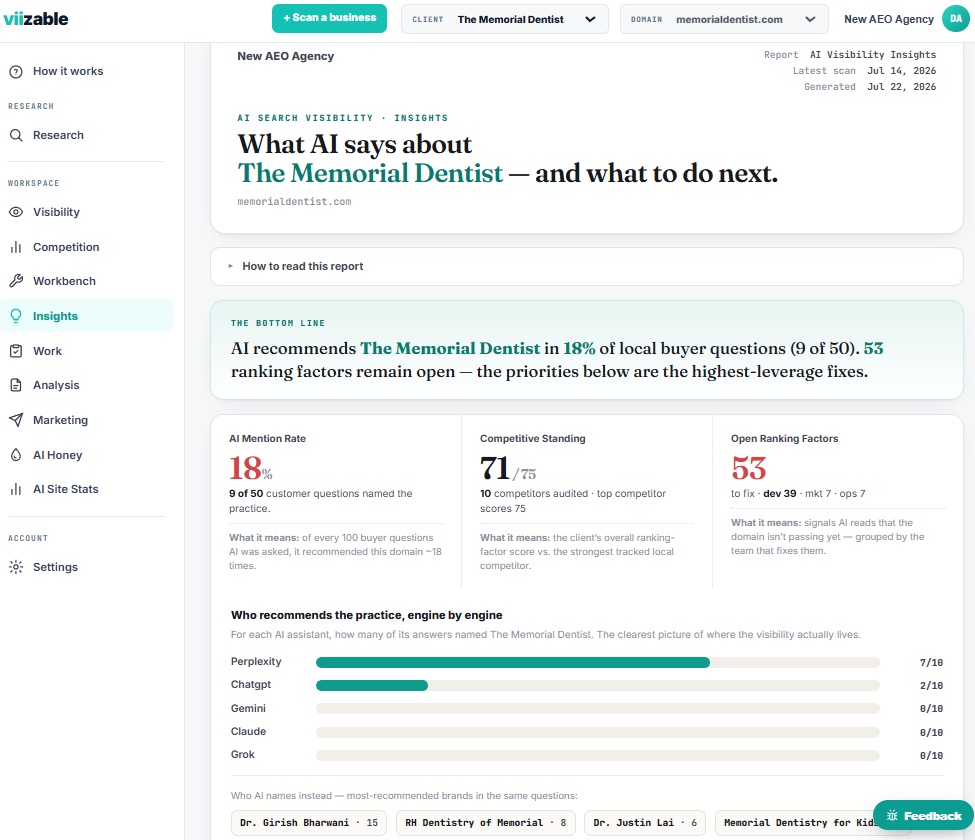
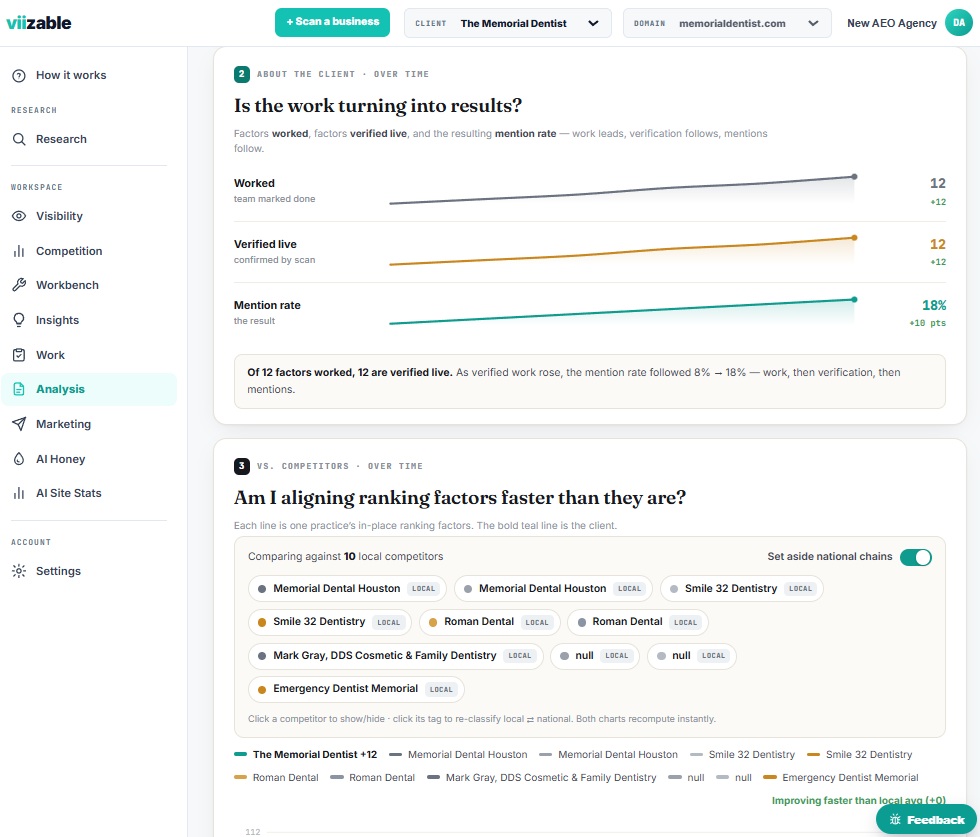
Our analytics are second to none. We provide dozens of reports for both the agency and the client, so there’s always that perfect report for the special situation. Our favorites are the trend reports that show, as you fix the foundational factors, the weekly scan picks them up, and the mentions follow a few weeks later. Lots of rising trend lines in the viizable system.
Since marketing is the backbone of any business—we built our agency clients a “marketing machine.” It uses our best technology to scan prospects’ domains and their competitors and compile the perfect comparisons, gap analyses, and proposals to win new clients. Bright, colorful, impactful—all branded with your agency logo and theme. Dozens of templates from social media, postcards, brochures, emails, PDFs…all showing your prospect why they need you. We’re still building, so bring your ideas and let’s make marketing fun again.
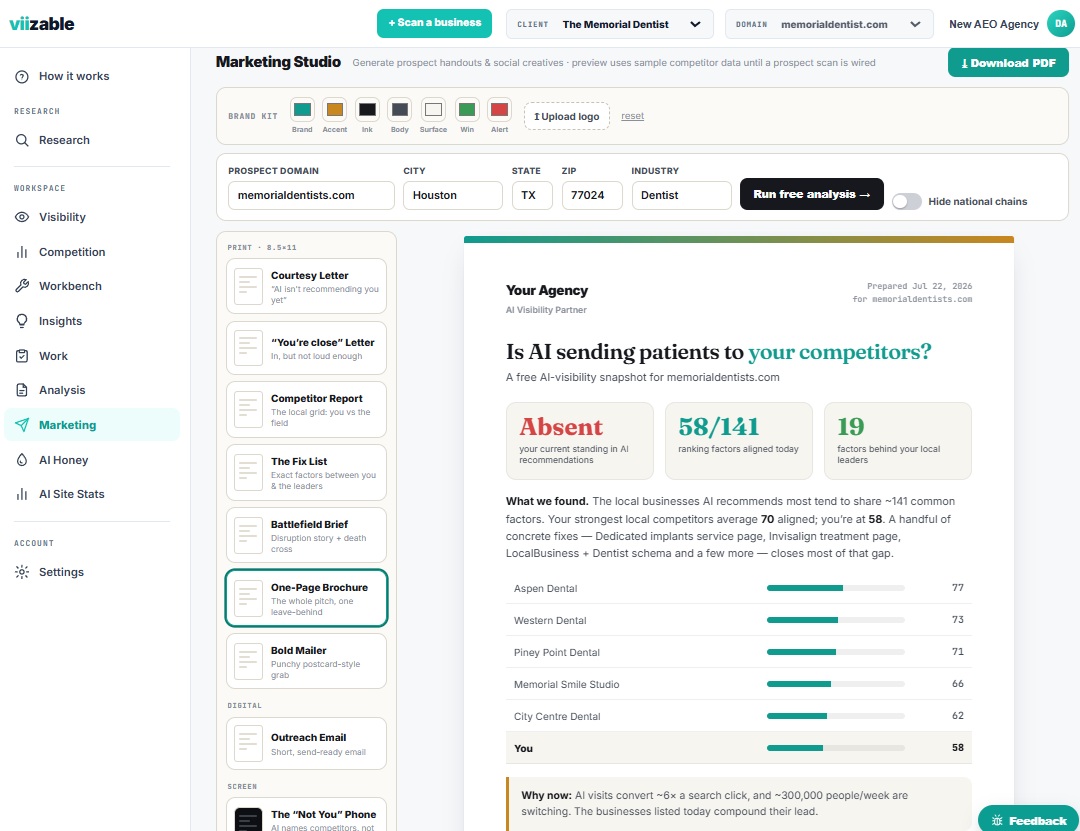
Everything is ‘push a button’ simple.
Final Thoughts About Ranking
Not sure the foundational factors matter? Still not sure what the key to ranking a business is? Whether you use any of the information in this book or not, these are the big rocks that can help you move your client into the rankings.
Focus on consistency. The business's name, phone, and owner have to match everywhere on the web — the site, the Google profile, the LinkedIn page, any old listing a past agency left behind. When they don't match, AI sees more than one "Joe" and can't tell which is the real business.
Focus on content. Right now Joe's site says "great service, honest prices," the same words as the shop next door. What Joe actually does is install glass-pack mufflers, carry one specific national tire brand, and work on old and rare cars other shops turn away — and none of that is on his site yet. Putting it there is the work, because specifics are what AI picks up.
Focus on community. Reviews are a big part of what AI weighs. Joe needs recent ones across more than one platform, like Google and Yelp, and the owner answering them — steady, answered reviews spread around do more than a pile of old ones on a single site.
Focus on corroboration. A claim on Joe's own site is stronger when something outside it agrees. If he says he's ASE-certified, the certifying body should show it; if he sponsors the local team or gets written up in the paper, that should be easy to find. A claim backed up somewhere else is worth far more than one that only lives on Joe's site. If possible, get publishers who write about Joe to link back to the mention on Joe's page.
Free Resources To Help Rank Your Client
I think if you got this far in the book, you know that tracking client domains and their competitors week after week across all the factors is nearly impossible. Even with AI you'd need to build at least one evaluator per factor and then find that data, hook up the collectors, and then build the reporting structure. But you don't have to because we did it for you. And because no one else built tools to attract or track AI, we made those as well.
Besides viizable.com, we built LLMSMaker.com, which is an extended LLMS that the AI engines say they love. And since no one had tracking to show us whether AI was even visiting our client sites, we built AISiteStats.com, a free tool that you snap into any site, and then you start to see the AI-based crawlers and bots and the pages they care about. With these three tools, you can leave the debates behind and start doing the things that can cement you as an expert in this new field.

Although we can’t give viizable away completely free, I do want anyone that is interested in trying it to bring a client domain and use it free—with no credit card, no sales pressure, and no obligation. I do want feedback, so if you’re willing to beat it to death, like we used to do in the testing lab, and tell us what to fix, we’d consider it a fair trade.
Email service@viizable.com to request access and we’ll set it up.
viizable
Need to see which factors are present for your client's domain? Need to see how the foundational factors for the 5 competitors around your client stack up? Just drop in your domain. In less than 5 minutes you are looking at a table with your client and five competitors, the delta marked for you. Every factor scanned and scored, in less time than it takes to cook a small bag of popcorn. Need to know what to do to fix each factor? The full resolution is right there. Need to assign the ‘fix the website title’ to a tech at the client, or to a contractor? That's built in. Need to track the factors you fixed this week? It does that. Need to see a chart showing the factors getting fixed each week and the client's mentions increasing as well? It does that. Want to scan a prospect's domain and send them a professional proposal that alerts them to the factors that need aligning, and how close they are to their competitors? It does that.
If you use viizable, the daunting task of checking the alignment of websites is as simple as pushing a button. Tracking the work and proving to your client that you're hustling is as simple as pushing a button. And marketing to prospects using dozens of branded templates, with deep analytical data yet simple to understand, is as easy as pushing a button.
Most AI-visibility tools stop at mentions and citations. They tell you where a client got named, which is worth knowing.
I spent almost a year analyzing data to determine what the top AI businesses had in place, and then built the tool to manage not only the content projects, but the rest of the stack. Grok just compared us to the leaders in the AEO/GEO/SEO transitioning tool providers, and named us the Top Tool For Ranking Local Businesses In AI.
LLMS Maker
There's a small file that is stirring up a lot of controversy that could turn out to be extremely valuable. The file is called llms.txt. It's a plain-text file you place at the root of your site. Jeremy Howard of Answer.AI proposed it in September 2024, and it's specified over at llmstxt.org. The idea is simple. You hand an AI a clean, plain-language guide to your most important content, so it doesn't have to piece your business back together from scattered HTML.
It got sold as a silver bullet. Publish llms.txt and the answer engines will find you. Then the skeptics showed up with data, and on the data, the skeptics are right.
Here's what they have, and it's fair. Google has said publicly that it doesn't use llms.txt and has no plans to. Independent studies have gone looking for a link between publishing one and getting cited by an AI, and they came up empty. And when you actually watch the crawl logs, which we do, the major answer engines almost never fetch the file at all. So on the plain question — does publishing a standard llms.txt get a local business recommended — the honest answer today is no.

But there's a wrinkle the skeptics undersell. llms.txt is real, and it is being adopted, just not for search. Where it has caught on is software. Technology companies publish one so that coding and documentation agents can read their docs cleanly, and for that job it works fine. That's the reason the local-business version fell flat. It was the right file aimed at the wrong job.
And that's the clue to the wrong question everyone was asking. The studies all measured the plain file — a name, a description, a list of links. Of course that carries no weight for a recommendation. It's just a business talking about itself in a tidier format, and self-description is the exact thing the models discount.
So we ran a different test.
We took one business, a restaurant, and built its llms.txt two different ways. The first was the standard version everyone publishes. The second was that same file rebuilt as a verifiable evidence manifest, with every claim paired to the independent source that confirms it. The license linked to the state board. The reviews pointed at the platforms that host them. The founding date matched to the public registry. The credentials tied to the bodies that issued them. Then we handed both versions to all five engines and asked each one what the file did for its confidence in the business.
The other four said the same thing about the corroborated file, in their own words.
The plain version got exactly what the skeptics predicted, a shrug that told the engine nothing about whether the business was real or good. The evidence-manifest version flipped every single one of them. The difference was the LLMS Maker format and data.
What that means is narrower than it sounds, and it's worth saying plainly. Five engines rewarding a corroborated file could mean the answer engines are ready to lean on a standard like this. But they're independent companies, each one racing to be the one people trust most, and whether any of them formally adopts a format is their call, not ours. What we can control is the input. And that's the whole of what we build: files and formats, generated from a business's own verifiable facts, that raise its corroborative value for the engines that do look. All of it without putting the business's existing organic search at risk. You're adding proof a machine can check, and you aren't gambling your Google ranking to do it.
So let me be exact about what makes the difference, because it isn't the file itself — it's how the file is built. Most tools that make an llms.txt hand you a flat list. Here's our name, here's what we do, here are a few links. Every line on it is something the business said about itself. It's a résumé, and you already know what a résumé is worth, because you've read a hundred of them.
The corroborated version is built the other way. Every claim gets broken into four parts: the value, the source it came from, whether it's been verified, and the link that proves it. "Founded 2009" stops being a sentence on a page and becomes a value — 2009 — tied to the Secretary of State's formation record, marked verified, with the government link sitting right there for the machine to confirm in a single hop. Do that across a whole business and you haven't written a summary. You've assembled something closer to a security-clearance application, where every line is checked against somebody other than you.
Set the two files side by side. The flat one says "licensed and insured," and the machine has nothing but your word for it. The built one says "license number C-48213, verified," with a link straight to the state board that confirms it, and the machine clicks once and knows. Same business, same spot on the same site. One is a résumé and one is a clearance.
A flat llms.txt is a résumé. A corroborated one is a security clearance.
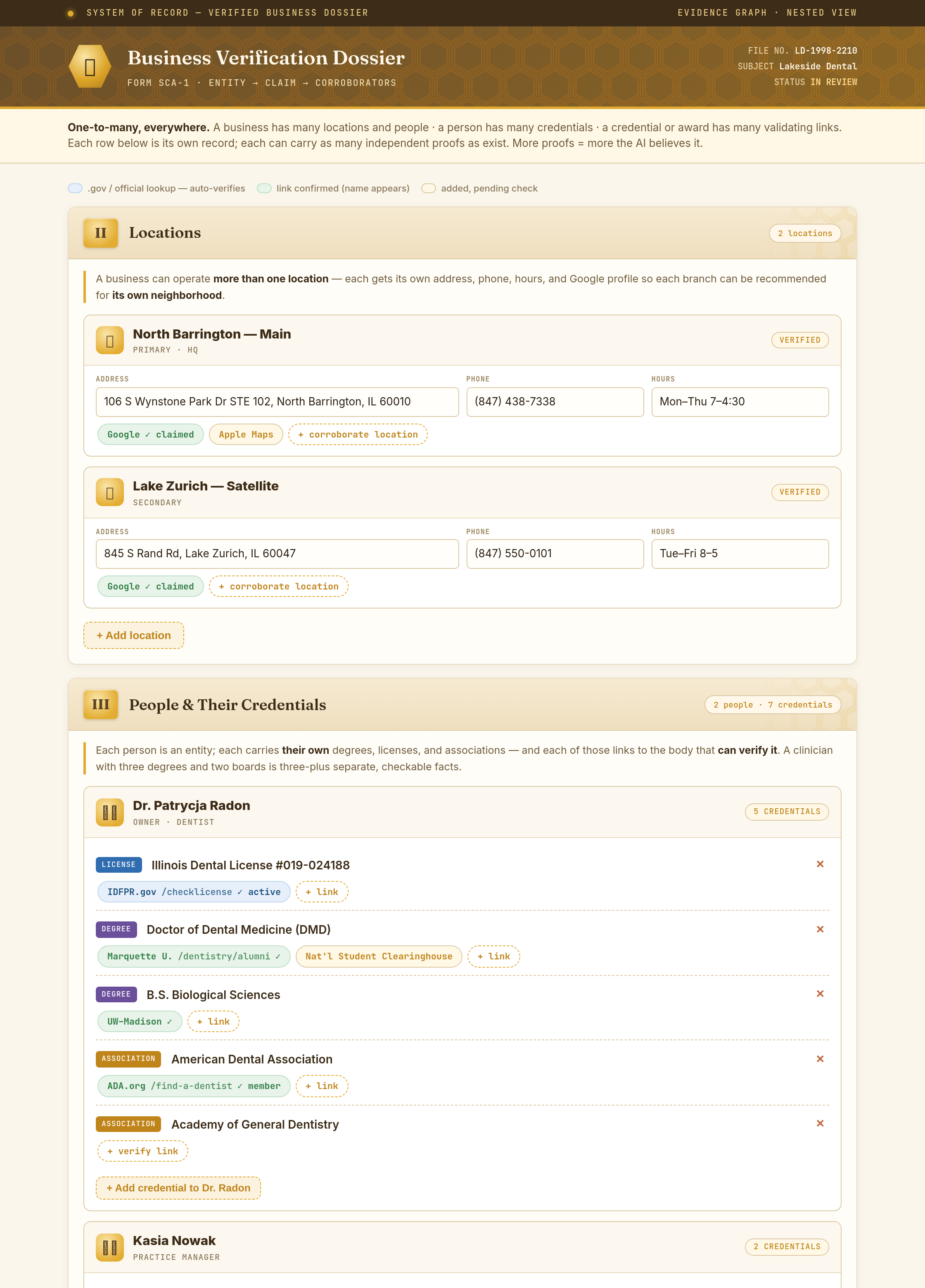
The best part of using LLMS Maker is that it uses our scanning engine to dig for data that other llms tools don't have. So it cuts your time in half and shows you clearly which factors you need to corroborate.
AI Site Stats
ChatGPT, Claude, Gemini, Perplexity and Grok read pages around the clock. AI Site Stats shows you which engine read which page, and how often. It installs as one line of code.
What earns it a place in a client meeting is the split it draws. In a raw server log every bot hit looks alike. AI Site Stats sorts them into two piles.
The first pile is the index crawlers. GPTBot, ClaudeBot, Google-Extended, PerplexityBot. Those are engines reading your pages to build up what they know about a business, on their own schedule, in the background. That work is how a business ends up inside the model at all, and it tells you nothing about today.
The second pile is the on-demand fetchers. ChatGPT-User, Perplexity-User, Claude-User. Those only fire when a person is sitting in a conversation at that moment and the engine goes out to read the page so it can answer them. That is a customer, mid-question, with your client's page open in front of a machine that is deciding what to say about them.
It's free, and it only takes 5 minutes to sign up, set up, and start tracking.
About the Author
J. Brent Tuttle has spent his career turning marketing into something you can measure. He grew up in El Campo, Texas, left college to run his father's insurance and real estate business, and then opened his own agency in Houston. Working from W. Edwards Deming's method — try something, measure the result, improve it, and try again — he grew that agency fast enough to be named the Fastest Growing Insurance Company in Houston.
In the early days of the web, he served as Director of Internet Marketing for a venture-backed startup, competing to rank its products back when Google was still running third behind Yahoo and AltaVista. Decades later he watched the same wide-open moment arrive with AI — and got to work.
He built the scanning engine and the study of nearly 30,000 businesses behind this book, along with the tools that put its findings to use: AIBusinessScore.com, where any owner can see where they stand, and viizable, the workbench built for the agencies and consultants doing the work. He wrote this book to hand that research to the people who can use it, while the window is still open.
You can find his work at aibusinessscore.com and viizable.com.
What the Categories Mean
This appendix walks the factor list, one category at a time. A few things to hold in mind as you read.
It's organized by weight, not by tradition. The categories and the factors are ordered by weight, which is our monthly read of how much each one actually counts. That's why the Google profile and reputation lead the list, and social trails, no matter how much attention the old SEO world paid to each. Every factor carries a weight from that monthly reweighting. Treat it as the current read, not a permanent constant, because the models shift and so do we.
Each category has the same shape.
- Why the category matters and where it ranks.
- What the engines themselves said about it, in their own words.
- How the average business actually scored, factor by factor, with the pass rate from the study.
- A close look at the factors that move the needle — what's available to the AI, why it matters, and how to fix it.
- And last, the rest of the category at a glance.
Every factor is entered in full in Appendix B.
| # | Category | What it covers | Factors |
|---|---|---|---|
| 1 | Local SEO & Google Business Profile Signals | Whether the Google Business Profile exists, is complete, and agrees with the site. The listing itself, its category, core fields, weekly hours, photo coverage, Google Posts, service area, map embed, and the name, address, and phone written on the site. | 11 |
| 2 | Reputation Signals | The review record read as a shape rather than a score. Volume, freshness, cadence, sentiment balance, rating distribution, owner responses, repeated complaints, what the business is known for, and any award stated where it can be read. | 11 |
| 3 | Business Identity Signals | The facts that establish a real, identifiable business. Name in the title, stated category, years in business, validated location, domain age, an email configured on the domain, an About page, named people and roles, and the legal entity. | 9 |
| 4 | AI Visibility | Whether the engines can reach the page and read it. Crawler permissions across the index bots and the on-demand fetchers, indexing and robots.txt rules, live-fetch speed, whether the content survives with JavaScript off, an llms.txt file, and the schema carrying the facts. | 22 |
| 5 | AI Corroboration | Whether independent sources confirm what the site claims. Name, phone, address, displayed rating, and posted hours matched against the Google profile. Recognition on Yelp, LinkedIn, the BBB, and Trustpilot. The license checked against the state source and the founding date against an offsite record. | 12 |
| 6 | Content Quality & Expertise Signals | What the site states about who it serves and what it knows. Target customer, declared specialization, language or population served, pricing transparency, case studies, testimonials, FAQ content, content recency and length, readability, and author schema. | 12 |
| 7 | Trust & Safety Signals | The published terms and the security underneath them. Privacy policy, terms of service, data handling, refund and cancellation policy, guarantee statement, third-party and payment seals, BBB and Trustpilot references, and the SSL certificate, security headers, and content-security policy. | 16 |
| 8 | Contact Prominence | Whether a customer can reach the business from the page. Email address, contact page, accessible form, clickable phone tags, visible physical address, posted operating hours, and calls to action. | 7 |
| 9 | SEO — Technical & On-Page | The familiar fundamentals, weighed against what the recommended businesses actually carry. Load speed and server response, title, meta, H1, canonical, and viewport tags, sitemap and robots.txt, redirects and errors, internal links, image optimization and alt text, responsive layout, page weight, and schema depth. | 26 |
| 10 | UX & Conversion Signals | What sits above the fold, whether booking or availability is offered, whether popups obstruct the page, and the range of calls to action. | 4 |
| 11 | Service Trust & Eligibility Signals | The vetting markers a service business carries. Services described, licensing and insurance stated on the site, the owner identified, contact options available, and local profile completeness. Applies mainly to the trades. | 6 |
| 12 | Social Presence Signals | The lightest-weighted category. Whether the site links its Facebook, Instagram, LinkedIn, YouTube, and Yelp profiles. | 5 |
| Total | 141 |
Local SEO & Google Business Profile Signals
Your Google Business Profile isn't a marketing nicety anymore. To AI, it's your birth certificate.
Why this category matters, and where it ranks
When someone asks an AI for "a good plumber near me," the machine has to do two things before it can answer: figure out which businesses are real and where they are, and then figure out which ones are near the person asking. The Google Business Profile (GBP) is the structured record it reaches for first. It's the canonical, machine-readable version of a business — category, hours, location, phone, photos, reviews — and the answer engines lean on it harder than on anything written on the site itself.
Here's the hard truth this category exposes: a business with no Google Business Profile is, to AI, very close to a business that doesn't exist. It can't be placed on a map, can't be matched to "near me," can't be recommended with confidence. And yet the average business passes only 34% of the checks here — often because the profile exists but is half-built, points at the wrong website, or says something different from the site it's supposed to match.
AI Opinion Of The Month
| AI engine | Importance rating | In its own words |
|---|---|---|
| Perplexity | 10 | Strongly affects local discovery and entity matching for location-based intent. |
| GPT-4o (OpenAI) | 8 | Key for ensuring local discoverability and relevance. |
| Grok (xAI) | 7 | Directly impacts local discoverability and matching to user queries. |
| Gemini (Google) | 7 | Indicates relevance and discoverability for local queries. |
| Claude (Anthropic) | 6 | Important for local discovery, though it leans harder on direct trust signals. |
Higher = weighs heavier in the recommendation decision. AI engines weigh in each month so we can see how closely they concur with our weighting formula. The formula is based on prominence factors present in actual top-ranked businesses since the last weighting period. While collectively they may agree, they usually vary wildly and thus we can't use them in weighting the factors.
What the average business actually scored
| Factor | Weight | % pass | |
|---|---|---|---|
| Active Google Business Profile | 2.0 | 48.9% | |
| NAP Elements Present On Site | 2.0 | 46.3% | |
| GBP Listing Present (domain-matched) | 1.9 | 23.0% | |
| GBP Category Aligns With Site Content | 1.7 | 27.2% | |
| Photo Coverage Strength | 1.5 | 24.6% | |
| GBP Core Profile Fields Complete | 1.3 | 46.6% | |
| GBP Core Listing Fields Present | 1.3 | 46.5% | |
| Contact Channel Readiness | 1.2 | 43.0% | |
| Map Embed Present | 1.0 | 29.6% | |
| Service Area Specificity | 1.0 | 5.9% |
Full entries for every factor are in Appendix B.
The factors that move the needle
Active Google Business Profile
- Test Criteria
- That a Google Business Profile exists, is matched to your domain, and carries the marks of an actively-managed listing: primary category, hours, photos, reviews, phone.
- Why it matters
- This is the single most important local signal in the index. Answer engines lean on GBP data first when recommending local businesses. No profile, or a sparse one, and the trust signal collapses even if you're a real, excellent business.
- How to fix it
- Claim your profile, fill every field, add photos, and keep it current. If you have no GBP at all, stop everything else and fix that first — it's the prerequisite for being recommended locally.
- Applies to
- Every local business with a physical location or service area.
NAP Elements Present On Site
- Test Criteria
- That your Name, Address, and Phone (NAP) all appear in your own site's content — the foundational identity record everything else is matched against.
- Why it matters
- NAP is the key AI and local-ranking systems use to tie your website, your GBP, and your directory listings into one entity. Miss any element and the matching weakens — and matching is the whole game in local.
- How to fix it
- Put complete, identical NAP in your site footer so it's on every page, and make sure it matches your GBP and directories character-for-character. (Consistency is so important it gets its own category — see AI Corroboration.)
- Applies to
- Every local business.
GBP Listing Present & Domain-Matched
- Test Criteria
- Whether a GBP record is found in Google's Maps data and whether the website on that profile is this exact domain.
- Why it matters
- A profile that points to the wrong website — or to no website — can't pass its reviews, category, and authority to your site. Only 23% of businesses clear this, which means most are leaving their profile's trust stranded.
- How to fix it
- Open your GBP, check the website field, and make sure it's your real, current domain (not an old one, not a Facebook page, not blank). It's a two-minute fix that three out of four businesses haven't made.
- Applies to
- Every local business.
GBP Category Aligns With Site Content
- Test Criteria
- Whether the words in your GBP primary category actually show up in your website's text. If your profile says "Italian Restaurant" but your site never says it, that's a conflict.
- Why it matters
- When the structured record and the crawled content disagree, the business's category is unclear, and in our data these businesses fade from category-driven queries.
- How to fix it
- Make your homepage say plainly what your GBP category says you are. Align the language; don't make AI reconcile two different stories.
- Applies to
- Every local business.
Service Area Specificity
- Test Criteria
- Whether you name specific neighborhoods, suburbs, zip codes, or a defined radius — versus a vague "serving the greater metro area."
- Why it matters
- Specific geography is what ties a business to this caller in this neighborhood. 94% of businesses stay generic and lose the close-proximity match to whoever got specific.
- How to fix it
- List the actual areas you serve by name. A "Service Areas" section with real place names is a cheap, almost-uncontested win.
- Applies to
- Every local business, especially service-area trades that travel to the customer.
The rest of this category, at a glance
| Factor | Weight | % pass | What it checks (full entry in Appendix B) |
|---|---|---|---|
| Photo Coverage Strength | 1.5 | 24.6% | Fresh, sufficient photo coverage on the profile — an engagement and credibility signal. |
| GBP Core Profile Fields Complete | 1.3 | 46.6% | Description, phone, address, and category all populated. |
| GBP Core Listing Fields Present | 1.3 | 46.5% | Hours, phone, address, category, and at least one photo. |
| Contact Channel Readiness | 1.2 | 43.0% | Multiple ways to reach you — phone, booking link, messaging. |
| Map Embed Present | 1.0 | 29.6% | An embedded map that reinforces your location to AI and visitors. |
Deal-breakers
- No Google Business Profile.
- A GBP website field that is empty or points at a different domain.
- A GBP category that does not match what the site says the business does.
Note: While we query AI engines for the weight that they may put on certain factors or categories of factors, we reweight based on actual prominence data from our scanning and evaluations of top recommended businesses. Figures as of June 2026.
Reputation Signals
What customers say about you — and whether AI can find it said in more than one place.
Why this category matters, and where it ranks
Prominence is very high in this category, and although we don't use the AI engines to weigh the factors, we do want to see if they corroborate our data. When we asked GPT, Gemini, Grok, Perplexity, and Claude, in their own words, what moves their decision to recommend a local business, reputation came back first or second on every single engine.
Here's the catch, and it's the whole point of this chapter: this is the category local businesses fail the hardest. Across the businesses we scanned, the average one passes only about 28% of the reputation checks. The signal AI trusts most is the signal most businesses are weakest on. That's not bad news — that's the opening.
AI Opinion Of The Month
| AI engine | Importance rating | In its own words |
|---|---|---|
| Claude (Anthropic) | 14 | Strongest signal of actual customer satisfaction. |
| Grok (xAI) | 13 | Strong evidence of reliability and satisfaction. |
| Gemini (Google) | 12 | Directly reflects satisfaction and builds trust. |
| Perplexity | 12 | Volume, freshness, sentiment = core trust inputs. |
| GPT-4o (OpenAI) | 10 | Heavily influences consumer trust and ranking. |
AI engines weigh in each month so we can see how closely they concur with our weighting formula. The formula is based on prominence factors present in actual top-ranked businesses since the last weighting period. While collectively they may agree, they usually vary wildly and thus we can't use them in weighting the factors.
What the average business actually scored
Below is every reputation factor we measure, sorted by how heavily it weighs, with the share of real businesses that pass it. Read the right-hand column as a map of where the money is: the lower the pass rate on a high-weight factor, the bigger the opportunity sitting untouched.
| Factor | Weight | % that pass | |
|---|---|---|---|
| Review Volume & Recency | 2.0 | 40.6% | |
| Review Volume Strength | 1.8 | 44.0% | |
| Negative-Review Pattern | 1.8 | 36.8% | |
| Review Freshness | 1.7 | 40.7% | |
| Review Sentiment Balance | 1.6 | 45.1% | |
| Rating Distribution Health | 1.5 | 41.3% | |
| Multi-Platform Review Presence | 1.5 | 14.0% | |
| Directory Citation Presence | 1.5 | 6.0% | |
| Responsiveness to Reviews | 1.4 | 0.8% | |
| Review Distribution Across Platforms | 1.3 | 4.8% | |
| GBP Photos & Reviews Present | 1.2 | 34.3% |
Every factor in this category — and the other eleven categories — is listed in full in Appendix B.
The factors that move the needle
Review Volume & Recency
- Test Criteria
- Not just that you have reviews — whether you have reviews in the last 90 days. A business with 200 reviews and nothing since 2023 is a yellow flag. Recency is a heartbeat.
- Why it matters
- To an AI, a stale review pile reads as a business that might be closed, coasting, or declining. Recent reviews prove customers are still walking through the door this month.
- How to fix it
- Ask satisfied customers for a Google review within a week of service, while it's fresh. Text or email them your direct review link (Google Business Profile → "Ask for reviews"). Aim for a steady drip, not a one-time blitz.
- Applies to
- Every local business. No exceptions.
Review Volume Strength
- Test Criteria
- Whether you have enough reviews to clear the bar for authority in your category. Thin volume reads as low trust and low relevance.
- Why it matters
- Recommendation systems weigh quantity heavily when they pick which businesses to name. Ten reviews lose to fifty almost every time, all else equal.
- How to fix it
- Build a habit: ask every happy customer, every time, with a direct link. Two to three new reviews a month compounds fast and clears the volume threshold within a quarter or two.
- Applies to
- Every local business.
Negative-Review Pattern Recognition
- Test Criteria
- Clusters of low-rated reviews complaining about the same thing — wait times, billing, quality. A pattern carries far more weight than one angry one-off.
- Why it matters
- One bad review is noise. Five saying the same thing is a signal, and AI treats it as a reliability problem it should steer customers away from.
- How to fix it
- Find the repeated complaint and fix the operation behind it — don't just argue with the reviews. Respond professionally, show what you changed, and let fresh positive reviews dilute the old cluster over time.
- Applies to
- Every local business; sharpest impact on service trades and anything appointment-based.
Review Freshness Indicators
- Test Criteria
- The ongoing cadence of reviews as a proxy for whether the business is active and currently serving customers.
- Why it matters
- Freshness is how an AI tells the living from the dormant. A flat line says "maybe gone." A steady pulse says "open and busy."
- How to fix it
- Automate it. Set a follow-up text or email to fire 1–2 days after every completed job asking for a review. One to two new reviews a month is enough to keep the pulse reading "alive."
- Applies to
- Every local business.
Responsiveness to Reviews
- Test Criteria
- Whether the owner replies to reviews — both the good and the bad.
- Why it matters
- Responsiveness reads as professionalism and service integrity. And here's the kicker: fewer than one business in a hundred does it. This is the rarest pass in the entire category, which makes it the cheapest way on earth to look better than 99% of your competition.
- How to fix it
- Reply to every review within 24–48 hours. Thank positive reviewers by name and mention the specific service. For negative ones, apologize, own it, and move the resolution to a phone call. That's it. There is no faster win in this book.
- Applies to
- Every local business.
The corroboration pair — where Reputation overlaps the new AI rules
Two reputation factors aren't really about reviews at all. They're about whether your reputation exists in more than one place — and they're the two almost nobody passes.
Multi-Platform Review Presence
- Test Criteria
- Whether you have reviews on Google, Yelp, Facebook or other review sites.
- Why it matters
- Reputation on a single platform can be gamed. The same reputation echoed across independent sources can't, easily — so AI trusts it more. Breadth is corroboration.
- How to fix it
- Stand up profiles on Yelp, Facebook, BBB, and the directories that matter in your trade (Angi, Houzz, Avvo, Healthgrades), then ask for reviews there too. Consistency across sources says "real," not "manufactured."
- Applies to
- Every local business; platform mix varies by industry.
Directory Citation Presence
- Test Criteria
- Whether trusted directories — Angi, HomeAdvisor, Thumbtack, the Chamber of Commerce, industry-specific lists — point to your business.
- Why it matters
- Inbound references from sources AI already trusts transfer some of that trust to you. It's the offsite half of reputation, and 94% of businesses are invisible here.
- How to fix it
- List on the major directories and the ones specific to your field, and make your name, address, and phone identical on every one. Mismatched listings cancel the benefit.
- Applies to
- Every local business; the specific directories depend on industry.
The rest of this category, at a glance
| Factor | Weight | % pass | What it checks (full entry in Appendix B) |
|---|---|---|---|
| Review Sentiment Balance | 1.6 | 45.1% | Whether tone skews positive, even when the star average looks fine. |
| Rating Distribution Health | 1.5 | 41.3% | At least 60% five-star, no more than 10% one-star — shape beats the raw average. |
| Review Distribution Across Platforms | 1.3 | 4.8% | Volume plus breadth across listings; concentrated-on-one-platform reads as narrow. |
| GBP Photos & Reviews Present | 1.2 | 34.3% | Profile carries both customer photos and reviews — harder-to-fake authenticity. |
Deal-breakers
- A cluster of recent one-star reviews sharing a common complaint.
- No reviews, or none in over a year.
- Reviews on a single platform, with nothing to corroborate them.
Note: While we query AI engines for the weight that they may put on certain factors or categories of factors, we reweight based on actual prominence data from our scanning and evaluations of top recommended businesses. Figures as of June 2026.
Business Identity Signals
Being recognized as a legitimate business is a key foundational factor.
Why this category matters, and where it ranks
This is the front door. Every other category in this book assumes one thing: that the AI already accepts you exist and are who you say you are. Identity is where that gets settled. It's the third-highest-weighted category across the engines we test, and it's the one that gates everything else — a brilliant review profile does you no good if the AI can't confirm there's a real, locatable, named business attached to it.
Here's the gut-punch: the average local business passes only 35% of the identity checks. Not because owners are hiding — because the basics live in their heads, on a business card, on their Google profile, anywhere except in plain, crawlable text on their own website. AI can't read your mind or your intentions. It reads your page. If the page doesn't say it, to the machine it isn't true.
AI Opinion Of The Month
We put the question to every engine on a rolling basis, and identity came back as a baseline requirement on all of them — the thing that has to be true before anything else counts. Below is the current read.
| AI engine | Importance rating | In its own words |
|---|---|---|
| Perplexity | 12 | AI needs to know the business is a real entity before any recommendation is credible. |
| Grok (xAI) | 10 | Confirms the business is legitimate and consistently represented. |
| GPT-4o (OpenAI) | 10 | Crucial for verifying legitimacy and consistency across platforms. |
| Claude (Anthropic) | 10 | Essential foundation for verifying a business exists and is legitimate. |
| Gemini (Google) | 8 | A baseline requirement for any recommendation. |
AI engines weigh in each month so we can see how closely they concur with our weighting formula. The formula is based on prominence factors present in actual top-ranked businesses since the last weighting period. While collectively they may agree, they usually vary wildly and thus we can't use them in weighting the factors.
What the average business actually scored
Every identity factor we measure, sorted by weight, with the share of real businesses that pass. The low numbers on high-weight rows are the opportunities.
| Factor | Weight | % pass | |
|---|---|---|---|
| Phone Number Present On Site | 1.6 | 49.5% | |
| Business Email Configured (domain MX) | 1.6 | 49.1% | |
| Title Tag Present | 1.5 | 50.4% | |
| Location Validation Strength | 1.5 | 44.7% | |
| Domain Age Verification | 1.5 | 2.7% | |
| Business Credential Summary | 1.4 | 25.2% | |
| About Page Present | 1.4 | 61.6% | |
| Physical Address Present On Site | 1.3 | 47.0% | |
| Business Category Clarity | 1.3 | 16.4% | |
| Contact Page Present | 1.3 | 35.5% | |
| Legal Entity Type Disclosed | 1.3 | 33.9% | |
| Content Section Headings | 1.2 | 44.1% | |
| Homepage Content Length | 1.2 | 42.7% | |
| Local or Family Ownership Signal | 1.2 | 20.4% | |
| Operating Hours On Site | 1.1 | 44.6% | |
| Named Personnel Present | 1.0 | 49.3% | |
| Years In Business Signal | 0.8 | 4.8% | |
| Insurance Signal On Site | 0.5 | 27.6% | |
| Licensing Signal On Site | 0.5 | 15.4% |
Every factor is listed in full in Appendix B.
The factors that move the needle
Phone Number Present On Site
- Test Criteria
- That at least one phone number appears in the actual page content — not in an image, not in a script, in readable text.
- Why it matters
- A reachable phone number is a core legitimacy and contactability signal. When it is missing from the content, the business reads as less reachable and less established, and in our data these businesses fall behind on high-intent local queries.
- How to fix it
- Put your phone number in plain text in the header and footer of every page so it's site-wide. Don't bury it in a graphic. If you serve by appointment, it still belongs on the page.
- Applies to
- Every local business.
Business Email Configured (domain MX records)
- Test Criteria
- Whether your domain has live mail (MX) records — meaning you run email at your own domain (you@yourbusiness.com) instead of a free Gmail or Yahoo inbox.
- Why it matters
- Domain-based email is a baseline "this is a real, operating company" signal. A domain with no mail infrastructure looks dormant or thin — a parked shell rather than a going concern.
- How to fix it
- Set up email on your own domain (Google Workspace or Microsoft 365 take an afternoon) and use it publicly. This is one of the few identity factors that's invisible on the page but checkable under the hood — and half of businesses fail it.
- Applies to
- Every local business.
Title Tag Present
- Test Criteria
- That your homepage has a real HTML title tag with actual text in it — the single most-read line when any crawler first characterizes your site.
- Why it matters
- The title is your primary declared identifier. No title tag means AI has to guess who you are from scraps, which weakens how it resolves you as an entity across systems. Half of businesses leave it blank or default.
- How to fix it
- Write a clear title in the format Business Name — Primary Service in City. Specific, human-readable, no keyword salad.
- Applies to
- Every local business.
Domain Age Verification
- Test Criteria
- How long your domain has been registered, via WHOIS/RDAP lookup. A domain that's been around 10+ years carries far more trust than one registered three months ago.
- Why it matters
- Age is hard to fake, which is exactly why AI leans on it. A brand-new domain is the single most common shape of a scam or a fly-by-night, so a fresh registration gets discounted until other signals prove otherwise.
- How to fix it
- Honest answer: you can't buy time. The fix is to never let your domain lapse — losing it resets the clock — and, if you're new, to over-deliver on every other identity and corroboration signal so age isn't the only thing AI has to go on. If you're rebranding, keep the old domain registered and redirect it rather than abandoning its history.
- Applies to
- Every local business. (A near-universal fail — don't panic; treat it as a reason to win the factors you can control.)
Business Credential Summary
- Test Criteria
- Whether your site gathers its legitimacy signals in one place — licensing or certification language, insurance or bonding, years in operation, awards, named ownership, an About page.
- Why it matters
- Answer engines weight corroborated credentials heavily when choosing which provider to trust. A site that pulls these together reads as a real, established business; a site that scatters them or omits them reads as a thin shell.
- How to fix it
- Build one clear "Why us / credentials" block — licensed and insured, in business since [year], owner-led by [name], [award] winner — and link each claim to proof wherever you can (the corroboration layer in this book covers how).
- Applies to
- Every local business; sharpest for licensed trades and health/finance/legal.
Business Category Clarity
- Test Criteria
- Whether your site communicates one clear primary category that matches your Google Business Profile — not three different descriptions of what you do.
- Why it matters
- "Best [category] near me" queries go to businesses whose category is unambiguous and consistent across sources. A vague or conflicting category, "we do a little of everything," drops a business out of category-driven results, and 84% of businesses muddy this.
- How to fix it
- Pick your one primary category, lead with it in your title and homepage copy, and make sure it matches the category set on your Google profile word-for-word in spirit. Specialties can be secondary; the primary must be crisp.
- Applies to
- Every local business.
The rest of this category, at a glance
| Factor | Weight | % pass | What it checks (full entry in Appendix B) |
|---|---|---|---|
| Location Validation Strength | 1.5 | 44.7% | Structured, consistent physical-location signals that confirm where you operate. |
| About Page Present | 1.4 | 61.6% | A reachable About page — where AI and humans learn who you are. |
| Physical Address Present | 1.3 | 47.0% | A street address in readable page text to anchor local relevance. |
| Contact Page Present | 1.3 | 35.5% | A contact page at a standard path that actually resolves. |
| Legal Entity Type Disclosed | 1.3 | 33.9% | LLC / Inc. / Corp. markers that signal a properly formed business. |
| Content Section Headings | 1.2 | 44.1% | Enough H2/H3 structure for AI to segment and extract your services. |
| Homepage Content Length | 1.2 | 42.7% | At least ~300 words so engines have substance to work with. |
| Local or Family Ownership Signal | 1.2 | 20.4% | Family-/locally-/veteran-owned cues for "support local" intent. |
| Operating Hours On Site | 1.1 | 44.6% | Published hours so AI can answer "open now" queries. |
| Named Personnel Present | 1.0 | 49.3% | Real human names — owner, staff, team — versus a faceless shell. |
| Years In Business Signal | 0.8 | 4.8% | An explicit tenure/experience claim ("serving since 2004"). |
| Insurance Signal On Site | 0.5 | 27.6% | Insured/bonded language — a trust cue for service trades. |
| Licensing Signal On Site | 0.5 | 15.4% | License/certification language for regulated categories. |
Deal-breakers
- No phone and no address in readable text.
- A blank or default title tag.
- A stated category that contradicts the Google profile.
- No named people, no About page, and a free-inbox email on a young domain.
Note: While we query AI engines for the weight that they may put on certain factors or categories of factors, we reweight based on actual prominence data from our scanning and evaluations of top recommended businesses. Figures as of June 2026.
AI Visibility
It doesn't matter how good your business looks to a human if the AI can't read the page at all. This is the category that barely existed two years ago.
Why this category matters, and where it ranks
Every other category assumes the AI can see your website. This one checks whether that's actually true. And the answer, for a surprising number of modern sites, is no — because the slick JavaScript framework that makes the site feel fast in a browser hands an empty shell to the AI crawlers that don't run JavaScript. The business is invisible at the exact layer where the recommendation happens.
This is the youngest category in the index — half its factors didn't exist as ranking concerns two years ago — and it's the fourth-heaviest by weight. It also contains the single highest-weighted factor in the entire book: whether your content is readable without JavaScript. Most sites pass this category overall (the average is 76.5%, second-highest), largely because you'd have to actively block crawlers to fail the access checks. But the few sites that fail the big factors fail catastrophically: they're not ranked low, they're absent.
AI Opinion Of The Month
| AI engine | Importance rating | In its own words |
|---|---|---|
| Grok (xAI) | 12 | Fundamental requirement for AI to access and process business information. |
| Gemini (Google) | 10 | If AI can't access the info, it can't evaluate or recommend you. |
| Perplexity | 10 | If crawlers can't access the site, the business may not be eligible at all. |
| Claude (Anthropic) | 9 | If AI can't parse your info, the business effectively doesn't exist for AI. |
| GPT-4o (OpenAI) | 8 | Critical for ensuring AI can access and interpret content. |
Notice the language — "doesn't exist," "not eligible at all." This is a gate, not a dial. AI engines weigh in each month so we can see how closely they concur with our weighting formula. The formula is based on prominence factors present in actual top-ranked businesses since the last weighting period. While collectively they may agree, they usually vary wildly and thus we can't use them in weighting the factors.
What the average business actually scored
| Factor | Weight | % pass | |
|---|---|---|---|
| Content Visible Without JavaScript | 2.5 | 83.8% | |
| Server Response Speed (for live fetch) | 2.0 | 88.5% | |
| Crawler Access Allowed | 1.8 | 98.8% | |
| Open Graph Tags Present | 1.8 | 35.9% | |
| Indexing Allowed (no noindex) | 1.7 | 99.6% | |
| LocalBusiness Schema Present | 1.4 | 30.5% | |
| Structured Data Completeness | 1.4 | 22.3% | |
| Service or Product Schema | 1.2 | 3.2% | |
| llms.txt File Present | 1.0 | 4.0% | |
| AI crawler allow-list (8 bots: GPTBot, ClaudeBot, PerplexityBot, Google-Extended, …) | 1.0 | ~99% |
The individual AI-crawler permission checks (GPTBot, OAI-SearchBot, ChatGPT-User, Google-Extended, PerplexityBot, Perplexity-User, ClaudeBot, Claude-User/SearchBot) each pass ~99–100% and are collapsed into one row here; they're listed individually in Appendix B.
The factors that move the needle
Content Visible Without JavaScript
- Test Criteria
- Whether your content is present in the raw HTML the server sends, or only appears after JavaScript runs in a browser.
- Why it matters
- Most AI crawlers run little or no JavaScript. A client-side-rendered site (many React/Vue/SPA builds, some page builders) returns a near-empty shell to them. No matter how beautiful it looks to a human, the AI sees nothing to read, evaluate, or cite. This is why it's the single most heavily-weighted factor in the book — get it wrong and every other signal you worked on is invisible.
- How to fix it
- Serve your core content (who you are, what you do, where, your services) in the server HTML — via server-side rendering, static generation, or a builder that outputs real HTML. Test it: disable JavaScript in your browser and reload. If the page goes blank, AI sees blank.
- Applies to
- Every business, but especially anyone on a modern single-page-app framework.
Server Response Speed (for live fetch)
- Test Criteria
- How fast your server returns the page (time to first byte). This is the speed an AI crawler actually experiences — not the visual paint metrics a human notices.
- Why it matters
- When an AI assistant fetches your page live to answer someone's question, it has a tight timeout budget. A slow server gets skipped mid-conversation, and you lose the recommendation you'd otherwise have won.
- How to fix it
- Get time-to-first-byte under a second: decent hosting, caching, a CDN. This is infrastructure, not design — and it pays off across the SEO category too.
- Applies to
- Every business.
Open Graph Tags Present
- Test Criteria
- That your pages carry og:title and og:description meta tags — the ones that control how a link renders when shared and give AI a clean title-and-description signal.
- Why it matters
- Missing OG tags produce broken previews and remove a reinforcing signal AI reads when characterizing your page. Two-thirds of businesses skip them.
- How to fix it
- Add og:title and og:description (and an og:image) to your pages. Most SEO plugins do it in a checkbox.
- Applies to
- Every business.
LocalBusiness Schema & Structured Data
- Test Criteria
- Whether your page includes LocalBusiness/Organization structured data (JSON-LD) that spells out your name, address, phone, hours, and category in machine-readable form — and whether it's complete.
- Why it matters
- Schema hands AI an explicit, unambiguous definition of your business instead of forcing it to infer everything from prose. Without it, the entity anchor is weaker and you're cited less confidently.
- How to fix it
- Add a LocalBusiness JSON-LD block with name, address, phone, hours, and category populated. Generate it once, drop it in the page head.
- Applies to
- Every local business.
Service or Product Schema
- Test Criteria
- Whether your specific offerings are marked up as Service/Product/Offer structured data, rather than buried in paragraph text.
- Why it matters
- Machine-readable offerings let AI match a specific query ("who does tankless water heater repair") to you with confidence. Almost nobody does this — fewer than 1 in 25 — so it's a near-empty field for anyone willing to claim it.
- How to fix it
- Add Service or Offer schema listing your actual services. Pair it with the specific service descriptions covered in the Content chapter.
- Applies to
- Every local business; biggest payoff for multi-service trades.
The access layer
The remaining factors are the AI-crawler permission checks: whether your robots.txt lets in GPTBot, OAI-SearchBot, ChatGPT-User, Google-Extended, PerplexityBot, Perplexity-User, ClaudeBot, Claude-User, and Claude-SearchBot, plus the general "crawler access allowed" and "indexing allowed" gates. Nearly everyone passes these (~99%) because you have to actively block a bot to fail — but when a site does fail, it's usually an accident (a developer's leftover Disallow, a staging noindex that shipped to production) that quietly erases the business from one or more AI engines. Plus the emerging llms.txt file (4% adoption), a forward-looking signal that you're paying attention to AI discoverability.
| Factor | Weight | % pass | What it checks (full entry in Appendix B) |
|---|---|---|---|
| Crawler Access Allowed | 1.8 | 98.8% | robots.txt doesn't blanket-block all crawlers. |
| Indexing Allowed | 1.7 | 99.6% | No noindex directive hiding the homepage from engines. |
| 8 named AI-bot permissions | 1.0 ea | ~99% | GPTBot, ClaudeBot, PerplexityBot, Google-Extended, and the on-demand fetch agents are each allowed. |
| llms.txt File Present | 1.0 | 4.0% | An /llms.txt file signalling AI-discoverability awareness. |
Deal-breakers
- A JavaScript-only site that renders blank without JavaScript.
- A noindex tag or Disallow: / in production.
- A server slow enough that live fetches time out before the page returns.
- GPTBot, ClaudeBot or PerplexityBot blocked in robots.txt.
Note: While we query AI engines for the weight that they may put on certain factors or categories of factors, we reweight based on actual prominence data from our scanning and evaluations of top recommended businesses. Figures as of June 2026.
AI Corroboration
Anyone can claim anything on their own website. This category checks whether the rest of the internet agrees.
Why this category matters, and where it ranks
Here's the shift that breaks the old SEO playbook. For twenty years, optimization was mostly about what you put on your own site. But an AI that's about to recommend you to a real person has a problem the old search engines didn't worry about as much: it can hallucinate, and it can be lied to. In the businesses that get recommended, the claims are corroborated. Does the claim of a medical degree resolve to the issuing school or a professional association? Does the address on three directories agree? Does the license resolve to a state board record? On the businesses that rank, the answer is yes.
Corroboration is a high-impact category that's easy to fix, where the average business actually scores relatively low at 48% pass.
AI Opinion Of The Month
| AI engine | Importance rating | In its own words |
|---|---|---|
| Gemini (Google) | 23 * | The ultimate validation — the most critical factor for a confident recommendation. |
| Claude (Anthropic) | 12 | Independent corroboration is the ultimate validation that claims are accurate. |
| Grok (xAI) | 11 | Validates claims across independent sources, preventing misinformation. |
| Perplexity | 10 | Cross-source consistency reduces the risk of hallucinated or untrustworthy claims. |
| GPT-4o (OpenAI) | 5 | Ensures claims are verified by independent sources, enhancing credibility. |
* Gemini rated this category far above the normal range — an unusually emphatic signal. Even setting that outlier aside, the remaining engines place corroboration in the top tier. AI engines weigh in each month so we can see how closely they concur with our weighting formula. The formula is based on prominence factors present in actual top-ranked businesses since the last weighting period. While collectively they may agree, they usually vary wildly and thus we can't use them in weighting the factors.
What the average business actually scored
| Factor | Weight | % pass | |
|---|---|---|---|
| Phone Consistent Across Sources | 1.8 | 38.2% | |
| Address Consistent Across Sources | 1.8 | 49.7% | |
| GBP Links This Domain | 1.5 | 77.7% | |
| Business Name Consistent Across Sources | 1.5 | 71.3% | |
| Directory Citations Match the Profile | 1.5 | 45.2% | |
| License Verified Against State Source | 1.5 | 6.4% |
Full entries in Appendix B.
The factors that move the needle
Phone Consistent Across Sources
- Test Criteria
- Whether the phone number on your website matches the one on your Google Business Profile (compared on the final ten digits).
- Why it matters
- A divergent phone number is one of the most common NAP inconsistencies: a tracking number in one place, an old number in another, until the business's contact details stop agreeing with each other. A mismatch like that can read as a duplicate or unreliable listing.
- How to fix it
- Pick one canonical phone number and make it identical on your site, your GBP, and every directory. If you use call-tracking numbers, make sure the same primary number is the one of record everywhere.
- Applies to
- Every local business.
Address Consistent Across Sources
- Test Criteria
- Whether the street number and street name on your site align with your Google Business Profile address.
- Why it matters
- Address mismatch breaks the geo-routing AI depends on for "near me" queries. If the sources disagree on where you are, AI can't confidently place you near anyone.
- How to fix it
- Write the address one way — including suite format and abbreviations — and use that exact form everywhere. "Ste 200" vs "Suite 200" vs "#200" can be enough to break the match.
- Applies to
- Every local business with a physical address.
Directory Citations Match the Profile
- Test Criteria
- What share of your directory listings carry the same phone as your canonical Google profile.
- Why it matters
- Citation consistency is the top trust multiplier in this category. Broad agreement across directories signals a real, stable business; scattered numbers signal an unmaintained or duplicated presence — exactly the pattern AI is built to distrust.
- How to fix it
- Audit every directory listing and correct the ones with old or wrong numbers. This is tedious, high-value work — and it's the bridge into the action layer (Category 13).
- Applies to
- Every local business.
License Verified Against State Source
- Test Criteria
- Whether your site has an outbound link that resolves to a state or government license-verification page — bonus credit when that page names your business.
- Why it matters
- A link to a government record is worth far more than the unverifiable word "licensed" on a page. It converts a claim into a fact AI can follow and confirm. Only 6.4% of businesses do it, which makes it a high-bar, rare-but-real trust signal — and a genuine differentiator for licensed trades.
- How to fix it
- Find your license on the issuing state board's public lookup, and link your license number directly to that record. (Category 13 makes this its own action item — it's that valuable.)
- Applies to
- Licensed trades and regulated professions.
The rest of this category, at a glance
| Factor | Weight | % pass | What it checks (full entry in Appendix B) |
|---|---|---|---|
| GBP Links This Domain | 1.5 | 77.7% | The website on your Google profile is this exact domain, so its authority flows to you. |
| Business Name Consistent | 1.5 | 71.3% | Your name matches between site and GBP (tolerating legal suffixes), so AI unifies you into one record. |
Deal-breakers
- A phone or address that disagrees across the site, external review sites, public records or licensing authorities.
- Credentials claimed on the site that resolve to no public record.
- Independent directory listings carrying old numbers or stale addresses.
Note: While we query AI engines for the weight that they may put on certain factors or categories of factors, we reweight based on actual prominence data from our scanning and evaluations of top recommended businesses. Figures as of June 2026.
Content Quality & Expertise Signals
AI recommends the business that can prove it knows what it's doing. Most sites only claim it.
Why this category matters, and where it ranks
When an AI weighs two plumbers, it's not just checking that they exist and have reviews — it's reading their content to judge which one actually knows the work. Specific service descriptions, real expertise language, current information, evidence of completed jobs: these are how a machine distinguishes a genuine specialist from a generic template that says "we do plumbing." It's the fifth-heaviest category by weight, and every engine ranks it highly because content is where competence becomes legible.
The average business passes 41% — but the breakdown is brutal and full of opportunity. Sites pass the easy structural checks (a non-stuffed title, a stated specialization) at high rates, and fail the prove-it checks almost completely: current content, specific service detail, first-person expertise, pricing, case studies.
AI Opinion Of The Month
| AI engine | Importance rating | In its own words |
|---|---|---|
| Claude (Anthropic) | 11 | Indicates whether a business can competently serve user needs. |
| GPT-4o (OpenAI) | 10 | Fundamental for establishing authority and relevance. |
| Gemini (Google) | 9 | Lets AI understand offerings and match them to user needs. |
| Perplexity | 8 | AI favors content that demonstrates authority and real domain knowledge. |
| Grok (xAI) | 7 | Demonstrates expertise that helps AI match you to specific needs. |
AI engines weigh in each month so we can see how closely they concur with our weighting formula. The formula is based on prominence factors present in actual top-ranked businesses since the last weighting period. While collectively they may agree, they usually vary wildly and thus we can't use them in weighting the factors.
What the average business actually scored
| Factor | Weight | % pass | |
|---|---|---|---|
| Content Recency Signals | 1.8 | 0.6% | |
| Content Originality | 1.6 | 34.6% | |
| Service Description Specificity | 1.5 | 8.7% | |
| Title Tag Not Keyword-Stuffed | 1.5 | 95.6% | |
| Content Structure Readability | 1.4 | 36.8% | |
| Target Customer Stated | 1.3 | 89.8% | |
| Specialization Declared | 1.3 | 91.1% | |
| External Links Present | 1.2 | 85.2% | |
| Language or Population Served | 1.1 | 46.5% | |
| First-Person Expertise Signals | 1.0 | 9.3% | |
| Copyright Year Currency | 1.0 | 16.6% | |
| Pricing Transparency | 1.0 | 8.4% | |
| Case Study or Portfolio Presence | 1.0 | 13.0% | |
| Testimonial or Review Content | 1.0 | 14.8% | |
| FAQ Content Present | 1.0 | 13.6% | |
| No Known Stock-Photo Hosts | 1.0 | 90.8% |
Full entries in Appendix B.
The factors that move the needle
Content Recency Signals
- Test Criteria
- Whether the site shows signs of being current — a present-year copyright, recent date references in the content.
- Why it matters
- Stale content reads as a neglected or possibly-closed business. Our data shows very few top ranked sites have stale data. A pass rate of 0.6% means this is almost completely uncontested — the easiest expertise signal to win.
- How to fix it
- Keep the copyright year current (automate it), and reference the current year in your copy where it's natural. Touch the site so it doesn't look abandoned.
- Applies to
- Every business.
Service Description Specificity
- Test Criteria
- Whether your services are described with real detail — brand names, procedures, technical specifics ("we repair Rinnai and Navien tankless water heaters") — versus vague claims ("we do plumbing").
- Why it matters
- Specificity is how AI knows you can handle a particular job, and it's the differentiator for long-tail queries chains can't serve. Generic copy collapses you into the lowest-common-denominator pile.
- How to fix it
- Rewrite service pages with the actual brands, models, procedures, and problems you handle. Specific beats polished.
- Applies to
- Every business; biggest payoff for specialized trades and professionals.
First-Person Expertise Signals
- Test Criteria
- First-person language that demonstrates direct experience — "We've served Houston since 2004," "Our team specializes in…" — rather than detached third-party description.
- Why it matters
- AI prioritizes content that signals real, lived expertise over generic marketing copy that could describe anyone. The voice itself is a signal.
- How to fix it
- Write in your own voice about what you actually do and have done. Name the years, the neighborhoods, the specialties.
- Applies to
- Every business.
Case Study / Portfolio & Pricing Transparency
- Test Criteria
- Evidence of completed work (case studies, before/after galleries, portfolios) and any pricing information (exact, ranges, "starting at," or free estimates).
- Why it matters
- Proof of work converts claims into evidence, which sharply raises AI's confidence. And hiding all pricing reads as evasive to both humans and machines — even a "free estimates" line beats total silence.
- How to fix it
- Publish a few real project examples with photos, and put some pricing signal on the site — a range, a starting point, or a clear free-estimate offer.
- Applies to
- Every business; portfolios matter most for visual/project trades.
The rest of this category, at a glance
| Factor | Weight | % pass | Note |
|---|---|---|---|
| Content Originality | 1.6 | 34.6% | Distinctive, non-templated writing vs boilerplate. |
| Content Structure Readability | 1.4 | 36.8% | Clear formatting and headers aid comprehension. |
| Testimonial or Review Content | 1.0 | 14.8% | First-party social proof embedded on the site. |
| FAQ Content Present | 1.0 | 13.6% | Q&A format maps directly to how people ask AI. |
| Copyright Year Currency | 1.0 | 16.6% | "© 2019" signals neglect. |
| Title Tag Not Keyword-Stuffed | 1.5 | 95.6% | Mostly fine — avoid superlative spam in the title. |
| Target Customer Stated | 1.3 | 89.8% | Mostly fine — say who you serve. |
| Specialization Declared | 1.3 | 91.1% | Mostly fine — name specific services. |
| External Links Present | 1.2 | 85.2% | Mostly fine — at least one outbound link to an authority. |
| Language or Population Served | 1.1 | 46.5% | Languages spoken / communities served route audience-specific queries. |
| No Known Stock-Photo Hosts | 1.0 | 90.8% | Mostly fine — original photography reads as authentic. |
Deal-breakers
- Templated copy that could describe any competitor.
- An old copyright date and no current references.
- No portfolio, no testimonials, no specifics.
Note: While we query AI engines for the weight that they may put on certain factors or categories of factors, we reweight based on actual prominence data from our scanning and evaluations of top recommended businesses. Figures as of June 2026.
Trust & Safety Signals
Everyone has the padlock now. AI has moved on to whether you're actually safe and transparent to deal with — and that's where almost everyone falls short.
Why this category matters, and where it ranks
A decade ago, "is this site secure?" meant "does it have HTTPS?" That war is over — 99.6% of businesses now have the padlock, and it no longer distinguishes anyone. So AI has moved the goalposts to the next layer: do you publish a privacy policy and terms? Do you say, in plain language, how you handle customer data? Do you send modern security headers? Do you back your work with a guarantee or refund policy, and reference independent trust bodies? This is a mid-weight category, but it's one where the basics are universal and the depth is wide open.
The average business passes only 37% — because they have the SSL certificate everyone has, and almost none of the policy, transparency, and security-header signals that now do the actual distinguishing.
AI Opinion Of The Month
| AI engine | Importance rating | In its own words |
|---|---|---|
| GPT-4o (OpenAI) | 10 | Essential for reinforcing reliability and security. |
| Grok (xAI) | 8 | Builds confidence through security, transparency, and policy adherence. |
| Claude (Anthropic) | 8 | Important trust markers, especially for sensitive services or transactions. |
| Gemini (Google) | 7 | Policies and security reinforce reliability and protect users. |
| Perplexity | 5 | Reinforces reliability, but usually supporting rather than primary. |
AI engines weigh in each month so we can see how closely they concur with our weighting formula. The formula is based on prominence factors present in actual top-ranked businesses since the last weighting period. While collectively they may agree, they usually vary wildly and thus we can't use them in weighting the factors.
What the average business actually scored
| Factor | Weight | % pass | |
|---|---|---|---|
| Secure Connection Indicators | 1.9 | 99.6% | |
| Privacy Policy Availability | 1.7 | 28.6% | |
| User Data Handling Clarity | 1.6 | 7.5% | |
| Security Headers Present | 1.6 | 20.6% | |
| Award or Recognition Signal | 1.6 | 18.4% | |
| Terms of Service Accessibility | 1.5 | 17.0% | |
| Refund Policy Published | 1.5 | 1.3% | |
| HSTS Header Present | 1.5 | 17.4% | |
| SSL Certificate Present | 1.4 | 99.4% | |
| SSL Not Expiring Soon | 1.4 | 96.8% | |
| Guarantee Statement Present | 1.4 | 2.9% | |
| Policy Update Freshness | 1.4 | 48.1% | |
| BBB Reference Present | 1.3 | 4.8% | |
| Third-Party Trust References | 1.3 | 15.0% | |
| Mixed Content Free | 1.0 | 99.5% | |
| Content Security Policy | 1.0 | 9.1% |
Full entries in Appendix B.
The factors that move the needle
Privacy Policy & User Data Handling Clarity
- Test Criteria
- Whether you publish a findable privacy policy, and whether you state in plain language how customer data is collected, used, and protected.
- Why it matters
- For any business that collects an email or a form submission, transparency about data is a core legitimacy signal. Its absence reads as a transparency gap — and only 7.5% of sites actually explain their data handling.
- How to fix it
- Publish a real privacy policy linked in the footer, and add a plain-language line about how you handle and protect customer information. Keep it current (see Policy Update Freshness).
- Applies to
- Every business that collects any customer information.
Security Headers Present
- Test Criteria
- Whether your site sends modern HTTP security headers — HSTS, X-Frame-Options, Content-Security-Policy, Referrer-Policy.
- Why it matters
- These headers protect visitors from common attacks and signal a well-maintained, security-conscious operation. Now that everyone has SSL, headers demonstrate real technical hygiene — and 80% of sites don't have them.
- How to fix it
- Add the recommended security headers at your server or CDN. It's a configuration change, not a redesign, and it lifts several factors at once (HSTS, CSP, headers).
- Applies to
- Every business.
Guarantee Statement & Refund Policy
- Test Criteria
- Whether you state a satisfaction/money-back/workmanship guarantee, and whether you publish a refund, return, or cancellation policy.
- Why it matters
- These reduce a customer's purchase anxiety and signal an accountable business that stands behind its work. Pass rates of 1–3% make these among the most uncontested trust wins in the entire index.
- How to fix it
- If you offer a guarantee, say so plainly. Publish a clear refund/cancellation policy. Both are copy you can add this week, and almost none of your competitors have.
- Applies to
- Every business; essential for anything transactional or service-based.
Award or Recognition Signal
- Test Criteria
- Whether the site shows an award or recognition claim — strongest when it names the awarding body and year.
- Why it matters
- An award is a concrete third-party endorsement AI can cite. A specific, sourced award is worth far more than a vague "award-winning."
- How to fix it
- Display the awards you've actually earned with the source and year — and link them to the awarding organization (the Corroboration layer shows why the link matters).
- Applies to
- Every business that has earned recognition.
The rest of this category, at a glance
| Factor | Weight | % pass | Note |
|---|---|---|---|
| Secure Connection Indicators | 1.9 | 99.6% | Modern TLS. You almost certainly pass. |
| Terms of Service Accessibility | 1.5 | 17.0% | A findable terms page sets expectations and signals accountability. |
| HSTS Header Present | 1.5 | 17.4% | Forces HTTPS — part of the security-headers fix. |
| SSL Certificate Present / Not Expiring | 1.4 | 99% / 97% | Don't let the cert lapse. |
| Policy Update Freshness | 1.4 | 48.1% | Legal pages dated within ~24 months read as maintained. |
| BBB Reference Present | 1.3 | 4.8% | A recognized third-party trust reference. |
| Third-Party Trust References | 1.3 | 15.0% | Badges, associations, audits that establish authenticity. |
| Mixed Content Free | 1.0 | 99.5% | No insecure resources on an HTTPS page. |
| Content Security Policy | 1.0 | 9.1% | An advanced security signal — part of the headers fix. |
Deal-breakers
- No HTTPS.
- An expired SSL certificate.
- Customer data collected with no privacy policy published.
Note: While we query AI engines for the weight that they may put on certain factors or categories of factors, we reweight based on actual prominence data from our scanning and evaluations of top recommended businesses. Figures as of June 2026.
Contact Prominence
Being easy to reach is just good business.
Why this category matters, and where it ranks
A recommendation is only useful if it leads somewhere. When AI hands a customer your name, it's implicitly promising that customer can get in touch — call, email, fill out a form, find the door. If your contact details are buried, broken, or missing, you're a dead end, and AI learns to route around dead ends. This category sits in the middle of the pack by weight, but it's a quiet gatekeeper: it's the difference between being named and being useful.
The average business passes about 35% of these checks — usually failing not because they can't be reached, but because the contact path isn't obvious to a machine reading the page.
AI Opinion Of The Month
| AI engine | Importance rating | In its own words |
|---|---|---|
| Grok (xAI) | 9 | Reduces friction in the recommendation-to-action path. |
| Perplexity | 9 | Helps verify the business is reachable, accountable, and operational. |
| Claude (Anthropic) | 8 | Enables verification and user action — trust signal and practical necessity. |
| GPT-4o (OpenAI) | 6 | Ensures users and systems can easily reach the business. |
| Gemini (Google) | 6 | Essential for user convenience and verifying legitimacy. |
AI engines weigh in each month so we can see how closely they concur with our weighting formula. The formula is based on prominence factors present in actual top-ranked businesses since the last weighting period. While collectively they may agree, they usually vary wildly and thus we can't use them in weighting the factors.
What the average business actually scored
| Factor | Weight | % pass | |
|---|---|---|---|
| Physical Address Visibility | 1.8 | 39.8% | |
| Contact Form Accessibility | 1.6 | 23.9% | |
| Call-to-Action Placement | 1.4 | 45.1% | |
| Clickable Phone Tags | 1.3 | 42.1% | |
| Email Address Present On Site | 1.2 | 26.2% | |
| Multiple Contact Methods Availability | 1.1 | 32.6% |
Full entries in Appendix B.
The factors that move the needle
Physical Address Visibility
- Test Criteria
- Not just that an address exists, but that it's somewhere obvious — the site footer (so it's on every page) or the contact page.
- Why it matters
- A hard-to-find address weakens the location signal AI uses for proximity queries, even when the address is technically buried somewhere on the site. Placement is part of the signal.
- How to fix it
- Put your full address in the footer site-wide and again on the contact page. Don't make AI or a customer hunt.
- Applies to
- Every local business with a physical location.
Contact Form Accessibility
- Test Criteria
- Whether a reachable, functioning contact form exists and is easy to find.
- Why it matters
- A form is the contact channel for people who won't call. A missing or broken one lowers your lead-readiness in AI's eyes — and three-quarters of businesses fail this.
- How to fix it
- Add a simple, working contact form on a clearly-linked contact page. Test that it actually submits and that someone reads the inbox.
- Applies to
- Every local business.
Call-to-Action Placement
- Test Criteria
- Whether clear next-step prompts ("Call now," "Book online," "Get a quote") are present and well-placed.
- Why it matters
- Strong, visible CTAs raise the predicted action rate, which feeds the intent-match signal AI weighs. Weak placement reads as a low-conversion site.
- How to fix it
- Put a clear primary action above the fold and repeat it through the page. Tell the visitor exactly what to do next.
- Applies to
- Every local business.
Clickable Phone Tags
- Test Criteria
- Whether your phone number is a tap-to-call link (a
tel:link) rather than plain text a phone can't dial. - Why it matters
- Most local searches happen on a phone. A tap-to-call number is a mobile-readiness signal; without it you've added friction at the exact moment a customer wants to call.
- How to fix it
- Make every displayed phone number a clickable
tel:link. It's a one-line change per number. - Applies to
- Every local business.
The rest of this category, at a glance
| Factor | Weight | % pass | What it checks (full entry in Appendix B) |
|---|---|---|---|
| Email Address Present On Site | 1.2 | 26.2% | A visible email for customers who prefer to write rather than call. |
| Multiple Contact Methods | 1.1 | 32.6% | Several ways to reach you, signalling readiness for different customer preferences. |
Deal-breakers
- No phone and no form a machine can find.
- A contact page that 404s, or a form that fails silently.
- No address on the site for a business with a storefront.
Note: While we query AI engines for the weight that they may put on certain factors or categories of factors, we reweight based on actual prominence data from our scanning and evaluations of top recommended businesses. Figures as of June 2026.
SEO — Technical & On-Page
The familiar category, weighed honestly. The fundamentals still gate whether AI can read you — but most of the old obsessions have quietly lost their grip.
Why this category matters, and where it ranks
If you're an SEO or run an agency, this is the chapter you came in trusting. So here's the straight talk: technical SEO still matters, but not for the reasons it used to. The engines rank it mid-pack — Perplexity gives it a 9 for crawlability, but the rest sit around 6. The reason is a shift in why it matters. Speed and clean structure used to be about pleasing Google's algorithm. Now they're about something more basic: whether an AI can fetch your page fast enough and parse it cleanly enough to use it at all.
This is also the biggest category in the index — 25 factors — and the data tells a blunt story. Businesses pass the structural basics (the site loads, it's reachable, the server responds) at very high rates, and fail the quality basics (image optimization, payload weight, Core Web Vitals, rich markup) almost universally. The average is 43%, the highest of the trust-relevant categories — but it hides a split between "everybody passes" and "almost nobody passes."
AI Opinion Of The Month
| AI engine | Importance rating | In its own words |
|---|---|---|
| Perplexity | 9 | Helps AI crawl, parse, and understand the site accurately. |
| Grok (xAI) | 6 | Ensures the site is crawlable and ranks in supporting searches. |
| GPT-4o (OpenAI) | 6 | Essential for visibility and technical performance. |
| Gemini (Google) | 6 | Ensures discoverability; structured data aids AI understanding. |
| Claude (Anthropic) | 6 | Helps discoverability and extraction, but isn't a primary trust indicator. |
Note the phrase that recurs: "not a primary trust indicator." SEO is necessary plumbing, not the thing that earns the recommendation. AI engines weigh in each month so we can see how closely they concur with our weighting formula. The formula is based on prominence factors present in actual top-ranked businesses since the last weighting period. While collectively they may agree, they usually vary wildly and thus we can't use them in weighting the factors.
The factors that move the needle
Page Load Speed
- Test Criteria
- How quickly the page loads overall.
- Why it matters
- Slow pages lose visitors and signal a poorly-maintained site — and, increasingly, a slow page is one an AI assistant may abandon mid-fetch. Speed is the rare SEO factor that's getting more important in the AI era, not less.
- How to fix it
- Compress images, cut heavy scripts, use a CDN and caching. Most local sites are slow because of unoptimized images and bloated page builders — fix those two and you fix most of it.
- Applies to
- Every business.
Title Tag Quality
- Test Criteria
- That your title tag exists and is a usable length — not truncated, not thin.
- Why it matters
- The title is the first thing any engine reads to characterize the page, and the headline shown when AI links to you. A good one anchors your entity, service, and locality in a single line.
- How to fix it
- Business Name — Primary Service in City. Roughly 50–60 characters. Clear, not stuffed.
- Applies to
- Every business.
Core Web Vitals Signals
- Test Criteria
- Google's experience metrics — loading (LCP), interactivity, and visual stability (CLS).
- Why it matters
- Weak vitals drag down both user experience and search visibility. The shocking part is how few sites pass — under 5% — which means decent vitals are a real, mostly-uncontested edge.
- How to fix it
- Same medicine as load speed: optimize images, reserve space for elements so the layout doesn't jump, defer non-critical scripts. Measure with PageSpeed Insights and fix the flagged items.
- Applies to
- Every business.
H1 Tag Presence
- Test Criteria
- That the homepage carries exactly one H1 — its primary heading.
- Why it matters
- The H1 is the standard signal engines use to identify a page's main topic. None removes the anchor; several create ambiguity. Two-thirds of sites get this wrong, usually because a page builder sprays H1s around the template.
- How to fix it
- One clear H1 stating what the page is about. Demote the rest to H2/H3.
- Applies to
- Every business.
Image Optimization Indicators
- Test Criteria
- Whether images are compressed and sized appropriately rather than shipped as giant uncompressed files.
- Why it matters
- Heavy images are the number-one cause of slow local-business sites, which drags speed, vitals, and AI-fetchability all at once. A pass rate of essentially zero means this is the most uncontested technical win in the book — and the single highest-leverage fix, because it improves several factors simultaneously.
- How to fix it
- Compress every image, serve modern formats (WebP/AVIF), and size them to their display dimensions. One afternoon with an image optimizer can move multiple factors at once.
- Applies to
- Every business.
Schema Depth & Richness
- Test Criteria
- Whether your LocalBusiness schema goes beyond the bare type to include rich fields — priceRange, areaServed, hasOfferCatalog, aggregateRating, paymentAccepted.
- Why it matters
- Rich, complete schema is a machine-readable gift to AI; minimal schema is a missed opportunity. It overlaps the AI Visibility category for a reason — structured data is where SEO and AI-readability meet.
- How to fix it
- Expand your schema block with the fields that apply to you, and populate them with real values (especially aggregateRating, if you have reviews).
- Applies to
- Every local business.
The rest of this category, at a glance
The remaining factors split cleanly into "almost everyone passes" (the structural basics) and "almost no one passes" (the quality basics). The near-universal fails are where the easy points hide.
| Factor | Weight | % pass | Note |
|---|---|---|---|
| Server Response Time | 1.9 | 94.2% | Mostly fine. |
| Total Page Response Time | 1.8 | 97.4% | Mostly fine. |
| PageSpeed SEO Score | 1.8 | 83.9% | Most pass the technical-fundamentals audit. |
| Desktop PageSpeed Performance | 1.6 | 49.2% | Coin-flip — image/script weight decides it. |
| Page Payload Weight | 1.4 | 0.9% | Near-universal fail — missing gzip/brotli compression. Easy server win. |
| Internal Link Structure | 1.4 | 44.7% | Needs ≥5 internal links so AI can crawl deeper pages. |
| Script Efficiency Signals | 1.4 | 28.2% | Too many heavy scripts slow the page. |
| Meta Description Quality | 1.4 | 29.5% | Present and ~150–160 chars. |
| Low Redirect Count | 1.4 | 97.1% | Mostly fine. |
| Responsive Layout Stability | 1.3 | 44.5% | Elements shouldn't shift as the page loads. |
| Image Alt Text Coverage | 1.3 | 23.6% | ≥80% of images need descriptive alt text. |
| PageSpeed Best-Practices Score | 1.3 | 40.9% | HTTPS, image ratios, no console errors. |
| Sitemap Availability | 1.3 | 19.5% | An XML sitemap accelerates AI crawl discovery. |
| Canonical Tag Presence | 1.2 | 42.9% | Declares the authoritative URL. |
| Robots.txt Accessibility | 1.2 | 49.0% | Present, ideally with a Sitemap directive. |
| Site Reachable Without Errors | 1.2 | 99.4% | Mostly fine — if you fail this, nothing else matters. |
| Viewport Meta Tag Present | 1.1 | 95.5% | Mostly fine — mobile scaling. |
| Healthy Page Size | 1.0 | 4.3% | Near-universal fail — pages too thin or too bloated. |
| Review Markup with Data | 1.0 | 4.0% | Near-universal fail — aggregateRating with real values. Big uncontested win if you have reviews. |
Deal-breakers
- A site that does not load reliably.
- A page slow enough that the fetch is abandoned.
- Zero H1s, or more than one.
Note: While we query AI engines for the weight that they may put on certain factors or categories of factors, we reweight based on actual prominence data from our scanning and evaluations of top recommended businesses. Figures as of June 2026.
UX & Conversion Signals
The one category most businesses already pass — which is exactly why it's easy to ignore the part you don't.
Why this category matters, and where it ranks
This is the good-news chapter. Of all twelve categories, UX & Conversion is the one the typical business actually passes — the average score here is 81%, the highest in the index. Modern website builders bake in a clear hero section and block the worst popup behavior by default, so most sites clear the bar without trying.
That's also the trap. Because it ranks lower by weight (the engines treat it as a supporting signal, not a trust anchor) and because most sites pass, it's tempting to assume there's nothing to do here. But the two factors most businesses do miss — clear above-the-fold messaging and a real booking/availability cue — are the ones that turn a recommendation into a customer. Don't pour effort here at the expense of Reputation or Corroboration. Just don't leave the cheap wins on the table.
AI Opinion Of The Month
| AI engine | Importance rating | In its own words |
|---|---|---|
| GPT-4o (OpenAI) | 7 | Vital for user engagement and reducing friction. |
| Grok (xAI) | 6 | Supports seamless experiences that lead to higher conversion. |
| Perplexity | 6 | A clear, low-friction site suggests legitimacy. |
| Gemini (Google) | 5 | Ensures a good experience after the recommendation — reflects well on the AI. |
| Claude (Anthropic) | 5 | Suggests professionalism, though it doesn't directly validate trust. |
A supporting signal — real, but lighter than the trust categories. AI engines weigh in each month so we can see how closely they concur with our weighting formula. The formula is based on prominence factors present in actual top-ranked businesses since the last weighting period. While collectively they may agree, they usually vary wildly and thus we can't use them in weighting the factors.
What the average business actually scored
| Factor | Weight | % pass | |
|---|---|---|---|
| Above-the-Fold Clarity | 1.8 | 92.2% | |
| Call-to-Action Variety | 1.8 | 80.6% | |
| Booking or Availability Signal | 1.2 | 54.1% | |
| No Aggressive Popups | 1.0 | 98.8% |
Full entries in Appendix B.
The four factors
Above-the-Fold Clarity
- Test Criteria
- Whether the top of your homepage — heading, lead line, call-to-action — makes clear who you are, what you do, and where you serve, before anyone scrolls.
- Why it matters
- A muddled or generic opening (or one buried under a giant slideshow) slows both visitors and answer engines from grasping relevance. Most sites pass — but the ones that don't lose the match in the first second.
- How to fix it
- Lead with a plain headline: "[Service] in [City] — [the one reason to pick you]." Put your primary CTA right there. Kill the auto-rotating hero slider.
- Applies to
- Every local business.
Call-to-Action Variety
- Test Criteria
- Whether your CTAs use varied, descriptive wording instead of the same generic "Submit" or "Click here" repeated everywhere.
- Why it matters
- Specific, benefit-oriented CTAs ("Book your free estimate," "Schedule a same-day visit") guide visitors more effectively and read as a more intentional, conversion-ready site.
- How to fix it
- Rewrite your buttons to say what happens when you click. Match the verb to the action.
- Applies to
- Every local business.
Booking or Availability Signal
- Test Criteria
- Whether your copy and buttons carry scheduling and urgency cues — "book online," "same-day," "24/7," "emergency service," "open now."
- Why it matters
- Time-sensitive queries ("emergency plumber open now") and book-now intent need these cues to match. Without them, a business tends to miss the urgent jobs, often the most valuable ones.
- How to fix it
- Add a booking link if you take appointments, and state your availability plainly. If you do same-day or emergency work, say so in words AI can read.
- Applies to
- Every local business; critical for trades, health, and anything appointment- or emergency-based.
No Aggressive Popups
- Test Criteria
- Whether the site avoids aggressive interstitials — modal overlays, exit-intent traps, stacked popups.
- Why it matters
- Aggressive popups hurt the experience AI is implicitly vouching for, and they read as low-quality engagement tactics. Nearly everyone passes — so being the rare site that fails is a needless self-inflicted wound.
- How to fix it
- If you must use a popup, make it one, make it dismissible, and don't fire it the instant someone lands or tries to leave.
- Applies to
- Every local business.
Deal-breakers
- A homepage that does not say what the business does, or where, above the fold.
- Popups covering the content.
- No way to book or signal availability for an appointment-based business.
Note: While we query AI engines for the weight that they may put on certain factors or categories of factors, we reweight based on actual prominence data from our scanning and evaluations of top recommended businesses. Figures as of June 2026.
Service Trust & Eligibility Signals
The vetting markers a service business needs — licensed, insured, responsive, accountable. Mostly for the trades, and AI knows the difference.
Why this category matters, and where it ranks
This category is named for the signals behind Google's Local Services Ads — the "Google Guaranteed / Screened" world of licensed, insured, background-checked providers. It's the most industry-specific category in the index, and the AI ratings show it: Claude weighs it a 7 for service businesses, while Gemini drops it to a 3, reasoning it's "less universally critical." They're both right. If you're a plumber, electrician, roofer, lawyer, or any licensed trade, this matters a lot. If you're a restaurant or a boutique, AI doesn't check whether your contractor's license is valid.
It's near the bottom of the index by average weight precisely because it doesn't apply to everyone. But for the businesses it does apply to, these are exactly the trust markers that decide a high-stakes "who should I let into my home" recommendation. The average across all businesses scanned is 29.5% — dragged down by service businesses that simply never state the credentials they actually hold.
AI Opinion Of The Month
| AI engine | Importance rating | In its own words |
|---|---|---|
| Claude (Anthropic) | 7 | Indicates rigorous verification — strong trust for service businesses. |
| Grok (xAI) | 6 | Compliance with verification standards that prioritize trustworthy providers. |
| GPT-4o (OpenAI) | 5 | Important for ad placement, less critical for organic recommendations. |
| Perplexity | 5 | Matters for businesses that rely on Local Services Ads — narrower in scope. |
| Gemini (Google) | 3 | Less universally critical than broader trust signals. |
The wide spread (3 to 7) is the signal here: this category's importance depends heavily on industry. AI engines weigh in each month so we can see how closely they concur with our weighting formula. The formula is based on prominence factors present in actual top-ranked businesses since the last weighting period. While collectively they may agree, they usually vary wildly and thus we can't use them in weighting the factors.
What the average business actually scored
| Factor | Weight | % pass | |
|---|---|---|---|
| Responsiveness Score Indicators | 1.8 | 24.8% | |
| Service Category Eligibility Match | 1.6 | 41.6% | |
| Complaint & Negative-Signal Indicators | 1.6 | 29.2% | |
| Service Area Eligibility Match | 1.5 | 38.9% | |
| Business Owner Identity Signals | 1.4 | 33.6% | |
| GBP Hours Set For All Seven Days | 1.3 | 44.8% | |
| LSA Profile Completeness | 1.3 | 28.4% | |
| Insurance Signal On Site | 1.0 | 23.6% | |
| License Signal On Site | 1.0 | 0.7% |
Full entries in Appendix B.
The factors that move the needle
Responsiveness Score Indicators
- Test Criteria
- Signals that you actually respond to inbound contact — fast and consistently.
- Why it matters
- Responsiveness is AI's proxy for "will this business actually show up and serve the customer I send them?" Slow or inconsistent signals lower your odds for high-intent queries — the ready-to-buy ones.
- How to fix it
- Answer leads fast and visibly: enable messaging on your GBP, respond to reviews and inquiries promptly, and put "we respond within the hour" type commitments where they can be read.
- Applies to
- Service businesses, especially trades and appointment-based providers.
Complaint & Negative-Signal Indicators
- Test Criteria
- An AI assessment of your site copy, trust signals, and review text for signs of unresolved complaints or a negative reputation pattern.
- Why it matters
- For services that enter your home or handle your money, an unresolved-complaint pattern is a strong negative trust input.
- How to fix it
- Resolve the recurring complaint at its source, respond to negative reviews showing what you fixed, and make your guarantees and accountability explicit on the site.
- Applies to
- Service businesses; highest stakes for in-home and high-trust trades.
Business Owner Identity Signals
- Test Criteria
- Whether a real, named owner or principal is identifiable for the business.
- Why it matters
- A verifiable human behind the business is a foundational trust input for high-stakes service categories. A faceless operation lowers AI's confidence that you're a legitimate, accountable provider.
- How to fix it
- Name the owner on the site and About page, and corroborate it offsite (the LinkedIn and registry links in the Corroboration layer make this checkable).
- Applies to
- Service businesses; especially licensed and regulated trades.
License Signal On Site
- Test Criteria
- Whether your crawlable text contains license or certification language — "licensed," "certified," accreditation terms, an actual license number.
- Why it matters
- For regulated trades, an on-site license claim is a baseline legitimacy signal. Here's the staggering part: fewer than 1% of sites show it — even though most licensed businesses hold the license. They just never put it in words AI can read. That's a free, near-uncontested win for the trades.
- How to fix it
- State your license type and number in readable text, and link it to the state board lookup. (The Corroboration layer shows why the linked version is worth far more.)
- Applies to
- Licensed trades and regulated categories. Not relevant to restaurants, retail, most hospitality.
The rest of this category, at a glance
| Factor | Weight | % pass | What it checks (full entry in Appendix B) |
|---|---|---|---|
| Service Category Eligibility Match | 1.6 | 41.6% | Your declared services align with structured data and directory signals. |
| Service Area Eligibility Match | 1.5 | 38.9% | Geographic coverage is precise enough for location-specific queries. |
| GBP Hours Set For All Seven Days | 1.3 | 44.8% | Hours defined for every day — an availability completeness signal. |
| LSA Profile Completeness | 1.3 | 28.4% | Bio, services, and business details fully populated across sources. |
| Insurance Signal On Site | 1.0 | 23.6% | Insured/bonded language AI can read and cite. |
Deal-breakers
- For a regulated trade, no license or insurance language anywhere a machine can read it.
- No named owner for an in-home service.
- A pattern of unresolved complaints with no response.
Note: While we query AI engines for the weight that they may put on certain factors or categories of factors, we reweight based on actual prominence data from our scanning and evaluations of top recommended businesses. Figures as of June 2026.
Social Presence Signals
The lightest-weighted category in the index — but the profiles you link still quietly corroborate that you're real.
Why this category matters, and where it ranks
Let's be honest about this one: it's the lowest-weighted category in the entire index. Every engine rated it a 4 or 5, and they agree on why — social presence is supporting evidence, not a trust anchor. A linked Facebook page won't get a bad business recommended, and the absence of a TikTok won't sink a good one. So don't pour your energy here.
But don't ignore it either, because the profiles you link do one useful thing: they're another set of independent places where your business shows up consistently, which feeds the corroboration signal that AI does weigh heavily. Think of social links less as "marketing" and more as additional anchors confirming you exist. The average business passes only 34% here, mostly by linking one or two profiles and stopping.
AI Opinion Of The Month
| AI engine | Importance rating | In its own words |
|---|---|---|
| Grok (xAI) | 5 | Community engagement and social proof beyond reviews. |
| GPT-4o (OpenAI) | 5 | Additional social proof and brand legitimacy. |
| Gemini (Google) | 4 | Less critical than direct performance or reputation. |
| Claude (Anthropic) | 4 | Adds legitimacy, but less critical than direct verification and reviews. |
| Perplexity | 4 | Useful supporting evidence; usually less decisive than reputation and corroboration. |
Striking agreement at the bottom of the scale. AI engines weigh in each month so we can see how closely they concur with our weighting formula. The formula is based on prominence factors present in actual top-ranked businesses since the last weighting period. While collectively they may agree, they usually vary wildly and thus we can't use them in weighting the factors.
What the average business actually scored
| Factor | Weight | % pass | |
|---|---|---|---|
| Social Profile Count | 1.4 | 18.6% | |
| Facebook Profile Linked | 0.5 | 72.6% | |
| Instagram Profile Linked | 0.5 | 50.0% | |
| YouTube Channel Linked | 0.5 | 24.8% | |
| Yelp or BBB Profile Linked | 0.5 | 20.0% | |
| LinkedIn Profile Linked | 0.5 | 16.1% |
Full entries in Appendix B.
The factor that moves the needle
Social Profile Count
- Test Criteria
- How many distinct, recognized social profiles (Facebook, Instagram, LinkedIn, YouTube, X, and others) you link from your site.
- Why it matters
- A spread of linked profiles is a corroboration signal — more independent places confirming a real, maintained presence. A site that links none offers AI fewer offsite anchors to verify you against. This is the one factor here that carries real weight; the individual-platform checks below are worth a fraction each.
- How to fix it
- Link the profiles you actually maintain from your footer. You don't need all of them — three or four real, active ones beat ten dead links. Don't link a profile you've abandoned; a ghost town can read worse than absence.
- Applies to
- Every local business.
The individual platform links, at a glance
Each of these is worth only 0.5 — together they roll up into the Social Profile Count above. Link the ones that fit your business; skip the ones that don't.
| Factor | Weight | % pass | Note |
|---|---|---|---|
| Facebook Profile Linked | 0.5 | 72.6% | The most common — most local businesses already have this. |
| Instagram Profile Linked | 0.5 | 50.0% | Strong for visual trades (food, beauty, contracting). |
| YouTube Channel Linked | 0.5 | 24.8% | Worth it only if you actually publish video. |
| Yelp or BBB Profile Linked | 0.5 | 20.0% | Doubles as a reputation/corroboration anchor — higher value than its weight suggests. |
| LinkedIn Profile Linked | 0.5 | 16.1% | Best for B2B and professional services; ties to owner-identity corroboration. |
Deal-breakers
- Linked profiles that are dead or abandoned.
Note: While we query AI engines for the weight that they may put on certain factors or categories of factors, we reweight based on actual prominence data from our scanning and evaluations of top recommended businesses. Figures as of June 2026.
The Full Factor List
A Note on Method
The factors in this book were derived by measuring and scoring the presence and prominence of each factor across the businesses that AI systems were observed to recommend. They were not obtained from any AI system's stated requirements, nor from any other source claiming to know what an AI needs in order to recommend a business. The relationships described here are observational — they reflect what the data showed, not a proven cause.
Nothing in this book is a representation, warranty, or guarantee that any factor, or any combination of factors, must be present for an AI to recommend a business, or that acting on these factors will produce any particular ranking, visibility, or result. Any suggestion that a given factor is required for an AI recommendation is coincidental to the underlying data and should not be relied on as such.
AI systems change their behavior often and without notice, and outcomes will vary by business, industry, and market. This material is provided for informational and educational purposes only and is not professional, legal, or business advice. Do your own investigation of what ranks a local business in AI applications before making decisions for your business or your clients.
The author is the founder of the platform whose scanning technology and data resources were used to produce the index.
Every active factor in the standard, grouped by category and ordered by weight — what each one measures and how to fix it. This is the complete reference behind the twelve categories. The weights shown are the current monthly read and shift over time.
Business Identity Signals
Business Name In Title
- In short
- Checks whether the homepage title tag contains the business name.
- What it measures
- Compares the homepage title tag against the business name from the Google Business Profile and confirms the title carries it, matching on two consecutive significant words from the name (common words such as and, or, of are skipped). A title that names the business anchors entity resolution; a generic title such as Home leaves answer engines without the primary on-page identifier tying the page to the business.
- How to fix it
- Set the homepage title tag to include the business name, ideally as Business Name | Primary Service | City, and keep it consistent with the name on the Google Business Profile so answer engines tie the page to the business.
Business Category Clarity
- In short
- Confirms the site communicates a single, clear primary business category that matches its Google Business Profile.
- What it measures
- Determines the primary business category from the site's content and AI classification and checks it is unambiguous and consistent with the category set on the Google Business Profile. Answer engines route category-driven queries to businesses whose category is clear and corroborated across sources; a vague or conflicting category weakens classification and suppresses the business in 'best [category] near me' style results.
- How to fix it
- State the core service category plainly in the title tag, primary heading, and opening copy, and ensure it matches the primary category selected on the Google Business Profile. Avoid overly broad or conflicting descriptors so answer engines can classify the business with confidence.
Years In Business Signal
- In short
- Checks whether the site makes a years-in-business or experience claim.
- What it measures
- Verifies that the website states how long the business has operated or otherwise asserts tenure or experience. Answer engines treat an explicit longevity claim as a durability and legitimacy signal, favoring established providers over those that present no track record when assembling recommendations.
- How to fix it
- Add a clear tenure statement to the site, such as 'serving the area since 2004' or 'over 20 years of experience,' on the homepage, About page, or footer. Express it as crawlable text so answer engines can extract the figure and credit the business with an operating history.
Location Validation Strength
- In short
- Whether the site presents clear location signals — a real address, business hours, and map/geo coordinates.
- What it measures
- Checks for the structured location signals that confirm where the business physically operates: a real street address, posted business hours, and map coordinates in the structured markup. When these are clearly present, AI can confidently place the business and recommend it for nearby, location-based searches; gaps leave its location uncertain.
- How to fix it
- Strengthen your local signals by adding your full address, business hours, and an embedded Google Map to your Contact page. Add LocalBusiness structured data (schema.org markup) to your website — plugins like Rank Math or Yoast (WordPress) can generate this automatically. AI systems use these signals to confirm your physical location and weight you for proximity-based recommendations.
Team & Role Transparency
- In short
- Whether the site references the people and roles behind the business — owner, team, staff, or professional titles.
- What it measures
- Whether the site openly references the people and roles running the business — an owner or founder, a team or staff, named professional roles like technicians, dentists, or attorneys. Showing the people behind it reads as a real operation rather than a faceless shell. (The owner's specific name is assessed separately.)
- How to fix it
- Show the people behind your business — an About or Team page introducing your owner, team members, and the roles they fill (technicians, stylists, etc.), ideally with photos. Even role-and-team language like 'our experienced team' or 'our licensed technicians' signals a real operation.
Domain Age Verification
- In short
- Checks the domain registration age — how long ago the domain was first registered.
- What it measures
- Checks how long the domain has been registered. A domain registered 10+ years ago carries substantially more trust than one registered 3 months ago — domain longevity is a foundational signal of an established, committed business.
- How to fix it
- Domain age reflects how long ago your domain was first registered — there is no shortcut to make it older. If your domain is new, keep using the same domain long-term (avoid migrating to a fresh one, which resets the clock) and build trust signals that compensate for a short track record: consistently publish content, earn genuine reviews, and build legitimate backlinks over time. Age and authority accrue as long as you hold and actively use the same domain.
Business Email Configured
- In short
- Checks whether your domain has DNS MX records — the setup that lets it send and receive email.
- What it measures
- Looks up your domain's DNS MX (mail exchange) records. MX records route email for a domain, so their presence indicates the business runs email on its own domain (name@yourbusiness.com) rather than a generic free address — a small but real marker of an established, legitimate operation. Their absence doesn't always mean no email (some businesses run mail on a separate domain), so treat this as a supporting signal.
- How to fix it
- If your business uses email at your own domain, make sure its MX records are published in DNS (your email provider supplies the exact records). If you intentionally run email on a different domain, this signal simply won't apply here.
About Page Present
- In short
- Whether the site has an accessible About page.
- What it measures
- Checks for an About page using common URL slugs (about, about-us, who-we-are, our-story). An About page gives visitors and AI systems a place to learn who the business is, its history, and its credentials.
- How to fix it
- Create a dedicated About page that tells visitors who you are, your experience, and why they should trust your business. Include your founding story, team bios, credentials, and a professional photo. Link to it from your main navigation menu so visitors and search engines can find it easily.
Legal Entity Type Disclosed
- In short
- Checks whether the site displays a legal entity type such as LLC, Inc., or Corp.
- What it measures
- A stated legal entity type (LLC, Inc., Corp.). This factor checks whether the site shows a legal entity marker in its content.
- How to fix it
- Display your legal entity type — for example LLC, Inc., or Corp. — in your site content, such as the footer or About page.
Local SEO & GBP Signals
GBP Listing Present
- In short
- Confirms the business has a Google Business Profile that lists the scanned domain as its website.
- What it measures
- The Google Business Profile is the anchor for local ranking, and in our data it is the heaviest single factor: businesses without a claimed profile that matches their domain rarely rank at all. This checks that a profile exists, has been claimed, and carries the scanned domain in its website field. A missing or unmatched profile scores low.
- How to fix it
- Claim your Google Business Profile and set its website field to the exact domain being scored. Without a claimed, domain-matched profile, a business typically isn't in the running for AI recommendations.
GBP Category Aligns With Site Content
- In short
- Checks whether the primary category on the Google Business Profile is reflected in the site's own content.
- What it measures
- A clear, consistent business category is present on nearly every top-ranked local business. This checks that the primary category set on the Google Business Profile also appears in the site copy, headings, and metadata. When the profile category and the site disagree, the category signal is muddied, so a mismatch scores low.
- How to fix it
- Use the same core service terms in your site copy and headings as your Google Business Profile primary category. Consistent wording across the two tells AI exactly what the business is.
GBP Core Profile Fields Complete
- In short
- Checks whether the Google Business Profile carries its core fields: description, phone, address, and primary category.
- What it measures
- A complete Google Business Profile, with what the business is, where it is, and how to reach it, is present on nearly every top-ranked local business. This checks for a description, phone, address, and primary category on the profile. Missing core fields leave the profile thin, so they score low.
- How to fix it
- Fill every core field on your Google Business Profile: write a clear description, confirm phone and address, and set an accurate primary category.
Photo Coverage Strength
- In short
- Measures how many photos are published on the Google Business Profile.
- What it measures
- Once a business clears the Google Business Profile threshold, the photos on that profile help AI gauge that it is real, active, and established. This measures the photo count on the profile. A profile with few or no photos reads as thin, so it is scored down.
- How to fix it
- Upload at least 20 current, high-quality photos to your Google Business Profile — storefront, interior, team, and your work or products. (A handful helps, but 20+ is what reads as a strong, active visual presence.)
Weekly Operating Hours Coverage
- In short
- Confirms the Google Business Profile posts operating hours for a significant number of days each week.
- What it measures
- Businesses need to show they are open for a significant number of days each week, or they appear unstable, abandoned, or perhaps closing. This checks that operating hours are posted on the Google Business Profile across enough of the week to show the business is active.
- How to fix it
- Post your operating hours on your Google Business Profile for the days you're open — covering a significant part of the week — and mark any closed days explicitly rather than leaving them blank.
GBP Core Listing Fields Present
- In short
- Counts how many foundational Google Business Profile fields are populated: hours, phone, address, website, category, and photos.
- What it measures
- AI often will not begin ranking a business until its Google Business Profile is filled out enough to characterize it. This counts the foundational fields present on the profile: hours, phone, address, website, category, and photos. A profile missing several of these is too sparse for AI to characterize confidently.
- How to fix it
- Populate the foundational fields on your Google Business Profile: set hours for every day, confirm phone and address, choose an accurate category, and add photos.
NAP Elements Present On Site
- In short
- Checks whether the business name, address, and phone appear together in the site's own content.
- What it measures
- Consistent name, address, and phone on the site help AI confirm a business is the same one it sees on the Google Business Profile and in directories. This checks that all three appear in the site content. Site-only detection can miss a phone or address that is rendered by JavaScript, which is handled separately.
- How to fix it
- Show your business name, full address, and phone together on the site, typically in the footer and on a Contact page, matching your Google Business Profile exactly.
Contact Channel Readiness
- In short
- Measures how readily prospective customers can reach the business across its contact channels: phone, online booking, messaging or chat, contact form, and email.
- What it measures
- Looks at the range and accessibility of the contact channels a business offers: a phone number, an online booking or scheduling link, a messaging or live-chat option, a contact form, and email. It gauges how easily a prospective customer could get in touch. A business reachable through several clearly available channels reads as operationally active and ready to handle inbound leads, a readiness signal AI recommendation systems weigh when deciding whether to refer it. When a direct assessment is unavailable, the check falls back to detecting these channels on the listing and the site.
- How to fix it
- Make it easy to reach you through more than one channel: a phone number, an online booking or scheduling link, a messaging or live-chat option, a contact form, and email. The more clearly available and varied your contact options, the stronger your operational-readiness signal.
Service Area Specificity
- In short
- Checks whether the site names the specific area it serves — neighborhoods, zip codes, or a service radius.
- What it measures
- A described service area — specific neighborhoods, suburbs, zip codes, or a defined service radius, rather than a generic "serving the greater metro area." This factor checks whether the site spells out where it works, which is separate from where the business is located (covered by Location Present).
- How to fix it
- On your site, name the specific places you serve — neighborhoods, suburbs, towns, zip codes, or your service radius in miles — rather than a vague "we serve the whole area."
Map Embed Present
- In short
- Checks whether the site embeds an interactive location map — an embedded Google Map or map iframe.
- What it measures
- Looks for an embedded interactive map (a Google Maps embed or a map iframe) in the page HTML. When present, it exposes a machine-readable reference to the business location and, for visitors, reinforces that it has a real, findable place of business. An element merely styled as a map with a CSS class — but no actual embed — does not count, because there is nothing an answer engine can read. A minor, corroborating location signal.
- How to fix it
- Embed a real interactive map of your location (for example, a Google Maps embed with your business pin) on your homepage or contact page. Make sure it is an actual embedded map — an iframe or maps link in the page — not just a static image or a styled box.
Keeps Prospects Informed (Google Posts)
- In short
- Checks whether the business publishes Google Posts to keep prospects informed with current offers, updates, and news.
- What it measures
- AI puts a lot of weight on recency, reputation, and corroboration — and Google Posts feed all three. Active Posts show the profile is current (recency), they are owner-produced content on a trusted Google surface (corroboration), and they give the business another place to publish and be found. This checks for recent Posts on the Google Business Profile — short updates (offers, events, news) the owner publishes, which cannot be auto-populated. A profile with no recent Posts reads as stale and is scored down.
- How to fix it
- Publish Google Posts on your Google Business Profile regularly — offers, events, updates, or news — so prospects and AI always see something current. Aim for at least one fresh Post a month.
Reputation Signals
Review Volume Strength
- In short
- Measures the volume of Google reviews on the business profile.
- What it measures
- Review volume is a heavily weighted signal, and a solid base of reviews is present on nearly every top-ranked local business. This checks the count of Google reviews on the profile, so a low volume scores low.
- How to fix it
- Ask satisfied customers for Google reviews; the simplest way is a direct review link by text or email. Review volume is one of the first signals AI weighs when ranking a local business.
Review Freshness Indicators
- In short
- Checks whether the business has earned Google reviews recently — recent dates on the profile, not a long quiet gap.
- What it measures
- A steady flow of recent Google reviews signals to AI that a business is active and currently trusted, while a stale history suggests it may have gone quiet. This checks the dates on the profile reviews for recent activity, so a long gap is scored down.
- How to fix it
- Build a habit of requesting reviews so you earn at least one or two new Google reviews a month. Recency matters as much as total count.
Review Sentiment Balance
- In short
- Measures the share of positive versus negative reviews in the Google rating distribution.
- What it measures
- Compares positive reviews (4- and 5-star) against negative ones (1- and 2-star) in the Google rating distribution. An overwhelmingly positive share reads as a trustworthy reputation worth recommending and passes; a mixed balance is weaker; a distribution dominated by low ratings counts against the business and is scored down.
- How to fix it
- Improve sentiment by delivering consistently good experiences and following up with unhappy customers to resolve issues before they post.
Responsiveness to Reviews
- In short
- Measures how often the business owner responds to its Google reviews.
- What it measures
- Owner responses on the Google Business Profile show AI an engaged, accountable business that stands behind its service. This measures the share of reviews that carry an owner reply. A profile where reviews go unanswered reads as disengaged, so it is scored down.
- How to fix it
- Respond to every Google review within 24 to 48 hours, positive and negative; thank reviewers and address concerns directly and professionally.
Negative Review Pattern Recognition
- In short
- Checks the share of one-star reviews in the Google rating distribution for a concerning pattern.
- What it measures
- A cluster of one-star Google reviews signals to AI a recurring service problem that makes a business riskier to recommend. This checks the one-star share of the rating distribution, so a high proportion is scored down.
- How to fix it
- If one-star reviews repeat a common complaint, fix the root cause in your operations, then rebuild your rating with consistent service.
GBP Photos And Reviews Present
- In short
- Confirms the Google Business Profile carries both photos and customer reviews.
- What it measures
- A profile showing both photos and reviews reads to AI as active and credible; a profile missing either looks unestablished. This confirms both are present on the Google Business Profile.
- How to fix it
- Build out your Google Business Profile with a steady supply of photos and a flow of customer reviews.
Rating Distribution Health
- In short
- Checks whether the Google rating distribution skews strongly positive, with a high share of five-star and a low share of one-star reviews.
- What it measures
- Measures the shape of the Google rating distribution — the proportion of five-star versus one-star reviews — beyond the average score. A healthy reputation is heavily weighted toward five-star reviews with very few one-stars, and that concentration passes; a rating spread across many low scores is weaker; a distribution dragged down by one-stars is scored down. (This reads the current distribution as a snapshot, not a trend over time.)
- How to fix it
- Build a strong five-star share by delivering consistent quality and proactively requesting reviews from satisfied customers.
Complaint History Signal
- In short
- Whether the business has a reputation free of a recurring pattern of complaints.
- What it measures
- Whether the business carries a clean complaint history rather than a recurring pattern of complaints or clearly negative sentiment. A reputation that independent sources describe as consistently clean passes; a clear, recurring pattern of complaints fails; when no reputation data can be found at all, the result is left unverified rather than counted as positive.
- How to fix it
- Address recurring complaints at the source, then respond professionally to any unresolved negative feedback on Google and other directories with a clear resolution. Add satisfaction-guarantee and resolution-handling language to the site's trust copy, and keep a steady flow of positive reviews coming in to shift overall sentiment upward.
Known-For Clarity
- In short
- Whether the business has a clear, recognized specialty off-site.
- What it measures
- Whether the business is known for a clear, specific specialty rather than a generic, undifferentiated offering — the recognizable thing it gets named for, like 'the best brisket in town' instead of just 'a restaurant.'
- How to fix it
- Define and consistently promote your top few specialties instead of presenting as a do-everything generalist. Make what you're best known for clear and repeated across your site, listings, and the way customers describe you, so your business is recognized for those niches.
Review Cadence
- In short
- Checks whether reviews arrive at a steady, ongoing pace rather than in a single burst or one big old pile.
- What it measures
- Whether reviews arrive at a steady, ongoing pace rather than in a single burst. A business earning a few reviews every month looks active and currently delivering; one with a large all-time count but a long quiet stretch looks like it has slowed. This measures the recent rate of new reviews — distinct from the total count or whether one recent review exists.
- How to fix it
- Build a steady review habit: ask a few satisfied customers for reviews consistently as a part of normal operations rather than occasional bursts. A consistent trickle — even 2-3 a month — signals an active, currently-operating business better than a big one-time push.
Award or Recognition Present
- In short
- Checks whether the site shows an award, best-of, or recognition claim in its content.
- What it measures
- A criterion present in many of the top AI-recommended businesses we evaluated was a stated award or recognition. This factor checks whether the site shows an award, best-of, or formal-recognition mention in its content.
- How to fix it
- List your awards, best-of designations, or formal recognitions in your website text — include the award name, the organization that gave it, and the year.
LSA Eligibility Signals
Services Clearly Described
- In short
- Whether the site plainly describes the services the business provides, in clear language.
- What it measures
- Whether the site clearly states what the business does for its customers — naming its services in plain language rather than leaving them vague or implied. A site that plainly describes its services is easier to understand and match to what a customer is looking for.
- How to fix it
- Describe your services plainly on your site in the words customers would search — a clear 'our services' or 'what we do' section that names each offering — rather than vague or generic language.
Contact Options Available
- In short
- Counts the ways a customer can reach the business across its site and Google Business Profile: phone, click-to-call, contact form, and posted hours.
- What it measures
- Counts the ways a customer can reach the business across its site and Google Business Profile — a phone number, a click-to-call link, a contact form, and posted hours. A business with few or no contact options is harder for customers to reach.
- How to fix it
- Make contact effortless: show a clickable phone number, a contact form, and posted hours on both your site and your Google Business Profile.
Licensing Signal On Site
- In short
- Checks whether the site shows explicit licensing or certification language anywhere in its content.
- What it measures
- Verifies that the website states it holds the relevant licenses or certifications for its trade. For regulated service categories, answer engines treat an explicit license or certification claim as a baseline legitimacy signal and deprioritize businesses that omit it; putting this language in crawlable text gives AI a concrete credential to cite when recommending a provider.
- How to fix it
- Add plain-text licensing or certification language to the site, ideally on the About page and footer so it appears site-wide. Name the credential, the issuing authority, and the license number where applicable, and keep it as crawlable HTML text rather than an image so answer engines can read and attribute it.
Insurance Signal On Site
- In short
- Checks whether the site shows explicit insurance or bonding language anywhere in its content.
- What it measures
- Verifies that the website states it carries insurance or bonding. For service businesses and regulated trades, answer engines read an explicit insured/bonded claim as a trust signal and flag its absence when comparing providers; having this language in crawlable text gives AI a verifiable assurance to reference in a recommendation.
- How to fix it
- Add a plain-text statement of insurance or bonding coverage to the site, such as 'licensed, bonded, and insured,' on the About page or footer. Name the coverage type where relevant and keep it as crawlable HTML text so answer engines can detect and cite it.
Business Owner Identity Signals
- In short
- Whether a real person — owner or founder — is identifiable behind the business.
- What it measures
- Checks whether the site makes the people behind the business visible — a named owner or founder, an About-the-owner section, team or Person details, or an about page. A real, named human behind the business is a foundational trust signal, especially in high-stakes service categories; an anonymous site reads as less accountable and less legitimate.
- How to fix it
- Add a visible "About the Owner" section to your website with the owner or founder name, a professional photo, and a brief bio. Customers trust businesses where they can see who is behind the company. Include your name in the page footer or on your contact page alongside your business name.
Local Profile Completeness
- In short
- Measures how completely the business's Google Business Profile and key on-site local signals are filled in.
- What it measures
- The core local signals, business name, hours, phone, and reviews on the Google Business Profile, plus trust signals like license and insurance shown on the site, are present on nearly every top-ranked local business. This scores how completely those signals are filled in. A sparse profile scores low.
- How to fix it
- Fill in your Google Business Profile completely — business name, hours, phone, and actively gather reviews — and display trust signals like your license and insurance on your website. The more complete these core local signals are, the further a business gets in the evaluation.
Contact Prominence
Email Address Present On Site
- In short
- Confirms an email address is published somewhere on the site.
- What it measures
- Verifies that at least one email address appears in the page content. A visible email is a contactability and accessibility signal; when no email touchpoint is detectable, AI may read the business as offering fewer ways to reach it, weakening perceived service availability for buyers who prefer written contact.
- How to fix it
- Publish a professional, domain-based email address (such as info@thedomain.com) on the Contact page and in the site footer. Avoid free consumer providers as the primary business address since they read as less credible. Where spam is a concern, pair a contact form with a visible email for customers who prefer to write directly.
Contact Form Accessibility
- In short
- Checks whether the site has a contact or inquiry form.
- What it measures
- Checks whether the site provides a contact or inquiry form -- a simple, low-friction way for a visitor to send a message or request without calling. A form gives prospects, and AI assessing lead-readiness, an easy way to reach the business. This checks for the presence of a contact form.
- How to fix it
- Add a simple contact form to your website that asks for name, email, phone, and message at minimum. Place it on a dedicated Contact page and consider adding a shorter version in your site footer or sidebar. Make sure the form sends a confirmation message to the visitor and delivers the submission to an email you check frequently.
Call-to-Action Buttons Present
- In short
- Checks whether the homepage presents clear calls-to-action (Call, Book, Schedule, Get a Quote) for visitors to act on.
- What it measures
- Checks whether the homepage has clear action prompts — buttons or text links like Get a Quote, Book Now, Call Us, or Order — that tell a visitor what to do next. In crawlable HTML these are visible signals that the business is set up to be contacted and acted on, and they support the conversions and engagement that build a business reputation over time. How many different kinds of action are offered is judged separately by Call-to-Action Variety.
- How to fix it
- Add clear call-to-action buttons such as Get a Free Quote, Schedule Now, or Call Us Today in your hero section, after key content sections, and in your site header, in colors that stand out. Every page should have at least one CTA telling the visitor what to do next.
Clickable Phone Tags
- In short
- Whether the phone number is a tap-to-call (tel:) link, not just plain text.
- What it measures
- Checks whether the site's phone number is wrapped in a clickable tel: link rather than shown as plain text. A tap-to-call link lets mobile visitors reach the business in one tap — most local searches happen on phones — and clearly marks the number as the business's contact point.
- How to fix it
- Wrap your phone number in a clickable tel: link using the format <a href="tel:+15551234567">555-123-4567</a> so mobile visitors can tap to call instantly. Test this on both iPhone and Android to confirm it triggers the phone dialer. This is critical because over 60% of local business searches happen on mobile devices.
Contact Page Present
- In short
- Checks whether the site has a dedicated contact page at a common path.
- What it measures
- Checks whether the site has a dedicated contact page at a conventional path (contact, contact-us, get-in-touch). A dedicated contact page is a small structural convention that helps visitors and answer engines find, in one place, how to reach the business. It is a lighter signal than the actual contact details — phone, email, form, and address — which are scored separately; a business can still be reachable through those even without a page literally named contact.
- How to fix it
- Add a dedicated contact page at a standard path such as /contact or /contact-us, linked from your main navigation, listing your phone, email, address, and a contact form. This gives visitors and answer engines one reliable place to find how to reach you.
Physical Address Visibility
- In short
- Checks whether a verified street address is shown where it is easy to find — in the site footer or on the contact page.
- What it measures
- Confirms the business lists a real, verifiable street address and shows it where people and answer engines look. The address is validated against the business Google Business Profile, its on-page structured data, or a correctly formatted on-site line, so noisy page text (promos, menu fragments) never counts as an address. Placement is then scored: an address in the footer appears on every page; one on the contact page is where visitors look first. A missing or hard-to-find address weakens the location signal answer engines often use for nearby-business searches.
- How to fix it
- Publish your full street address (street, city, state, ZIP) in your site footer so it shows on every page, and on your contact page. Keep it identical to your Google Business Profile so the location reads as consistent.
Operating Hours On Site
- In short
- Checks whether operating hours appear anywhere on the site.
- What it measures
- Verifies that the website publishes business hours in its crawlable content. Answer engines use stated hours to judge availability and to answer time-sensitive and 'open now' style queries; when hours are absent the site forfeits an availability signal and AI must fall back to other sources or omit the business from time-bound recommendations.
- How to fix it
- Publish business hours as crawlable text on the site, typically in the footer or on the contact page, listing each day and its times. Keep the on-site hours synchronized with the Google Business Profile so answer engines see one consistent schedule.
UX & Conversion Signals
Above-the-Fold Clarity
- In short
- Confirms the top of the homepage makes clear who the business is, what it does, and the area it serves.
- What it measures
- Evaluates whether the homepage opening — primary heading, lead copy, and call-to-action — conveys the business identity, its core offering, and its service area, using document order and AI content analysis as a proxy for what renders before scrolling. A muddled or generic opening, or one buried under a large slider, slows both visitors and answer engines from grasping relevance, weakening engagement and the clarity signals AI uses to match the business to intent.
- How to fix it
- Lead the homepage with a clear headline naming the business and its core service, a short line stating what it does and the area served, and a primary call-to-action, all within the first screen. Avoid opening with large rotating sliders or generic stock imagery that pushes the core message below the fold.
Booking or Availability Signal
- In short
- Checks for booking links or availability cues (same-day, 24/7, emergency, book online).
- What it measures
- Scans copy and calls-to-action for availability and scheduling language. Urgency queries (open now, same-day, emergency) and book-now intent require these cues; without them the business is skipped for time-sensitive matches.
- How to fix it
- On your homepage, add a clear booking action and show any availability cues — in your buttons and visible text. Use plain wording: a "Book online," "Schedule now," or "Request an appointment" button, and where they apply, cues like "same-day," "walk-in," "emergency," "open now," or "24/7." These signal you're easy to reach and ready for urgency-driven searches.
No Intrusive Popups
- In short
- Checks that the site is free of aggressive popups, overlays, and interrupting dialog boxes that get in the way of visitors.
- What it measures
- An established business lets visitors read and act without interruption. This factor rewards a site that is free of intrusive popups, overlays, offers, and dynamic dialog boxes, and flags a site that uses two or more of these interrupting patterns.
- How to fix it
- Remove or reduce interrupting popups, overlays, and offer dialogs — especially ones that auto-open, cover the page, or trigger on exit. A well-established business rarely needs more than a single, unobtrusive prompt.
Call-to-Action Variety
- In short
- Whether the site uses varied, specific call-to-action wording.
- What it measures
- Checks whether calls-to-action use varied, descriptive wording rather than one generic label repeated everywhere. Specific, benefit-oriented CTAs guide visitors more effectively toward contacting or booking.
- How to fix it
- Use varied and specific call-to-action text instead of generic "Click Here" or "Submit" buttons. Write CTAs that describe the benefit, such as "Get My Free Estimate," "Download the Guide," or "Book My Appointment." Rotate different CTA phrases across your pages to match the context of each section and keep the messaging fresh.
SEO
Page Load Speed
- In short
- How quickly the site's pages load for visitors.
- What it measures
- Measures how quickly the site's pages load for real visitors, read from the PageSpeed performance score. AI does not experience load speed directly, but slow pages raise bounce and erode the engagement and reputation signals it does weigh; a fast site keeps visitors and reads as well maintained.
- How to fix it
- Test your site's loading speed with a free page-speed checker and address the specific recommendations it provides. The most common fixes are compressing images, removing unused JavaScript, and upgrading to faster hosting. If your site is slow to load, talk to your web host about a faster server plan or switching to a host that uses SSD storage.
Title Tag Quality
- In short
- Confirms the homepage has a title tag and that its length falls within the usable display range.
- What it measures
- This check reads the page's HTML metadata and verifies a non-empty title tag is present and sized appropriately (neither truncated by excessive length nor too thin to convey the business and its offering). The title tag is one of the first elements an answer engine reads when characterizing a page; it anchors entity, service, and locality understanding and is the headline shown when AI assistants and search results link to the page.
- How to fix it
- Set the homepage title tag to the pattern Business Name | Primary Service | City, State. Keep it under 70 characters so it isn't truncated in search and AI surfaces — 50 to 60 is ideal for full display. Edit the title element in the homepage head, or the SEO/Page Title field in your site builder, and make sure the business name matches your Google Business Profile and legal filings.
Image Optimization Indicators
- In short
- Whether the site shows evidence of image optimization for faster loading.
- What it measures
- Looks at whether images are compressed and sized for the space they fill. Oversized, unoptimized images make pages slow for real visitors, who then leave — and a site people abandon earns weaker engagement and reviews, the kind of signal AI does weigh. (AI does not view your images directly; the effect runs through the visitor experience.)
- How to fix it
- Convert your images to WebP or AVIF format using a free tool like Squoosh.app before uploading them. Resize images to the actual display size — if an image displays at 600px wide, don't upload a 3000px original. If you use WordPress, install a plugin like ShortPixel or Imagify to automatically optimize every image you upload.
Meta Description Quality
- In short
- Confirms the homepage has a meta description long enough to meaningfully describe the business.
- What it measures
- Whether the homepage has a meta description with enough length to meaningfully describe the business — roughly 100 characters or more. It's the short summary shown beneath the title when the page appears; too short and it can't convey what the business does.
- How to fix it
- Add a meta description in the homepage head — about 100 characters or more — that plainly states what the business does, who it serves, and the city served. Write it as a concise summary, not keyword stuffing.
H1 Tag Presence
- In short
- Checks that the homepage carries at least one H1 tag naming its primary topic.
- What it measures
- Reads the page heading structure and confirms an H1 heading is present. The H1 is the primary topic anchor answer engines read to classify what a page is about; its absence removes that anchor and weakens topical classification. One or more H1s satisfies the signal — overall heading depth and hierarchy are assessed separately.
- How to fix it
- Add an H1 to the homepage that states the core service and location. Use H2 and H3 for section subheadings so the page's topic and structure read clearly to answer engines.
Script Efficiency Signals
- In short
- Measures how much heavy JavaScript blocks the page from responding to the first tap or click (Total Blocking Time).
- What it measures
- Measures Total Blocking Time -- how long heavy JavaScript ties up the browser so the page cannot respond to taps or clicks while it loads. High blocking time makes a site feel sluggish and unresponsive to real visitors, who are quicker to leave.
- How to fix it
- Identify and remove or defer JavaScript that blocks page interaction. Audit your third-party scripts (chat widgets, analytics tools, ad trackers) and remove any you are not actively using. Move non-essential scripts to load after the page is visible by adding the "defer" or "async" attribute to your script tags.
Front-End Best Practices
- In short
- How well the site follows front-end technical best practices on mobile.
- What it measures
- Measures how well the site's front end follows technical best practices on mobile — secure (HTTPS) delivery, correct image aspect ratios, no console errors, and up-to-date, non-vulnerable JavaScript. Clean technical hygiene is the kind of quality signal common among well-run, reliably built sites.
- How to fix it
- Improve front-end best practices by serving every page and asset over HTTPS, declaring correct width/height on images to prevent layout shift, eliminating console errors, and updating vulnerable libraries to current versions. Then re-test to confirm the score climbs.
Image Alt Text Coverage
- In short
- Checks that at least 80% of homepage images carry descriptive alt text.
- What it measures
- Counts total images against those with a non-empty alt attribute and passes at 80 percent coverage or higher. Alt text is how answer engines classify image content and tie it to the surrounding topic; sparse coverage degrades both accessibility and the image-context signals AI reads when characterizing the page.
- How to fix it
- Add a concise descriptive alt attribute to each meaningful image (e.g. 'technician installing water heater'), and use an empty alt for purely decorative images so they are skipped without counting as missing.
Server Response Time
- In short
- Measures the server time to first byte -- how quickly it starts responding to a request.
- What it measures
- Measures time to first byte: how long the server takes to begin sending the page after a request. A slow first byte delays everything after it and makes the whole site feel sluggish; a fast response keeps visitors from leaving and lets crawlers fetch the site reliably.
- How to fix it
- Ask your hosting provider about improving server response time — aim for under 800ms to first byte. Faster hosting, server-side caching, or a CDN are the usual fixes.
Internal Link Structure
- In short
- Checks that the homepage contains at least five internal links to other pages on the same domain.
- What it measures
- Counts same-domain links and requires at least five to pass, with proportional partial credit below. Internal links are the primary pathway by which answer engines discover and weight additional pages; too few yields a shallow crawl graph that limits coverage of service and location pages.
- How to fix it
- Link the homepage navigation and body copy to at least five distinct internal destinations — service pages, About, contact, and location pages — using descriptive anchor text rather than 'click here'.
Main Content Load Speed
- In short
- Whether the largest piece of content on the page loads quickly.
- What it measures
- Whether the largest visible element on the page — usually a hero image, banner, or headline — loads quickly. A slow-loading main element makes the page feel sluggish and keeps visitors waiting for the core content.
- How to fix it
- Identify the largest visible element on your page (usually a hero image or banner) and make sure it loads as fast as possible. Add a preload tag in your page head for your hero image: <link rel="preload" as="image" href="your-image.webp">. Avoid lazy-loading images that appear in the first visible section of the page, and make sure your web fonts load quickly by using font-display: swap in your CSS.
Canonical Tag Presence
- In short
- Checks that the homepage declares a rel=canonical tag pointing to its preferred URL.
- What it measures
- Reads the page head and verifies a non-empty canonical link element is present. The canonical tag tells crawlers which URL is authoritative, preventing duplicate-content dilution when the same content is reachable via multiple URL variants. Without it, ranking signals can split across variants.
- How to fix it
- Add a self-referencing canonical tag to the homepage head matching the preferred domain format. Most SEO plugins emit canonical tags automatically when configured.
Responsive Layout Stability
- In short
- Measures visual stability -- whether page content stays put instead of shifting as the page loads (Cumulative Layout Shift).
- What it measures
- Measures Cumulative Layout Shift: how much the page content jumps or reflows while it loads. Content that shifts under a finger or cursor is frustrating and causes mis-taps; a visually stable page reads as polished and well built.
- How to fix it
- Always specify width and height attributes on every image and video element in your HTML so the browser reserves space before they load. Avoid inserting content dynamically above existing content — banners, cookie notices, and ads that push the page down are the most common cause of layout shift. If you use web fonts, add font-display: swap to prevent text from jumping when fonts finish loading.
Page Payload Weight
- In short
- Total page weight is within a reasonable budget (lighter pages render faster).
- What it measures
- Whether the total download weight of the page — the HTML plus all its images, scripts, fonts, and other assets combined — is within a reasonable budget. A heavy page takes longer to load, and visitors abandon slow pages.
- How to fix it
- Reduce the page's total download weight: compress and right-size images (usually the largest part — use WebP), remove unused scripts and plugins, and enable text compression (Gzip/Brotli) for HTML, CSS, and JavaScript. In cPanel, the "Optimize Website" -> "Compress All Content" option turns on text compression.
Sitemap Availability
- In short
- Checks that an XML sitemap exists and is reachable at the standard location.
- What it measures
- Looks for an XML sitemap (typically /sitemap.xml) and confirms it's reachable. A sitemap lists your pages so crawlers — including the crawlers behind AI search — can discover everything you publish instead of inferring it from links. It's a common trait of well-structured sites. This check confirms a sitemap is present and counts the URLs it lists; it doesn't validate every entry.
- How to fix it
- Publish an XML sitemap at your domain root (e.g. /sitemap.xml) listing your important pages, and reference it in robots.txt with a "Sitemap:" line. Most CMS platforms and SEO plugins generate and update one automatically.
Desktop Load Performance
- In short
- How fast the site loads and becomes usable on a desktop connection.
- What it measures
- Measures the site's overall load performance on a desktop profile — render time, blocking resources, and payload weight. Slow desktop performance frustrates real visitors, and that experience is the kind of quality signal answer engines weigh.
- How to fix it
- Aim for fast desktop load times. Address the common culprits: compress and right-size oversized images, defer or remove non-essential third-party scripts, eliminate render-blocking CSS, and combine and minify CSS/JS to cut request count.
Robots.txt Published
- In short
- Confirms the site publishes a robots.txt crawl-policy file at the domain root.
- What it measures
- Checks whether the site publishes a robots.txt at the root. It is the crawl-policy file automated agents look for first; a site that publishes one is signaling a deliberately built, crawler-aware setup, and it is where a Sitemap directive lives to speed AI discovery of every page. A site without one is not blocked, but it gives no crawl guidance and misses the sitemap-pointer benefit.
- How to fix it
- Create a robots.txt at the domain root that permits crawling and includes a Sitemap directive. Avoid blanket Disallow rules unless specific directories require protection.
Breadcrumb Schema Present
- In short
- Checks for BreadcrumbList structured data describing the page position in the site.
- What it measures
- Looks for BreadcrumbList JSON-LD that maps where the page sits in the site hierarchy (Home, Services, a specific service). Machine-readable breadcrumbs help AI and search understand site structure and place each page in context. Present passes; absent is scored down.
- How to fix it
- Add BreadcrumbList structured data (Schema.org JSON-LD) reflecting your page hierarchy so AI and search can place each page in the context of your site.
Healthy Page Size
- In short
- Checks whether the page size sits in a healthy range — not thin, not bloated.
- What it measures
- Checks that the HTML response size falls within a healthy range — not too small (thin content, under 5KB) and not excessively large (bloated, over 3MB). Both extremes signal quality problems to AI systems.
- How to fix it
- This measures your homepage's HTML document size. If it is very large, the markup itself is bloated — usually from inline CSS and JavaScript, images embedded directly in the HTML as base64, or heavy auto-generated page-builder code. Move CSS and JavaScript into external files, do not embed images in the HTML, and remove unused or duplicated markup. If the page is very small (under 5KB), it is likely thin or just a redirect shell — add real, substantive content.
Schema Depth and Richness
- In short
- Schema includes detailed fields beyond basic type
- What it measures
- Checks whether LocalBusiness schema includes rich fields like priceRange, areaServed, hasOfferCatalog, aggregateRating, and paymentAccepted — not just the basic @type. Rich schema vs minimal schema is a significant quality gap for AI systems.
- How to fix it
- Expand your schema markup beyond basic business info to include fields like priceRange, areaServed, hasOfferCatalog, and specific service types. Add schema for your individual services using the Service type with name, description, and provider fields. Use Google's Rich Results Test tool to validate your schema and fix any errors or warnings it reports.
Review Markup with Data
- In short
- Checks whether AggregateRating schema is populated with actual rating values, not just present.
- What it measures
- Checks for aggregateRating in schema markup with ratingValue and reviewCount actually populated — not just the schema type existing but having real review data embedded that AI systems can directly consume.
- How to fix it
- Add review schema markup to your site that includes actual rating data such as your average star rating and total number of reviews. Use the AggregateRating schema type with ratingValue and reviewCount properties so AI systems and rich-result panels can display star ratings. Make sure the ratings in your markup accurately match your actual reviews. Inflated or fake review schema is a well-known spam signal and can backfire.
Low Redirect Count
- In short
- Checks your homepage reaches its final page in few redirect hops.
- What it measures
- Counts how many redirects the homepage passes through before landing on its final URL. Each redirect adds a round-trip of delay and another chance for something to break; one hop (e.g. http to https, or non-www to www) is normal, but long chains slow the first load and can confuse crawlers. One or fewer passes; longer chains are flagged.
- How to fix it
- Keep redirects to a single hop where possible. Point your links and canonical URLs straight at the final HTTPS address, and collapse any chains (e.g. http then www then https then final) into one direct redirect to the destination.
Total Page Response Time
- In short
- How quickly the full homepage finishes downloading.
- What it measures
- Measures total time from request to fully-received homepage. Under 2 seconds is good; over 5 is flagged as slow. A fast total response keeps visitors from leaving and signals a well-maintained site to search engines and AI systems.
- How to fix it
- This measures how quickly your full homepage finishes downloading — aim for under 2 seconds total (over 5 seconds is flagged as slow). Upgrade to faster hosting, enable server-side caching, use a content delivery network (CDN), and cut page weight by compressing images and minifying and combining CSS and JavaScript. If your total load time is over 5 seconds, make that the priority fix.
Site Reachable Without Errors
- In short
- Whether the website can be fetched without connection errors.
- What it measures
- Checks that the homepage can be retrieved with no connection failures - no DNS errors, timeouts, or SSL handshake problems. A site that cannot be reliably fetched cannot be evaluated, indexed, or recommended.
- How to fix it
- Check that your website loads without connection errors using a free uptime or site-health monitor. Common causes include expired SSL certificates, DNS misconfiguration, or server timeouts. Contact your hosting provider if you see persistent connection failures, and make sure your domain DNS records are correctly pointed to your server.
Viewport Meta Tag Present
- In short
- Confirms the homepage declares a viewport meta tag so mobile browsers render the page at device width.
- What it measures
- Checks for the viewport meta tag in the page head. This tag tells mobile browsers to scale the page to the device screen. Without it, mobile visitors see a shrunken desktop layout, which hurts usability and mobile ranking. This confirms the tag is present — it is a prerequisite for mobile-friendly rendering, not by itself proof of a fully responsive design.
- How to fix it
- Add a viewport meta tag to the <head> of every page using: <meta name="viewport" content="width=device-width, initial-scale=1">. This tells mobile browsers to scale your page to the device screen width. Without it, mobile visitors see a tiny desktop-sized page that requires pinching and zooming to read.
Technical SEO Score
- In short
- How well the page covers technical SEO fundamentals.
- What it measures
- Measures the page's technical SEO fundamentals — meta tags, crawlability, valid HTML, and mobile-friendliness. Strong technical SEO is a baseline crawlability signal that helps automated systems read and index the page.
- How to fix it
- Address the technical SEO fundamentals: add meta descriptions to every page, use proper heading hierarchy (H1 through H3), add alt text to all images, and ensure your pages return valid HTML. These are baseline crawlability inputs that automated systems rely on.
AI Visibility
Allows Anthropic ClaudeBot
- In short
- robots.txt allows Anthropic's ClaudeBot to crawl the site.
- What it measures
- ClaudeBot is Anthropic's crawler that informs Claude's understanding of your business. Blocking it means Claude will not name you when users ask about local businesses through Claude or Claude-powered apps.
- How to fix it
- Open robots.txt and verify there is no "User-agent: ClaudeBot" block with "Disallow: /". Older robots.txt files may use "anthropic-ai" — check both names. Claude is increasingly embedded in business apps, so being blocked compounds over time.
Allows ChatGPT On-Demand (ChatGPT-User)
- In short
- robots.txt allows ChatGPT's on-demand fetcher (ChatGPT-User) to reach the site.
- What it measures
- ChatGPT-User is the agent that fetches a specific URL when a user asks ChatGPT to read or summarize a page. Blocking it means ChatGPT can never retrieve your business page in a conversation.
- How to fix it
- Open robots.txt and verify there is no "User-agent: ChatGPT-User" block with "Disallow: /". If present, remove or change the Disallow line. This is the bot that fetches your page when a user pastes your URL into ChatGPT.
Allows Google-Extended
- In short
- robots.txt allows Google-Extended to use the site for AI answers.
- What it measures
- Google-Extended is the gate that controls whether Google's AI products (Gemini, Bard, Search Generative Experience) can use your content. Blocking it removes you from Gemini's recommendation surface.
- How to fix it
- Open robots.txt and verify there is no "User-agent: Google-Extended" block with "Disallow: /". Note: Google-Extended is separate from Googlebot — you can allow Googlebot (normal search) while accidentally blocking Google-Extended (Gemini/Bard). Both must be allowed for full AI visibility.
Allows OpenAI GPTBot
- In short
- robots.txt allows OpenAI's GPTBot to crawl the site.
- What it measures
- GPTBot is OpenAI's crawler that ingests web content for ChatGPT's knowledge base. If your robots.txt blocks GPTBot, ChatGPT learns less about your business over time and is less likely to name it in answers.
- How to fix it
- Open your robots.txt file at yourdomain.com/robots.txt and verify GPTBot is not blocked. If you see a "User-agent: GPTBot" block with "Disallow: /", remove that Disallow line or change it to "Allow: /". Also check your "User-agent: *" block does not block all crawling with "Disallow: /".
Allows OpenAI Search (OAI-SearchBot)
- In short
- robots.txt allows OpenAI's OAI-SearchBot to crawl the site.
- What it measures
- OAI-SearchBot powers ChatGPT's live search results. Blocking it means your site is invisible to users asking ChatGPT to find local businesses.
- How to fix it
- Open robots.txt and verify there is no "User-agent: OAI-SearchBot" block with "Disallow: /". If present, remove or change the Disallow line to "Allow: /". ChatGPT's search feature relies on this crawler to find your business.
Allows Perplexity On-Demand (Perplexity-User)
- In short
- robots.txt allows Perplexity's on-demand fetcher (Perplexity-User) to reach the site.
- What it measures
- Perplexity-User fetches pages live when a user asks Perplexity about a specific business. Blocking it means Perplexity cannot pull your latest content into an answer.
- How to fix it
- Open robots.txt and verify there is no "User-agent: Perplexity-User" block with "Disallow: /". This is the live-fetch agent, different from PerplexityBot (the index crawler). Both must be allowed.
Allows PerplexityBot
- In short
- robots.txt allows PerplexityBot to crawl the site.
- What it measures
- PerplexityBot is Perplexity's crawler that builds its answer index. Blocking it removes your business from Perplexity search results and answer citations.
- How to fix it
- Open robots.txt and verify there is no "User-agent: PerplexityBot" block with "Disallow: /". Perplexity weights AI-discoverability higher than most engines, so being blocked here is especially costly for local-business recommendations.
llms.txt File Present
- In short
- Checks whether an optional /llms.txt file is published at your site root — an emerging signal of an AI-ready setup.
- What it measures
- Looks for /llms.txt at your domain root. The llms.txt convention (llmstxt.org) lets a site publish a plain-language guide to its key content for AI tools. It is an emerging, optional standard — adoption is still early and no major AI engine requires it yet — so treat its presence as a forward-leaning, AI-ready signal. This check confirms the file exists; it does not grade the contents.
- How to fix it
- Optional. To publish one, create llms.txt at your domain root per llmstxt.org: include the business name, a short description, and links to your key pages, then expand over time with services and FAQs.
Established Entity Recognition
- In short
- Checks whether independent sources recognize the business as an established, identifiable entity off-site.
- What it measures
- Checks whether independent sources recognize the business as a real, established entity — the same name, location, and category appearing consistently across the web rather than only on its own site. Answer engines need a strong, corroborated entity definition before they will retrieve and name a business in a generated answer; when those identity signals are thin or inconsistent, the business is far less likely to be selected.
- How to fix it
- Build a consistent, widely-recognized presence so independent sources confirm your business is real and established: keep your exact name, location, and category identical across your website, Google Business Profile, and major directories; earn reviews and mentions over time; and publish clear About and contact details. Recognition strengthens as more independent sources describe your business the same way.
Indexing Allowed
- In short
- Confirms the page is not blocking search engines and AI crawlers via a noindex directive.
- What it measures
- This check reads the page's meta robots tag and verifies it does not carry a noindex directive. A noindex tag instructs search engines and AI crawlers to exclude the page from their indexes entirely; when present on the homepage it removes the site from organic results and from the corpus answer engines draw on, making the business effectively invisible to AI-driven recommendation. The absence of any meta robots tag is treated as fully indexable by default.
- How to fix it
- Inspect the homepage head for a meta robots noindex tag and remove it or change it to 'index, follow'. In WordPress, open Settings > Reading and confirm 'Discourage search engines from indexing this site' is unchecked, since that setting injects a site-wide noindex.
Crawler Access Allowed
- In short
- Confirms your robots.txt has no site-wide block that shuts every crawler out of the whole domain.
- What it measures
- Reads your robots.txt and checks for a blanket "User-agent: * / Disallow: /" — the one rule that bars every crawler from every page. With that rule in place, search engines and AI systems can't read, index, or cite any part of your site. A missing robots.txt counts as fully open and passes; the failure case is only a true site-wide lockout, not a scoped rule like "Disallow: /admin/".
- How to fix it
- Open robots.txt at the domain root and confirm there is no site-wide "Disallow: /" under "User-agent: *". Replace any blanket disallow with "Allow: /" so crawlers can reach your public pages. Where specific areas must stay private, scope the block with a targeted rule such as "Disallow: /admin/" rather than disallowing the entire site.
LocalBusiness Schema Present
- In short
- Confirms the page includes LocalBusiness or Organization structured data.
- What it measures
- This check reads the page's structured data and verifies a LocalBusiness or Organization schema type is present. This markup hands answer engines an explicit, machine-readable definition of the business entity — name, address, phone, hours, category — rather than forcing them to infer it from prose. Without it, engines have a weaker entity anchor and are markedly less likely to name or cite the business confidently in local and category-specific responses.
- How to fix it
- Add LocalBusiness (or Organization) JSON-LD to the homepage head with complete details: business name, street address, city, state, ZIP, phone, hours, and category. Generate the markup with a schema generator, then validate it at search.google.com/test/rich-results to confirm the type is recognized.
Reputation Standing
- In short
- Whether the business off-site reputation reads as positive.
- What it measures
- Whether the business's off-site reputation — the picture independent sources paint of it — reads as clearly positive. Answer engines lean on summarized third-party sentiment when deciding whom to recommend; a reputation that outside sources describe positively raises confidence, while a weak, mixed, or negative summary holds the business back.
- How to fix it
- Build a clearly positive public reputation: consistently earn genuine customer reviews on Google and other major platforms, respond professionally to all feedback — especially negatives — and resolve complaints in the open. A visible, steady pattern of positive, well-handled reviews is what independent sources reflect when your reputation is summarized.
Open Graph Tags Present
- In short
- Checks whether the page includes og:title and og:description tags.
- What it measures
- Open Graph tags (og:title and og:description) mainly control how a page looks when shared on social platforms, so their direct weight in AI recommendation is minor. That said, they were present on most of the top-ranked businesses we evaluated — a small, consistent marker of a well-set-up, maintained site. Having both gives social and answer engines a clean, self-supplied title and summary to draw on.
- How to fix it
- Add Open Graph tags to your page head: an og:title with your business name and primary service, and an og:description summarizing what you do and where. Keep them consistent with your page title and meta description.
Sitemap Linked In Robots.txt
- In short
- Confirms robots.txt declares a Sitemap line pointing crawlers to the XML sitemap.
- What it measures
- This check reads the site's robots.txt and verifies it contains a Sitemap directive pointing to the XML sitemap. Declaring the sitemap in robots.txt is the standard way to hand crawlers a complete map of indexable URLs without manual submission, which speeds discovery of every page by search engines and AI crawlers. When robots.txt is absent or carries no Sitemap line, crawlers must discover pages by following links alone, slowing coverage.
- How to fix it
- Ensure a robots.txt file exists at the domain root and append a Sitemap line at the bottom, for example 'Sitemap: https://www.example.com/sitemap.xml', using the live sitemap URL. Confirm the sitemap is reachable by loading it in a browser first.
Allows Claude On-Demand (Claude-User)
- In short
- Checks whether robots.txt lets Claude-User fetch your page live when a user asks Claude about it.
- What it measures
- Claude-User is the agent that retrieves a specific page in real time when a Claude user's request points to it. If robots.txt blocks it, that live fetch fails — so even a user who names your business can't have your page read back. This on-demand path is left open on sites users reach through Claude; keeping Claude-User allowed keeps it working.
- How to fix it
- Open robots.txt and confirm no rule disallows Claude-User — neither a "User-agent: Claude-User" block with "Disallow: /", nor a blanket "User-agent: * Disallow: /". To allow it explicitly: User-agent: Claude-User / Allow: /
Allows Claude Search (Claude-SearchBot)
- In short
- Checks whether your robots.txt lets Claude-SearchBot reach your pages — Anthropic's search-indexing crawler.
- What it measures
- Claude-SearchBot is the crawler that indexes content for Claude's search results. If robots.txt blocks it, your pages don't enter that index, so they can't appear when Claude searches. Pages that appear in Claude's search results are left reachable to this crawler; keeping Claude-SearchBot allowed keeps you eligible.
- How to fix it
- Open robots.txt and confirm no rule disallows Claude-SearchBot — neither a "User-agent: Claude-SearchBot" block with "Disallow: /", nor a blanket "User-agent: * Disallow: /". To allow it explicitly: User-agent: Claude-SearchBot / Allow: /
Structured Data Completeness
- In short
- Checks the LocalBusiness schema is present and carries its core fields.
- What it measures
- Confirms a LocalBusiness or Organization JSON-LD block exists and populates name, address, telephone, and hours. A complete schema block is a machine-readable entity declaration answer engines can parse and cite directly, rather than inferring the business from prose.
- How to fix it
- Add LocalBusiness structured data (Schema.org JSON-LD) using the type that fits your industry (LocalBusiness, Dentist, Restaurant, Attorney, Store). Include all four core properties: name, address, telephone, and openingHours. With the complete entity in JSON-LD, AI reads your core facts directly instead of inferring them from page text. (Google's Structured Data Markup Helper can generate the code.)
Service or Product Schema
- In short
- Checks for Service or Product structured data describing the offerings.
- What it measures
- Looks for Service, Product, or Offer JSON-LD so the business offerings are machine-readable rather than buried in prose. Structured offerings let answer engines match specific services to a query with confidence.
- How to fix it
- Add Service or Product structured data (Schema.org JSON-LD) for what you offer — use the Service, Product, Offer, or OfferCatalog type. Marking up each offering lets AI read your services or products directly and match you to the exact thing a customer asks for.
FAQPage Schema Present
- In short
- Checks for FAQPage structured data that exposes Q&A pairs to AI.
- What it measures
- Looks for FAQPage JSON-LD in the page structured data. FAQ schema hands answer engines ready-made question-and-answer pairs they can quote directly when someone asks about the business — one of the strongest AEO signals. Present passes; absent is scored down.
- How to fix it
- Add FAQPage structured data (Schema.org JSON-LD) wrapping your real FAQs — each as a Question with an acceptedAnswer. This lets AI lift your exact answers into responses about your business.
AI Live-Fetch Speed
- In short
- The server returns the page fast enough that a live AI fetch won't time out and skip it.
- What it measures
- Measures server response time (time to first byte). When an AI assistant fetches a page live to answer a user it has a tight timeout budget, so a slow-responding server gets skipped. Unlike visual paint metrics this is the speed an AI crawler actually experiences.
- How to fix it
- Speed up your server's first response (time to first byte) to under 800ms: choose quality hosting, enable server and page caching, and use a content delivery network (CDN). A fast first byte keeps real visitors from leaving and ensures a live AI fetch reads your site instead of giving up.
Content Visible Without JavaScript
- In short
- Page content is in the raw HTML, so AI crawlers that do not run JavaScript can read it.
- What it measures
- Checks whether content is present in the raw server HTML or only appears after JavaScript renders. Most AI crawlers run little or no JavaScript; a client-side-rendered site returns an empty shell to them and cannot be cited, no matter how it looks in a browser.
- How to fix it
- Make sure your core content — business name, services, location, contact details — is delivered in the page's server HTML, not injected by JavaScript after load. Many AI crawlers read raw HTML and don't run scripts, so a page that only fills in after JavaScript can look like an empty shell. Server-side rendering or static HTML for key content keeps it readable.
Content Quality & Expertise Signals
Content Recency Signals
- In short
- Checks for recency signals — a current copyright year, recent dates, or a structured-data publish/modified date.
- What it measures
- Looks for signs the site is actively maintained: a current copyright year, recent dates in the page content, and a datePublished or dateModified value in the structured data (schema). A current-year schema date or copyright year passes; an old or absent date suggests the content may not be kept up, which weakens the recency signal answer engines consider.
- How to fix it
- Keep a current copyright year in your footer, show dates on any news or blog content, and include a datePublished or dateModified value in your page structured data (schema). These tell answer engines the site is actively maintained.
Homepage Content Length
- In short
- Measures how much written content the homepage carries.
- What it measures
- Looks at how much written content the homepage carries. A homepage with fewer than 300 words is considered much shorter than average — giving AI answer engines less copy to read the business services, location, and expertise from, and less to characterize and recommend it on. Fuller, crawlable homepage copy gives engines more to work with.
- How to fix it
- Expand the homepage copy so it covers your core services, service area, and common customer questions in crawlable text. Each paragraph should add a fact an AI engine can extract and cite.
Content Structure Readability
- In short
- Checks whether the page uses a clear heading structure - a single H1 with supporting H2 and H3 subheadings.
- What it measures
- Checks the page heading hierarchy: a single top-level H1 plus supporting H2 and H3 subheadings that organize the content. A clear heading structure helps both readers and AI parse what the page is about and find the relevant section; a page with no headings or a jumbled hierarchy is harder to read and to machine-summarize.
- How to fix it
- Organize your page content with a clear heading hierarchy: one H1 tag for the page title, H2 tags for main sections, and H3 tags for subsections. Never skip heading levels (don't jump from H1 to H4) and don't use headings just for visual styling — use CSS for that instead. Each page should have exactly one H1 that clearly describes what the page is about.
Target Customer Stated
- In short
- Checks the site clearly states who it serves.
- What it measures
- Reads the content analysis for an explicit target market (residential vs commercial, families, seniors, small business). When who-it-serves is clear, answer engines can route best-X-for-customer-type queries to the business; absence forces a guess or a skip.
- How to fix it
- State plainly on your site who you serve — the customers, industries, or situations you specialize in (for example "families," "small businesses," "first-time home buyers"). When your ideal customer is named clearly, AI can confidently match you to people searching for exactly what you do.
Specialization Declared
- In short
- Checks the site names specific services beyond the generic category.
- What it measures
- Counts the distinct, specific services identified in the content. Niche and sub-service terms are the differentiators answer engines use for long-tail queries; a generic-only page collapses to lowest-common-denominator matches.
- How to fix it
- List at least three specific services or specializations prominently on your site — name the particular treatments, services, or focus areas you're known for, not just your general category. With three or more distinct offerings clearly stated, AI can recommend you for niche and specific requests, not just generic ones.
Language or Population Served
- In short
- Checks for languages spoken or specific communities served.
- What it measures
- Detects statements of non-English languages spoken or specific populations served (Spanish-speaking, seniors, veterans, family-owned). Answer engines route audience-specific queries to businesses that declare these; silence means no match.
- How to fix it
- On your homepage, name the languages you speak and the communities you serve, in plain words. Languages: "Se habla español," "bilingual," "languages spoken." Communities: "family-owned," "family-friendly," "serving seniors and veterans," "women-owned," "minority-owned," "wheelchair accessible." Naming these helps AI match you to customers looking for exactly that.
Pricing Transparency
- In short
- Checks whether the site shows any pricing — amounts, ranges, "starting at" figures, or a free-estimate offer.
- What it measures
- Detects whether the business shows any pricing — dollar amounts, ranges, "starting at" figures, or free-estimate / no-hidden-fee language. Pricing is not required, but when it is present it does two things: it reads as transparent, and it lets an AI match the business to price-specific requests. When a consumer asks an assistant for options in a range — a divorce attorney under $300/hour, a plumber who will fix a leaking toilet for under $150 — a site with no pricing has nothing for the assistant to match, so a business that could publish pricing but does not may be passed over for those queries.
- How to fix it
- Where it fits your business, publish indicative pricing — exact prices, typical ranges, "starting at" figures, or a clear free-estimate / quote offer with any "no hidden fees" assurance. Even ranges help an AI name you for price-specific requests. If you genuinely quote per job, say so and offer a free estimate, so there is still a price signal to match.
Case Study or Portfolio Presence
- In short
- Checks whether the site shows evidence of completed work — case studies, a portfolio, or before/after galleries.
- What it measures
- Detects case studies, portfolio pages, before/after galleries, project showcases, or work samples. Evidence of actual completed work dramatically increases AI confidence vs sites that only make claims without proof.
- How to fix it
- Create a portfolio page or case studies section that showcases your best completed projects with before-and-after photos, a brief description of the challenge, your solution, and the result. Even three to five well-documented projects will significantly boost credibility. If your work is service-based, write short case studies describing the client's problem, what you did, and the measurable outcome.
Title Tag Not Keyword-Stuffed
- In short
- Checks whether the page title tag contains excessive separators, repeated keywords, or superlative spam.
- What it measures
- Inspects the HTML title tag for three patterns: four or more pipe/dash segments, a keyword repeated three or more times, and three or more superlatives. The check is scoped to the title tag only. An over-stuffed title is a direct AI-trust signal because answer engines read the title as the primary page identifier; cluttered titles undermine entity clarity.
- How to fix it
- Rewrite the title to a clean 'Business Name | Primary Service | City, State' pattern under 60 characters, removing repeated keywords, excess separators, and stacked superlatives.
Testimonial or Review Content
- In short
- Checks whether the site displays customer testimonials or reviews on its own pages.
- What it measures
- Detects on-site testimonials, customer reviews, or "what our customers say" sections. First-party social proof embedded directly on the site increases AI trust beyond just linking to external review platforms.
- How to fix it
- Add customer testimonials to your homepage and service pages with the customer's first name, last initial, and city to show they are real. Reach out to your five most satisfied customers and ask them to write 2-3 sentences about their experience. Display testimonials near your calls to action — seeing positive reviews right before a "Contact Us" button significantly increases conversions.
FAQ Content Present
- In short
- Checks whether the site includes an FAQ section or FAQ-format content.
- What it measures
- Detects FAQ schema markup or FAQ-pattern content (question/answer format). FAQ content directly maps to how users ask AI questions, making the business more likely to be named for conversational queries.
- How to fix it
- Add a Frequently Asked Questions section to your homepage or create a dedicated FAQ page. Write 8-15 questions based on what customers actually ask you most often — cover topics like pricing, scheduling, service areas, warranties, and what to expect. Use the FAQPage schema markup so your questions can be shown directly by AI assistants and rich search results. FAQ schema is a strong AI input for natural-language queries about your business.
Author or Person Schema (Expertise)
- In short
- Checks for Person structured data declaring the people and expertise behind the business.
- What it measures
- Looks for Person JSON-LD that names the owner, practitioners, or content authors. Declaring who stands behind the business in machine-readable form is an expertise (E-E-A-T) signal answer engines weigh when deciding whether to trust and recommend it. Present passes; absent is scored down.
- How to fix it
- Add Person structured data (Schema.org JSON-LD) for your owner, practitioners, or content authors — include name, jobTitle, and credentials. Declaring who stands behind the business is an expertise (E-E-A-T) signal AI weighs.
Social Presence Signals
Facebook Profile Linked
- In short
- Whether the site links to a Facebook business profile.
- What it measures
- Checks the site for a link to a Facebook business page. A linked Facebook presence gives customers and AI systems another verified place to confirm the business is active and engaged.
- How to fix it
- Add a link to the business's Facebook page in the site header or footer, and keep the page active so it corroborates the site's presence to answer engines.
Instagram Profile Linked
- In short
- Whether the site links to an Instagram profile.
- What it measures
- Checks the site for a link to an Instagram profile. An active Instagram presence, linked from the site, adds a visual, verifiable signal that the business is real and active.
- How to fix it
- Add a link to the business's Instagram profile in the site header or footer, and keep it active so it corroborates the site's presence to answer engines.
LinkedIn Profile Linked
- In short
- Whether the site links to a LinkedIn company page.
- What it measures
- Checks the site for a link to a LinkedIn company page. A LinkedIn presence signals an established, professionally-run business and adds a credible verification point.
- How to fix it
- Add a link to the business's LinkedIn profile in the site header or footer, and keep it current so it corroborates the business identity to answer engines.
YouTube Channel Linked
- In short
- Whether the site links to a YouTube channel.
- What it measures
- Checks the site for a link to a YouTube channel. Video content linked from the site adds depth to the business presence and another verifiable platform.
- How to fix it
- Add a link to the business's YouTube channel in the site header or footer where video content exists, so it corroborates the site's presence.
Yelp Profile Linked
- In short
- Checks whether the site links to the business Yelp profile.
- What it measures
- Looks for a link to the business Yelp profile. A linked Yelp page is a strong, independent third-party review signal visitors and AI can follow. (BBB on-site is checked separately, and Yelp/BBB recognition is corroborated offsite.) Present passes; absent is scored down.
- How to fix it
- Link your Yelp business profile in the site footer or contact area, and keep the listing claimed and current so it corroborates your reputation.
Trust & Safety Signals
Privacy Policy Availability
- In short
- Whether the site links to a privacy policy page.
- What it measures
- Checks whether the site links to a privacy policy. A clearly linked privacy policy is a baseline sign of a legitimate business that handles visitor data responsibly; its absence weakens trust and is a credibility checkpoint for many platforms and AI systems.
- How to fix it
- Create a Privacy Policy page on your website that explains what personal data you collect, how you use it, and how visitors can contact you about their data. Use a free privacy policy generator like freeprivacypolicy.com to create one tailored to your business, then upload it as a page on your site. Link to it in your website footer so it is accessible from every page.
Terms of Service Accessibility
- In short
- Whether the site links to a terms of service page.
- What it measures
- Checks whether the site links to a terms of service (or terms of use) page. Published terms signal a professionally run business that sets clear expectations with customers; their absence reads as less established and less transparent.
- How to fix it
- Create a Terms of Service page that outlines the rules and guidelines for using your website and purchasing your services. Use a free generator like termsfeed.com to create a starting template, then customize it for your specific business. Add a link to this page in your website footer alongside your Privacy Policy so visitors can easily find it.
Secure HTTPS Connection
- In short
- Whether the site is served over a secure HTTPS connection.
- What it measures
- Whether the site is served over HTTPS rather than plain HTTP. HTTPS is the baseline secure-connection standard; a site still on plain HTTP is flagged 'Not Secure' by browsers, which undermines visitor trust.
- How to fix it
- Enable HTTPS (SSL) on your site — many hosts offer free certificates through Let's Encrypt. Once enabled, make sure every page loads over 'https://' and add a redirect so anyone visiting the 'http://' version is sent to the secure one.
User Data Handling Clarity
- In short
- Confirms the site states, in plain language, how user data is collected, used, and protected.
- What it measures
- Scans the crawlable pages for explicit data-handling language — statements about protecting personal information, how data is used, or commitments not to sell it — alongside the presence of a linked privacy policy. Clear data-handling disclosure is a trust-and-safety signal answer engines weigh when assessing legitimacy, and its absence reads as a transparency gap for businesses that collect customer information.
- How to fix it
- Add plain-language data-handling statements where customers share information (contact and intake forms), and link a complete privacy policy in the footer. Use direct phrasing covering how personal information is collected, used, and protected so the commitment is visible in crawlable text rather than buried.
Third-Party Trust References
- In short
- Whether the site shows third-party trust references — review-platform, accreditation, or marketplace badges.
- What it measures
- Whether the site shows external, third-party trust references — a BBB or Chamber listing, an Angi or review-platform badge — rather than only claims the business makes about itself. Independent references carry more weight than a business vouching for itself.
- How to fix it
- Display third-party trust references on your site — a BBB or Chamber of Commerce listing, an Angi/HomeAdvisor or review-platform badge (Yelp, Trustpilot), or a recognized security seal — near your contact form and checkout. These independent references reassure visitors that your business is legitimate and trustworthy.
Payment Trust Seals
- In short
- Whether the site shows recognized payment-trust marks (Stripe, PayPal, PCI, Verified by Visa).
- What it measures
- Payment seals don't guarantee a transaction is safe, but they show the business hands payments to established, trusted processors rather than handling card data itself. A recognizable payment mark at checkout reduces the hesitation customers feel before entering card details.
- How to fix it
- Show the marks of the trusted payment processors you use (Stripe, PayPal, Square, Apple Pay) and any card-security badges (PCI compliant, Verified by Visa) at checkout and in your site footer. Display only marks you genuinely use.
Trustpilot Badge or Reference
- In short
- Checks whether the site shows a Trustpilot badge or reference.
- What it measures
- Looks for a Trustpilot badge or reference on the site. Displaying a Trustpilot rating is an independent third-party review signal that reinforces trust for visitors and AI. Present passes; absent is scored down.
- How to fix it
- Display your Trustpilot rating or a Trustpilot badge on your site (footer or homepage) so visitors and AI see independent review proof, and keep the linked profile current.
Google Trust Badge Shown
- In short
- Checks whether the site shows a Google verified, partner, or reviews badge.
- What it measures
- Looks for a Google verified, partner, guaranteed, or reviews badge displayed on the site. A visible Google trust mark reinforces credibility that AI and visitors can see directly. Present passes; absent is scored down.
- How to fix it
- Display your Google rating or a Google verified or partner badge on your site so the trust mark is visible directly in your pages, not only on your Google listing.
Content Security Policy
- In short
- Site sends Content-Security-Policy header
- What it measures
- Checks for the Content-Security-Policy header, a measure that blocks cross-site-scripting attacks. It is a marker of a carefully maintained, professionally run site — the kind of technical hygiene common among well-run businesses.
- How to fix it
- Add a Content-Security-Policy HTTP header to your website to protect visitors from cross-site scripting attacks and data injection. Start with a report-only policy to identify issues, then enforce it once you know all your legitimate content sources. If you use cPanel, you can add this header through the Apache configuration or ask your hosting provider to help you set it up.
Secure Resource Loading
- In short
- Every resource on the page — images, scripts, styles — loads over a secure (HTTPS) connection.
- What it measures
- Checks that a secure (HTTPS) page does not quietly pull in pieces — images, scripts, stylesheets, fonts — over an insecure (HTTP) connection. When it does (known technically as "mixed content"), the browser can downgrade the padlock or show a "not secure" warning, undercutting the trust the HTTPS page was meant to convey.
- How to fix it
- Make sure every resource on your secure pages — images, scripts, stylesheets, fonts, iframes — also loads over https://. If you recently switched to HTTPS, do a find-and-replace across the site to change any remaining http:// references to https://. Your browser's developer console flags these as "mixed content" warnings.
Valid SSL Certificate
- In short
- Confirms the site serves a valid, browser-trusted SSL certificate.
- What it measures
- Checks that the site serves a browser-trusted SSL certificate — not expired, self-signed, issued for the wrong hostname, or missing part of its chain. A present-but-untrusted certificate triggers the browser's "Not Secure / your connection is not private" warning, which reads as a hard trust failure.
- How to fix it
- Serve a valid SSL certificate from a recognized authority (free via Let's Encrypt, or purchased), make sure it matches your domain and isn't expired, and that the full certificate chain is installed.
Security Headers Present
- In short
- Measures how many recommended HTTP security headers your site sends (HSTS, X-Frame-Options, CSP, Referrer-Policy, and more).
- What it measures
- Counts how many of the recommended HTTP security headers your site returns — such as HSTS, X-Frame-Options, Content-Security-Policy, and Referrer-Policy. These headers harden a site against common web attacks and are a hallmark of a well-maintained, professionally hosted site — a trait commonly seen among established businesses. Four or more present is treated as good coverage. This measures breadth of coverage, not whether each header is perfectly configured.
- How to fix it
- Add the recommended security headers at your server, CDN, or application layer. High-impact ones first: Strict-Transport-Security (HSTS), X-Frame-Options (or frame-ancestors in CSP), Content-Security-Policy, and Referrer-Policy. Many hosts and CDNs can set these globally without code changes.
SSL Certificate Not Expiring Soon
- In short
- Checks your SSL certificate has comfortable runway left — more than 30 days before it expires.
- What it measures
- Reads the expiry date on your served certificate and checks it has more than 30 days remaining. An expired certificate breaks HTTPS outright — visitors hit a full-page security warning and most leave — so renewal runway matters. More than 30 days passes; under 30 days is flagged so you can renew before anything breaks.
- How to fix it
- Renew your TLS certificate before it drops under 30 days remaining. If your host or CDN auto-renews (most do), confirm auto-renewal is enabled and succeeding; if you manage certificates manually, set a reminder well ahead of the expiry date.
Refund and Cancellation Policy Published
- In short
- Checks whether the site publishes its refund, return, cancellation, or money-back-guarantee terms.
- What it measures
- When a business takes payment, customers and AI both look for the terms around that money — refunds, returns, cancellations, and the conditions on any money-back guarantee. A 30-day guarantee or a contractor cancellation policy belongs here. Publishing these terms sets clear expectations and signals an accountable business, while their absence leaves customers and AI guessing how the business handles money disputes.
- How to fix it
- Publish a refund, return, or cancellation policy that states the conditions clearly — what qualifies for a refund or re-service, any time limits or steps the customer must follow, cancellation terms, and how to request one. If you advertise a money-back guarantee, put its conditions here.
Guarantee Statement Present
- In short
- Checks whether the site states a satisfaction, money-back, or workmanship guarantee.
- What it measures
- A criterion present in many of the top AI-recommended businesses we evaluated was a stated guarantee. This factor checks whether the site shows a satisfaction, money-back, or workmanship guarantee in its content.
- How to fix it
- State your guarantee clearly in your website text — for example a satisfaction or money-back guarantee. Put any conditions on your refund or terms page.
BBB Reference Present
- In short
- Whether the site references the Better Business Bureau.
- What it measures
- Checks the site for a Better Business Bureau reference or accreditation badge. A BBB reference is a recognized third-party trust signal.
- How to fix it
- Create or claim your Better Business Bureau profile at bbb.org and add your BBB accreditation badge or rating to your website footer. Even if you choose not to pay for accreditation, having a BBB profile with an A rating (based on complaint history) adds credibility. Mention your BBB status on your About page and link directly to your BBB profile so customers can verify it.
AI Corroboration
Google Business Profile Links This Domain
- In short
- Confirms the website listed on the Google Business Profile is the exact domain being scored.
- What it measures
- This is the website leg of cross-source consistency: it checks whether the website on the Google Business Profile is the exact domain under review. When Google's record points back to the site, the profile's authority, its reviews, category, and location, is tied to that domain. A profile that lists a different website, or none, leaves that authority stranded, so a mismatch scores low.
- How to fix it
- Set the website field on your Google Business Profile to your exact domain, matching www and https to the URL customers actually reach. When Google's record points back to your site, AI can confirm the profile and the website are the same business.
Independently Recognized on Yelp
- In short
- The business is independently recognized on Yelp, with a review rating on record.
- What it measures
- Checks whether the business is independently known on Yelp — present there as an established listing with a review rating on record, not merely self-asserted. A Yelp record that exists independently of the business's own site is second-source corroboration of identity and reputation that answer engines can cross-reference, raising confidence the business is real and well-regarded.
- How to fix it
- Claim and build out your Yelp business profile, then earn genuine customer reviews there. An established, well-reviewed Yelp listing becomes an independent record AI can cross-reference against your site, corroborating that your business is real and reputable.
Business Name Consistent Across Sources
- In short
- Checks the business name matches between the site and the Google Business Profile.
- What it measures
- Tokenizes and compares the site title against the Google Business Profile name, tolerating legal suffixes and honorifics. A name that differs across sources fragments entity resolution, and answer engines deprioritize businesses they cannot confidently unify into one record.
- How to fix it
- Use the exact same business name on your website, Google Business Profile, and directory listings, including spelling, spacing, and any suffix such as LLC or Inc. When the name matches everywhere, AI can confidently tie the sources together as one business.
LinkedIn Profile Matches the Business
- In short
- Checks whether the LinkedIn profile linked from the site actually belongs to the business.
- What it measures
- A LinkedIn profile, linked from the site, that matches the business. This factor follows the linked LinkedIn URL off-site and confirms the business name matches it — either in the profile URL or on the profile page. A LinkedIn link that does not match the business, or no LinkedIn link at all, does not pass.
- How to fix it
- Create or maintain a company LinkedIn page whose name exactly matches your business name, and link to it from your website. A matching LinkedIn presence gives AI an independent, professional record that confirms your identity.
Phone Consistent Across Sources
- In short
- Checks the phone number matches between the site and the Google Business Profile.
- What it measures
- Normalizes phone numbers to their final ten digits and compares the site tel link against the Google Business Profile number. A divergent phone number can read to answer engines as a duplicate or unreliable identity.
- How to fix it
- Show the same phone number on your website and your Google Business Profile, formatted consistently. A single matching number lets AI confirm the site and the profile belong to the same business; mismatches make it hesitate.
Address Consistent Across Sources
- In short
- Checks the street address matches between the site and the Google Business Profile.
- What it measures
- Extracts the street number and street name and confirms the site address aligns with the Google Business Profile address. Address mismatch breaks the geo-routing answer engines depend on to name a business for near-me queries.
- How to fix it
- Display the same street address on your website and your Google Business Profile, down to the suite number and formatting. A matching address is one of the strongest signals AI uses to confirm a business is real and correctly located.
Independently Recognized by the BBB
- In short
- The business has a Better Business Bureau record on file, with a grade on record.
- What it measures
- Checks whether the business is independently known to the Better Business Bureau — present in the BBB's record with a rating/grade, ideally accredited. The BBB is an independently maintained trust record answer engines recognize; an existing BBB record corroborates legitimacy and tenure beyond what the business claims about itself.
- How to fix it
- Establish (and where possible become accredited with) a Better Business Bureau profile, and keep a clean record by resolving any complaints. A BBB record gives AI an independent, recognized trust signal corroborating your legitimacy and longevity.
License Verified Against State Source
- In short
- Checks for a license link that resolves to a state or government verification source.
- What it measures
- Looks for an outbound license-verification link on the site and confirms it resolves to a state or government source, with bonus corroboration when the destination page names the business. A link to a government record is far stronger than the unverifiable word licensed on a page; few businesses provide it, so it is a high-bar, rare-but-real trust signal.
- How to fix it
- If your trade is licensed, link your license number to the official state or government verification page, not just a claim on your site. A verifiable link to an authoritative source is proof AI can trust and competitors cannot fake.
Independently Recognized on Trustpilot
- In short
- The business is independently recognized on Trustpilot, with a rating on record.
- What it measures
- Checks whether the business is independently known on Trustpilot, with a review rating on record. A second major review platform that agrees with Google is cross-platform corroboration — independent agreement across review sources is a signal answer engines weight heavily when deciding which businesses to trust and recommend.
- How to fix it
- Create a Trustpilot business profile and invite customers to review you there. A second well-reviewed platform that agrees with your Google rating gives AI independent, cross-platform confirmation of your reputation.
Corroborate the founding date with an offsite source
- In short
- Ensure the established date is backed by an offsite record (registry, BBB, LinkedIn).
- What it measures
- A founding date confirmed by an independent source becomes a verifiable anchor rather than self-praise.
- How to fix it
- Make your founding year easy to verify away from your own site: state it on your Google Business Profile and major directory listings, and on at least one independent record where possible — a business registry, professional association, or press coverage. When the same founding year appears across independent sources, your tenure is corroborated.
Displayed Rating Matches Google
- In short
- Whether a star rating shown on the site matches the actual Google rating and review count.
- What it measures
- If the site displays a star rating or review count, this checks it against the real Google rating. A site advertising a higher rating or far more reviews than Google actually shows is inflating its reputation. If the totals are generally the same or not present, this passes.
- How to fix it
- If you display a star rating or review count on your site, make sure it reflects your real Google rating — pull it live or update it regularly. An inflated or outdated rating that contradicts Google undermines trust and reads as fabricated.
Posted Hours Match Google
- In short
- Whether the operating hours posted on the site match the hours on the Google Business Profile.
- What it measures
- Takes the open and close times from the Google profile and looks for them on the site. A site that shows hours matching Google passes — when a customer asks an AI whether the business is open or what its hours are, that confirmed, consistent answer is exactly what gets it recommended. A site that shows no hours, or hours that differ from Google, does not earn this.
- How to fix it
- Make the hours posted on your website match your Google Business Profile. If they differ, update whichever is wrong so customers see one consistent schedule everywhere.
Now put it to work.
Run a client and their five nearest competitors against all 141 factors, watch the gaps surface in minutes, and hand your team the fix list in order of weight. That is viizable — the workbench built from this book.