AI search is an unruly beast. There’s no algorithm document, no index to buy, no rulebook anywhere — and there isn’t one coming. The AI engines are independent companies competing for market share, each pulling from different sources, on different timeframes, and reading what it finds its own way.
We knew the answer to the chaos was in the data. If no one publishes the rules, the rules are hiding in the results. So we scanned more than 30,000 local businesses that AI systems actively recommend and worked backward to the facts: what they have in common, and what AI needs to see before it will put a business on its short list.
That work produced the Viizable Ranking Factor Index — the criteria common to every major AI system, each weighted by how much it actually matters. Because the engines keep shifting, we re-weight the index on a regular cycle, so you always know which factors are gaining or losing importance, month to month.
One thing we deliberately don’t do: we don’t use AI to rank businesses. Scoring is computed from historical significance across that 30,000-business dataset — not the opinion of a chatbot. We derived the answer from concrete evidence — not conjecture, not speculation, not AI’s opinion.
When viizable runs a scan, it may look simple on the surface. Behind it, the engine runs individual evaluators to access the feedback from five critical areas.
The site’s content, schema markup, navigation consistency, and trust signals that AI crawlers evaluate.
How the business is referenced across directories, citations, review platforms, and third-party sources that AI cross-references.
Thorough contextual analysis, cross-referencing multiple API data sources to validate each ranking factor.
Freshness of content, reviews, updates, and engagement — AI systems favor businesses that show active, current operations.
Benchmarking the domain against sites AI already recommends in its category and geography to identify the specific gaps.
What each category measures, in order of how much AI weight it carries — with a real example of the kind of gap viizable surfaces. The full line-item checklist is part of viizable’s engine.
The five businesses AI recommends each carry 100+ Google reviews from the last year; this shop has 14, none in the past six months — so AI reads it as inactive and skips it.
The homepage says “award-winning” and “#1 rated,” but no outside source — press, an association, an awards body — confirms it, so AI treats the claim as unverified and discounts it.
The site title says Bob’s BBQ, the footer says Robert’s Barbeque & Grill, the license reads Robert’s Barbeque & Grill, LLC, and Yelp lists it differently again — AI can’t reconcile the mismatch into one trusted identity, so it hesitates to recommend it.
For “best auto repair near me,” the business is named by one engine and missing from the other four, while two competitors appear in all five — a visibility gap you watch close as the factors get fixed.
Homepage density is thin — no service-detail pages and no FAQ, so AI has almost nothing to extract; competitors with deep service pages get quoted instead.
The Business Profile is missing its primary category and service area, and the hours there don’t match the website — small gaps that make AI unsure the listing is current.
The phone number appears only inside a header image, with no clickable tel: link and no dedicated contact page, so AI can’t reliably extract how to reach the business.
The site has no HTTPS padlock, no privacy policy, and no visible licensing or guarantee — basic trust signals every recommended competitor displays.
The homepage is missing LocalBusiness schema and Open Graph tags and loads slowly on mobile, so AI struggles to read what the business is and where it serves.
There’s no clear call-to-action or booking path near the top of the page, so even when AI sends a customer, the visit stalls.
For contractors like plumbers, HVAC professionals, and electricians, AI looks for license, insurance, and verification cues before it trusts them — so one that never surfaces them can lose ground to competitors who do. For a restaurant or a retail shop, these signals simply don’t apply.
The site links to a Facebook page that hasn’t posted in two years and an Instagram handle that doesn’t match the business name — inconsistencies that weaken the picture.
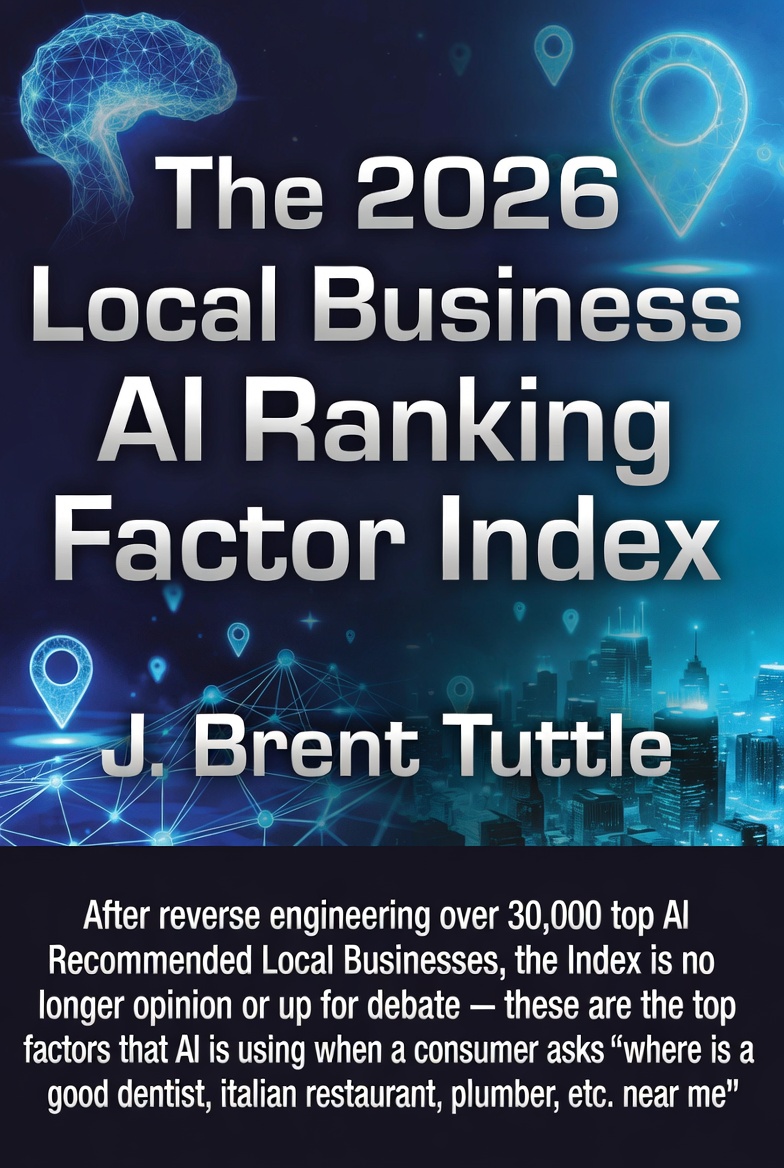
The complete methodology behind this index is laid out in full in the companion book — how we found the businesses AI recommends, worked backward to the common signals across 100+ industries, and determined what AI actually weighs. It teaches the heavy hitters category by category, with the complete factor list as a working reference.
It isn’t a sales pitch and it isn’t a chatbot’s opinion. It’s an industry gift — straight evidence the whole field can use.
📖 Free advance copy — available nowFounded & authored by J. Brent Tuttle. viizable’s scanning technology and data resources were the means used to run the study and build the index.